Blue of the Morning

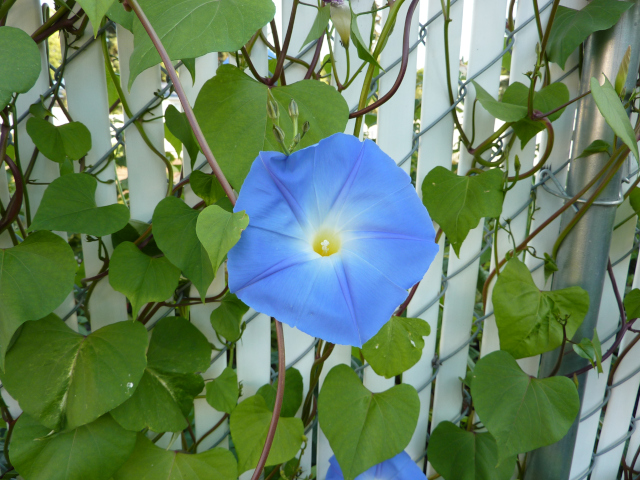
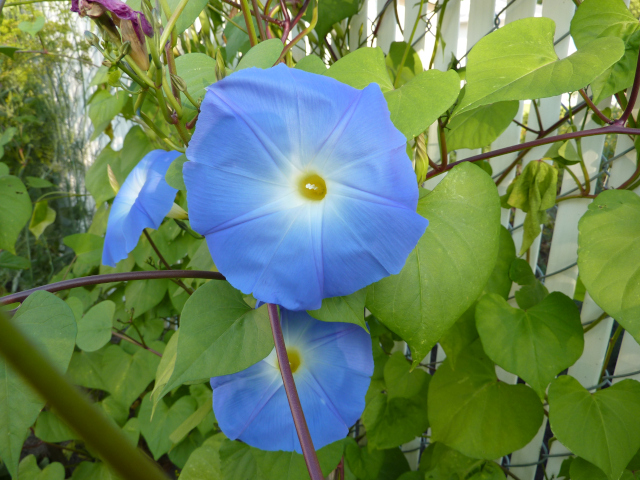
Single blue morning glory. Photo taken in the early morning when the blue is most intense.

One of my first photos of flowers taken with a digital camera, September of 2009.  

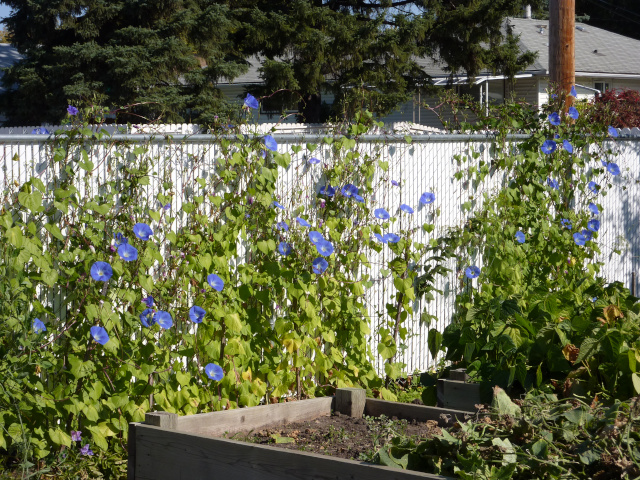
            I’d never grown morning glories before the summer of 2009, although I’d tried, once or twice. By then, we’d been gardening on our lot for 31 years. We’d replaced trees, removed shrubs and planted new ones elsewhere, moved our veggie garden from one side of the backyard to the other, and begun replacing the front lawn with flowers and shrubs and brick paths.

What hadn’t changed was the hedge of raspberries in the backyard along the fence that separated our garden from our neighbour’s garden. The raspberries had been planted by the original owners back in the 1950s. Since those long-lived raspberries had now developed blight, we’d destroyed them all the previous autumn and dug up the soil completely. Our intention was to leave it fallow for a year, but the empty chain link fence looked so forlorn I decided to give morning glories one more try.  

            They thrived gloriously.

From mid-summer on, I began my day by counting the sky-blue flowers, newly open every morning and wilted by mid-afternoon, gradually deepening the latent purplish hue in the process. The vines were so happy in full sunlight that they grew and intertwined and bloomed with reckless abandon. My word choices are deliberate. I had not known that those beloved vines were reckless, not until the afternoon when I saw that they had been ruthlessly cut back from the other side of the fence, down to the top of the chain link. Likely dozens of flower buds were now in the garbage, since said neighbour has no compost bin.

I cried. Then I was angry with our shears-wielding neighbour who deemed morning glories intrusive and refused to let them lean, even an inch, into her backyard. It might even have been that very morning I had counted over 70 dazzlingly blue flowers.

  Choosing in the end to keep peace with our neighbour and also craving raspberries, we never planted morning glories there again. Instead, we bought new raspberry canes, which have produced abundant berries. Later efforts to grow blue morning glories elsewhere in the yard never came to anything. All I have left of the gorgeous flowers are the photos – and memories.

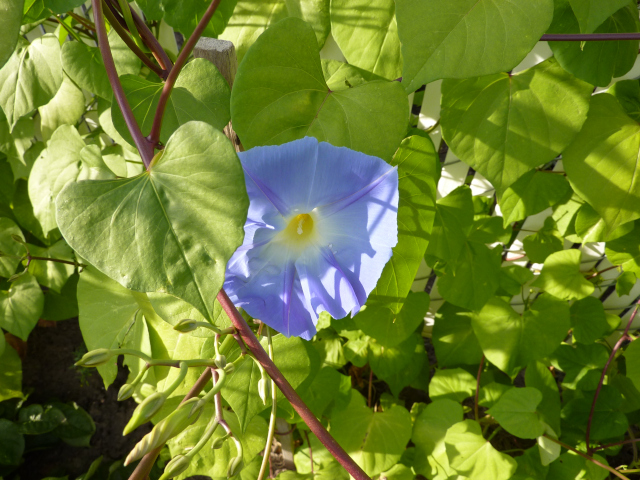
Single morning glory amongst leaves, whose shadows leave lines on the petals and turn the color slightly purple.

            My discovery of poet Denise Levertov was not actually a discovery. She insinuated her word gifts into my consciousness more gradually, beginning with a guest reading at a Mennonite Writer/s Conference I attended. Weary from a long day of traveling, I did not absorb much from that exposure to a poet I’d never of before, and I didn’t grasp why she was reading her work at a Mennonite conference (there’s no echo of Mennonite genealogies in “Levertov”). But thereafter, in some venue or other, now long forgotten, I read, or heard, “The Avowal,” a poem that has since become a primary text in my ongoing spiritual journey.

Then, finally, a few years ago, I read through Levertov’s Oblique Prayers 1981, and then borrowed two of her volumes of Selected Poems which lived on my bedside table until I had to return them. Her work is complex, sometimes obscure, definitely metaphysical, maybe too vivid, startling. Yet for me that is part of her power. She makes me come to a full stop; she evokes awe, a prolonged, soul-opening “oh!”

            As a companion to the glory of my morning glories, here is Levertov’s “The God of Flowers.”

            Levertov often sends me to the dictionary: cilium (plural cilia) is “a short minute hairlike vibrating structure on the surface of some cells, usually found in large numbers that (in stationary cells) create currents in the surrounding fluid” (Oxford English Dictionary). In humans, cilia function in the respiratory system, hence the association with “mouth.” But such arcane knowledge helps only so much. In Levertov’s poems, the mind is propelled forward from image to image with all the weird inevitability of a dream.

I linger briefly on “cosmos,” here a double meaning that combines the vastness of the universe (with all its wild improbabilities and infinite reach) and the flower “cosmos” whose petals flare out into an almost flat surface of bewitching shades of pink and magenta with a small sunny yellow centre.  Who knows how many flowers have appeared and still grow on our earth: “blossom on blossom, fragrance on fragrance, tint upon tint”? (at what point does blue become purple or vice versa?)

  Where does “disdain” come from? Disdain? Really? Not in the flowers themselves, surely. It is we who disdain some flowering weeds, such as dandelions, which are actually stunningly beautiful with a yellow so intense it defies the sun itself. We are the ones who insist on seeing opposites that clash. The position of “clash” at the end of the line creates an extra clanging dissonance in the mind, as if someone had just crashed a set of cymbals or spears had met metal shields.

[Please do read the poem aloud – more than once!]

  The inset line beginning with “but” is a deft silencing of noise, and a swift entrance to an increasingly small space – as if invisible cilia had propelled us inward. We are invited to become “minuscule,” to ponder the very source of life and beauty, in “the cell among cells.” Lest the mystery of the process become too mystical, Levertov returns us to a more familiar, grounded reality—soil, bins, hands of gardeners. The irresistible growth is both physical and spiritual.

  The “god of flowers” “sits and sits in the mustard seed.” Such an abrupt recital of monosyllables sits us down for the ultimate image of the mustard seed. It is not an accidental selection from multitudes of tiny seeds: Levertov is well aware that many readers will immediately remember a saying of Jesus: “The kingdom of Heaven is like mustard seed” (Matthew 13:31). From an infinitesimal speck of faith comes vital growth and beauty. The leathery hands of gardeners preside over miracles and accept blessings in blue and purple and yellow.   

A Line Runs Through

The last academic conference that I attended—Congress of Social Sciences and Humanities 2011—was held at the University of New Brunswick, Fredericton, NB. My husband had traveled with me this time, a few days before the conference began, so we could have a short holiday before I settled in to listen to many academics demonstrate their prowess with words and ideas.

            We visited the Hopewell Rocks, which we had been told many times we “absolutely had to see.” For land-locked prairie dwellers whose typical holiday was hiking in the Rockies, the mud flats of low tide, stretching endlessly toward the sky, were astonishing all on their own, never mind the mud-and-rock sculptures shaped by the tide, in its back-and-forthing for millenia. They were huge; they were grotesque and majestic all at the same time. Some were named: “Bear,” “Elephant,” “Dinosaur.” We were awed almost as much by the vast quantities of seaweed heaped up and sprawled everywhere. The mud itself had an enticing silky smoothness; I wanted to keep touching it.  

            Eventually, exhausted by sensory overload, we sat down on a clean rock to have some lunch. My gaze shifted down and inward. There is rest in mindful attention to detail. I had begun to appreciate still life photography, thanks to regular visits to Shawna Lemay’s blog Calm Things, which preceded her current blog Transactions with Beauty. I was learning to delight in small things, calm things, gentle juxtapositions, artful compositions. I was beginning to notice shades of color, textures, and lines, sometimes as subtle and beautiful and complex as anything I traced through novels and poems in my classrooms. So here, on a smooth rock in the midst of the ungainly, preposterous Hopewell Rocks, I assembled one small rock and half a kiwi, next to the line through which life was persistently growing.  

            My interest in Mennonite literature, which eventually became my PhD dissertation, began back in the early 1960s when I was in high school, when our small town’s comfortable insularity and piety was disturbed by the grandfather of Canadian Mennonite literature, Rudy Wiebe. His first novel (begun as an MA thesis) Peace Shall Destroy Many (1962) was the first novel in English by a Mennonite writer, and its realistic presentation of Mennonite life, with its hard work, godliness, pacifism, prejudice, and hypocrisy caused consternation among Mennonite congregations across Canada. That’s by way of backstory.

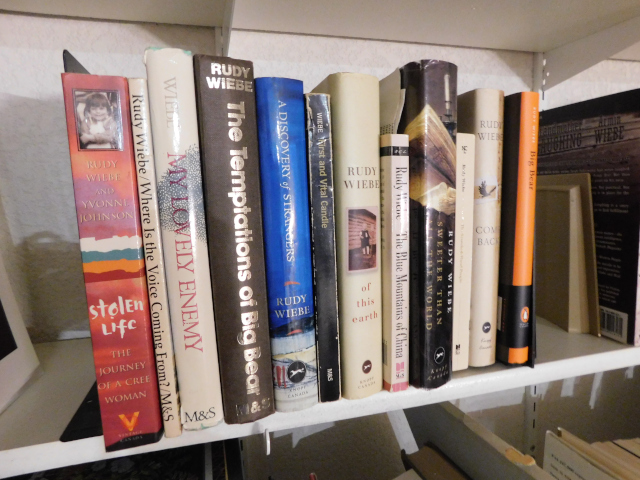
Wiebe subsequently became a major figure in Canadian literature; his best-known novels—Wiebe earned his first Governor General’s Award for fiction with The Temptations of Big Bear 1973—concern Indigenous peoples. He also wrote several novels with Mennonite characters at the centre, the last of which is Sweeter Than All the World (2001).

Photo of a book shelf, holding many of Rudy Wiebe's books. The prominent titles are Stolen Life, My Lovely Enemy, The Temptations of Big Bear, A Discovery of Strangers,, and Sweeter Than All the World.

            It was vintage Rudy Wiebe: a cast of unforgettable characters that spanned the entire history of Mennonites beginning in the 1500s; a central character struggling to make sense of his personal history and his inherited theology; a demanding, thick and powerful prose style that packed clauses within clauses in a breathless avalanche of thought and sensation, thus demanding close attention and several rereadings; and a network of metaphors that knit together not only various plot elements and characters in Sweeter Than All the World but also key themes explored in his previous Mennonite novels. I became aware of those latter connections only as I was working on a conference paper on STAW. As I unravelled and rewove those intertwined images, my heart strings were tugged so often that my writing repeatedly snagged to a halt in the midst of family memories of my own. Our worlds are not that far apart; his Mennonite novels lay bare my world, too.

Sweeter Than All the World may be difficult for non-Mennonites to get through. It takes a certain kind of awareness of both community solidarity and shared family histories of broken family connections to persevere through Wiebe’s seemingly fragmented story lines, so filled with suffering and loss. In the end, though, the fragmentation is undone, as much as it can ever be, by lines: threads of continuity, melodic lines of song, genealogical cords, pulleys and cables, all bound together by crucial sticking points (both those that hold—needles and poles—and those that hurt—knives), seemingly rooted in the earth. Call it grounded community, if you will, unsentimental, essential.

Fiction lets us enter other worlds, try on other identities, evaluate other values. It is thus that we learn compassion – through narrative imagination. Sometimes, too, fiction lets us see ourselves from another angle, from which we can test the strength of our personal connecting lines that let us grow.  

A Book and a Photo

            The title declares my new focus for this blog. I will still honor the “stones” and the “flowers” from time to time, but I want to talk about books that have meant much to me and photos that are likewise important.

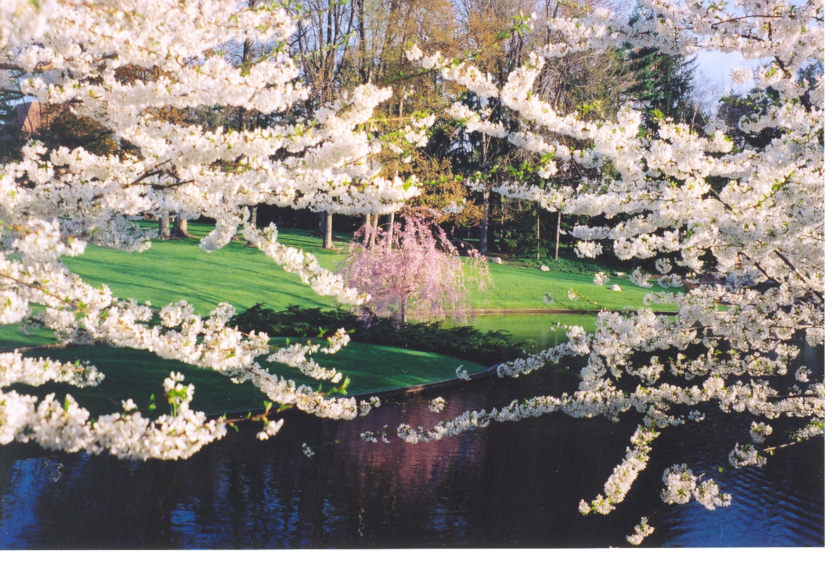
Photo of a small pond (lower foreground) with branches of flowering white trees taking up most of the photo. In the centre background is a small pink flowering tree against lush green lawn.

            Back in April 2004, when I visited Grand Rapids, Michigan, to attend a conference, Festival of Faith and Writing, at Calvin University (known then as Calvin College), I was still using a film camera. Remember those? Every picture cost enough to develop that I thought carefully before pressing the shutter. Mostly I took photos to keep a record. What little attention I paid to composition was instinctive and uninformed. However, when I was a child, thanks to my big sister’s influence, I had pored over books of photography from the Saskatoon Public Library. That was my only exposure then to the powerful and unsettling properties of visual art. The concept of photography as a form of art was thus not unfamiliar; it just hadn’t been in the realm of possibility for me.

That changed when I picked up the package of developed photos and discovered that this particular photo of the Seminary Pond had a small sticker attached: “Great shot!” Someone working in the lab thought I had captured something beautiful, something more than green grass, blue water, and white and pink flowering trees.

What that something is, I cannot say. I have not the language to analyze just what happens when foreground and background interact in some mysterious way. Putting that single pink flowering tree in the dead centre of the photo breaks the rule of thirds, of course, of which I hadn’t even heard then. Yet the whole charms me still, and not only because of the associated memories of attending an entirely new kind of conference for me, an experience I shared with two beloved friends.

Wordsmith that I have been for most of my life, I know that no number of books on how to write will actually nail down precisely what it is that differentiates a great text from a mediocre one. The making of a piece of visual art is just as much a mystery. The whole is greater than its parts and exists beyond and above the contexts of those parts.

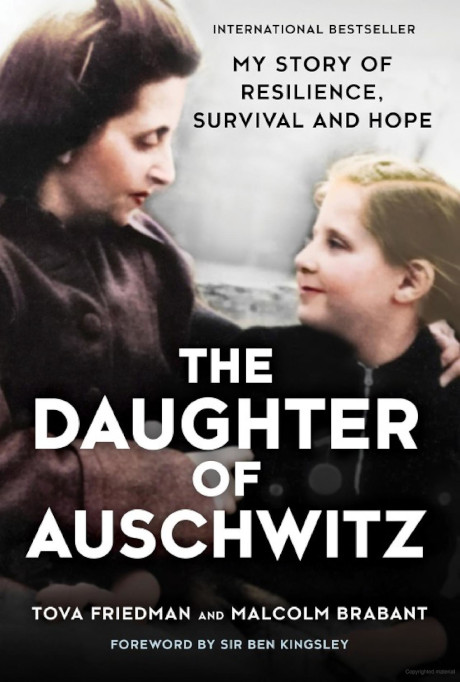
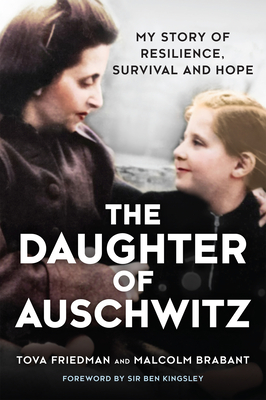
Photo of the book cover of The Daughter of Auschwitz.

Photo from Amazon, courtesy of Goodreads: https://images-na.ssl-images-amazon.com/images/S/compressed.photo.goodreads.com/books/1654481413i/60481659.jpg

I didn’t actually read The Daughter of Auschwitz: My Story of Resilience, Survival, and Hope by Tova Friedman and Malcolm Brabant (2022).

I listened to it. Which is precisely what should happen, I believe. We need to hear this voice, every painful word of the child who was a mere toddler in a Polish city when the Jewish ghetto became first a prison and then an ever-smaller antechamber to genocidal camps with their gas chambers and mass graves. She was only four years old at the beginning of WW2 when she and her parents were sent to a Nazi labor camp and eventually to Auschwitz. She was six when she, along with many other children, was herded into the gas chamber, only to be spared at the last minute by a German bureaucratic glitch. She was one of the youngest survivors to stumble out of Auschwitz when the camp was liberated by the Soviet army. She was probably 8 or 9 before she entered a school in the Polish city in which she had been born, only to be told by classmates, “What are you doing here? You’re supposed to be dead.”

The factual outlines of the Holocaust are well-documented and familiar. However, to hear the particulars through the perspective of a child is beyond chilling. Tova Friedman is in her early 80s as she writes this book in collaboration with Malcolm Brabant (the audio version is read by Saskia Maarleveld). She has the benefit now of her psychologist’s training and a sociologist’s understanding of human group behavior. The result is a poignant combination of childish unknowing and adult maturity, augmented by careful research and excerpts from her father’s written account. For her to have taken on this project speaks to her strength of character (reliving childhood experiences whose horror she now fully grasps gives her repeated nightmares) and her belief that the story must be told.

I agree with her. Over several decades, I have read many accounts of World War 2 and the Holocaust, including The Diary of Anne Frank. I’ve watched movies as well, including the powerful Schindler’s List (1993). Yet I would argue that this recent publication of Tova Friedman’s story is absolutely necessary, in light of recent social and political circumstances. Not that many survivors of the Holocaust are left now to counter the deniers and the minimizers and the trivializers. Anti-Semitism is on the rise again, in tandem with frivolous and self-serving comparisons between legitimate health measures and the dehumanizing, brutal policies of the Nazis. We really do need to hear the story of Tova Friedman, not only to remember what degradation human beings are capable of but to remember also the strength of the human spirit and the power of kindness.

What moved me most of all is the depth of the love of Friedman’s parents, especially her mother. I shall not forget the repeated, trusting “yes, Mama,” in response to instructions no child should ever, ever have to hear (to cuddle up to a warm corpse and pretend to be dead? for hours??). It was the love and trust within a family that made survival possible. Mama’s will to live, in sheer resistance to the Nazi project of extermination, gave life to Tova, who responded by living a full life of service, as listener, analyst, supporter, to those who had also been badly wounded—those  who needed much help before they could once again hope and love the blossoms of spring.

Please, go find the book and read it. Better yet, listen to it, so that no single word is lost.  

Taking Refuge in Numbers

            Each month that goes by, it becomes harder to write for this blog. Times have changed since I first began in January 2019; I had no idea what was coming in public and in private life. Now, every topic that invites my attention turns confrontational before I’ve composed a suitable title; each story that wants to be told reveals too much vulnerability before I’ve reached the second paragraph; each joyous incident loses its inspiration as I try to put it into language. In the face of ever more polarized political discussions and seeming social disassociation, not to mention shifting and deceptive language, my creativity and courage seem to have both taken a leave of absence. 

            So, what follows is a whimsical, not necessarily cohesive, reflection on numbers. We can still all count the fingers on one hand, can we not?  

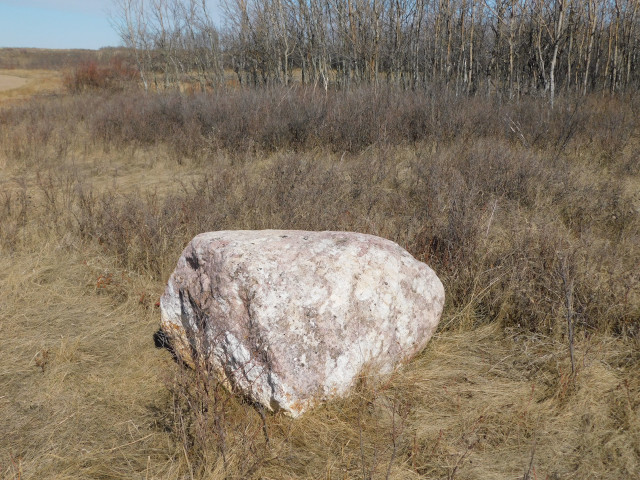
a large stone in dry grass against a backdrop of bare trees - it's autumn in the prairies.

One. The ideal. Oneness, unity, singularity.

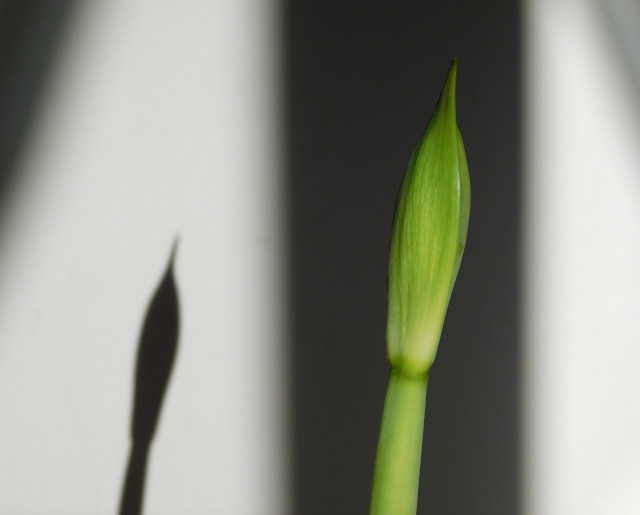
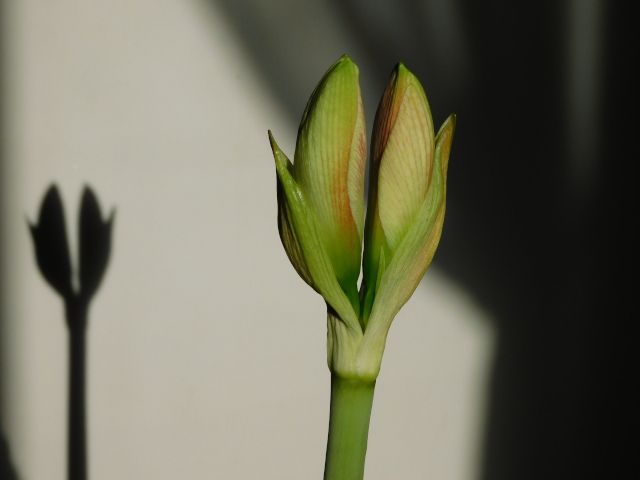
A single amaryllis bud in early stage. The background is a white wall with dark shadows.

“That you may become one” is what Jesus prays in the Garden the night before his death. One is absolute, monological. It subsumes all difference. In heaven, so we’re told by mystical writers, One is Beingness itself. It is not possible to beg to differ, or rather, one would not ever want to differ.

On earth, however, One is dangerous. Look at the countries that have bowed the knee to the One. It is a fearful thing to live under a One. It is just too easy—and tempting—for an Absolute to degenerate into absolutism, for an ideal to slide into coercive ideology, not to mention the unsavory means by which a multiplicity of ideas can be bludgeoned into a single orthodoxy. 

            No, Sam, I do not like just one green egg.

            No, Sauron, I am horrified by your single Eye. The One Ring must be destroyed lest all else be destroyed.

Two, then.

The same amaryllis bud, now dividing into two and its shadow is clear on the wall behind it.

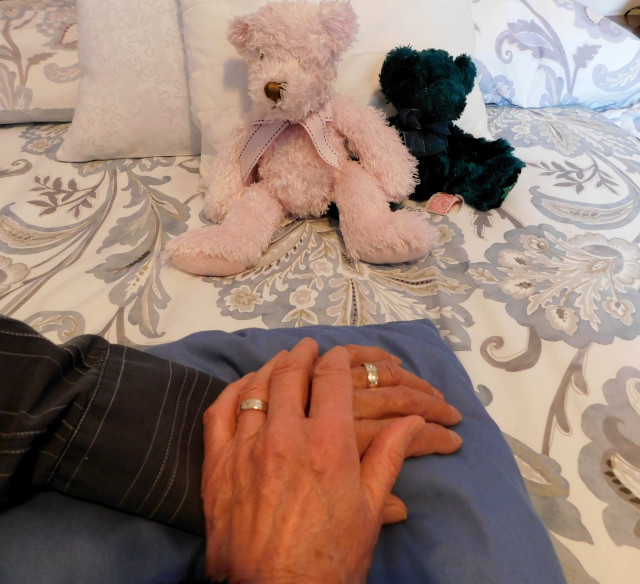
Two signals symmetry, evokes butterfly wings, holds up two hands. Two hands are held in companionship, if there is trust. It takes two to tango.

In the foreground are two hands, intertwined (one masculine, the other feminine) with wedding bands visible. The hands rest on a pillow. In the background are other pillows on the bed with two teddy bears in front of the pillows.

Two suggests balance, delicate and precise, equal and beautiful. Two is completion, yin and yang,  

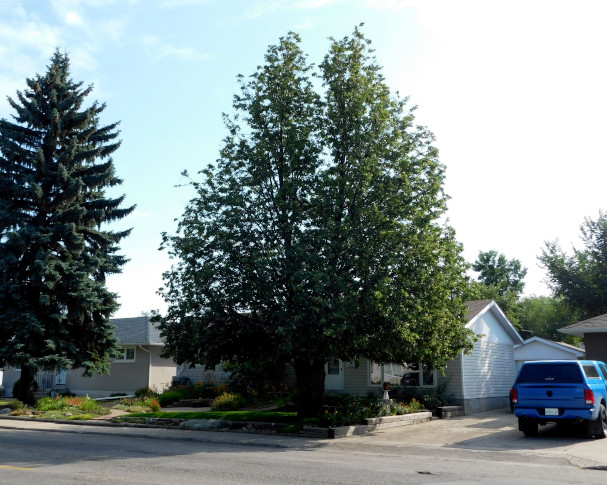
But Two is also duality, perpetual tension, oppositionality. Two too often longs to tear apart. Our beautiful tall linden tree has a trunk that exemplifies twoness – as the threat of a widening split loomed, we called in an arborist who put bolts through the trunk to prevent the inevitable tension outward in two directions. A split either way spelled disaster for our yard or for our neighbor’s vehicles.

Photo of a large tree that has a divided trunk.

Always that pull – the tug-of-war between breaking apart into two separate ones or the two becoming one which sets the stage for oneness to ask “which one?” Committees of two are a bad idea.  

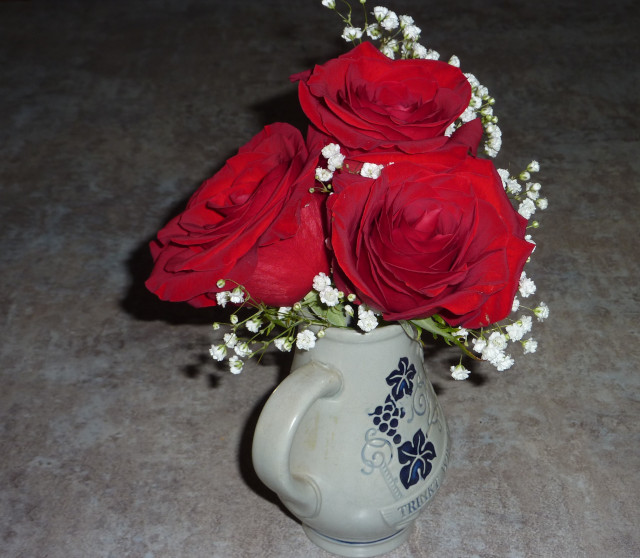
            Threeness – yes. Three is inherently communion.

Three dark red roses are tucked into a tiny grey pottery pitcher. Some baby's breath flowers as well.

Three can form a circle, practice a circle dance. Three can negotiate, learn to make alliances, engage in conversation. Christian theologians have claimed that the Trinity must truly be inspired – for it offers us the strength of the One but softened, embodied in community. There are choices now among the three; this is not the starkness of Two’s either-or. Threeness gives us vocabulary for our complex nature: body, mind, and spirit.

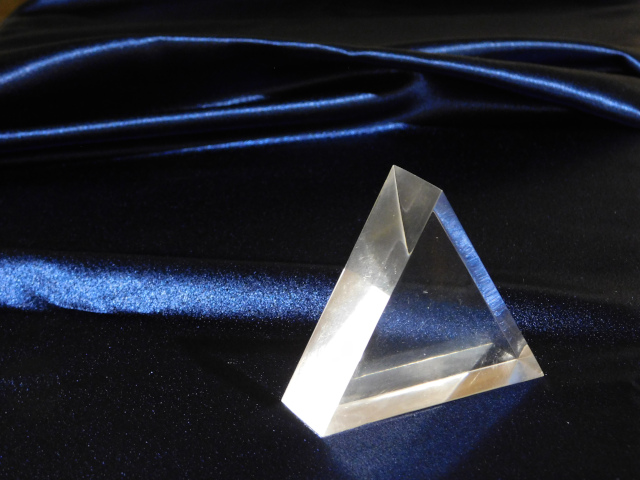
 Scientists exploring memory have said that our minds think in threes. One can memorize items in a long list by grouping them mentally into threes. Three sides create a triangle, an intrinsically strong structure; two triangles placed upon one another yield a Star of David. We have three dimensions by which we perceive our world—height, length, and depth. To lose one is to produce the world of Flat Stanley, impossible except in fiction.

a clear glass triangle-shaped prism sits on a background of dark blue satin.

 So is three the ideal? Not so fast. Ask any family with three children: the making of alliances (seemingly a good thing) can also mean exclusion. That business of two against one? Even a small child knows that that’s unfair, and children, of all people, detect unfairness long before it manifests itself. Mind you, committees of three are considerably more functional than committees of two, because it’s possible for two to agree and persuade or outvote the third.

            Okay, Four then. Let’s hear it for Four.

Those of us in countries further from the equator know about four seasons; we could not do without any of the Four. Four directions – in the Indigenous cultures of North America, the four directions have deep meanings, symbolized in the medicine wheel. The four quadrants of the wheel speak to the four parts of our being: physical, mental, emotional, and spiritual. All those parts of our being are inter-connected, just as we are connected to others in our relationships.

Medieval thinking offered us four elements (earth, air, fire, water), four humors (phlegm, blood, yellow bile, and black bile) which corresponded to four personality types (phlegmatic, sanguine, choleric, and melancholic). Four seems instinctive. It restores the symmetrical beauty of Two without the duality.

 And yet, something about Four smacks of two Twos with precisely that break-apart tension. Think of committees of four: they’re workable because work can be divided among four people and the burden lessened. They’re most functional when complete consensus can be achieved, but can be miserable when the afore-mentioned alliances come into play. Nothing declares, of course, that Four must divide into opposed Twos. Each One within the Four could claim its own delicate poise, celebrate individual uniqueness like the seasons or the directions.

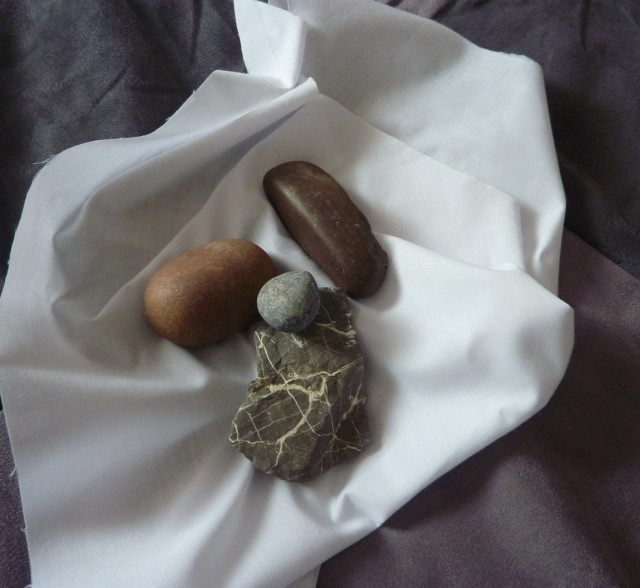
Four completely different stones placed on a white cloth. Each is a different shape, different size, different color, different surface.

Still, I can’t help remembering the instructions of an experienced gardener: “never put an even number of plants into a pot. It will look awkward, artificial, squarish in a way that undoes the beauty of the flowers.”

            So, nothing even? Is balance too tippy to be managed for long? Five it is then.

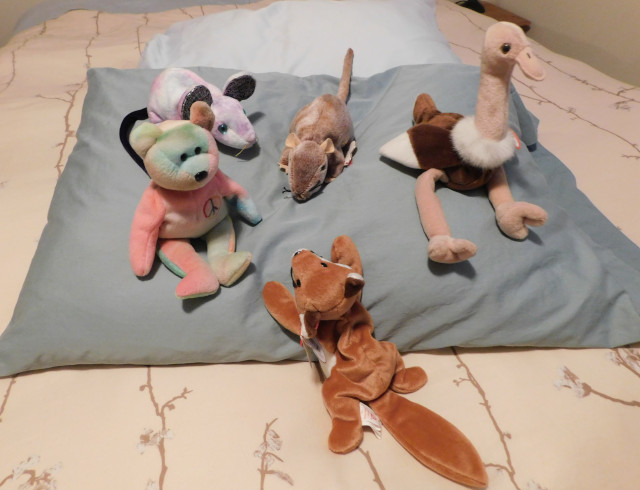
A pillow on a bed serves as a stage for five Beanie Babies animals, each a different species. Three are grouped closer together, with a fourth facing them and a fifth slightly separate and looking outward.

All hail to five: a prime number, the precise number of fingers on each hand, the number of our senses (sight, sound, touch, smell, and taste), the points of a star, five pillars of Islam (the holy obligations), five times of the day for prayer in Islam, five books of the Law in the Hebrew Bible, five wounds of Christ, and . . . . .

            I’m beginning to see patterns here, themes. Human beings cannot help but seek meaning in all things, which means, among other things, that we are enmeshed in overlapping webs of interrelatedness. Numbers do not stand alone, after all. Even prime numbers work in equations, can be divided into smaller numbers; even One – as my pictures indicate – imply one of something . . . .

Human beings cannot help but seek meaning in all things, which means that we are enmeshed in overlapping webs of interrelatedness.

 As philosopher Ken Wilbur explained in A Brief History of Everything, one atom is whole in itself but belongs to a molecule, which is whole in itself and part of a cell, which is whole in itself and part of a whole organism, and so on. One stone is singular, but part of the landscape and belongs to whole genus of stones. Even a symbol, or an image or a concept – always part of a whole. Everything and everyone is a “holon,” a part of something else.

 Then it is hardly surprising that human beings create meaning by thinking and speaking symbolically. Five means something, so does fifteen or thirty-three. It’s not just the magic of numbers in their dance with one another (and they are magical – ask any mathematician), but our compulsion to enchant almost any number into significance. Think about the shorthand of 9/11, 24/7, 666, the eleventh hour of the eleventh day of the eleventh month; and then there’s numerology, the practice of connecting numbers to alphabet letters in order to find all manner of mysteries and prophecies and conspiracies.

            There it is: even a light-hearted speculation about numbers has led me, repeatedly, into a swamp where the lushest of foliage cannot hide dark shapes in the water.

Thus, I have decided to take something of a holiday from blog-writing. Let 2023 become a new beginning (sometime or other), perhaps with a different look and/or focus.   

            I wish all of my readers a wonderful holiday season. Happy Hanukkah! Merry Christmas! Happy New Year!

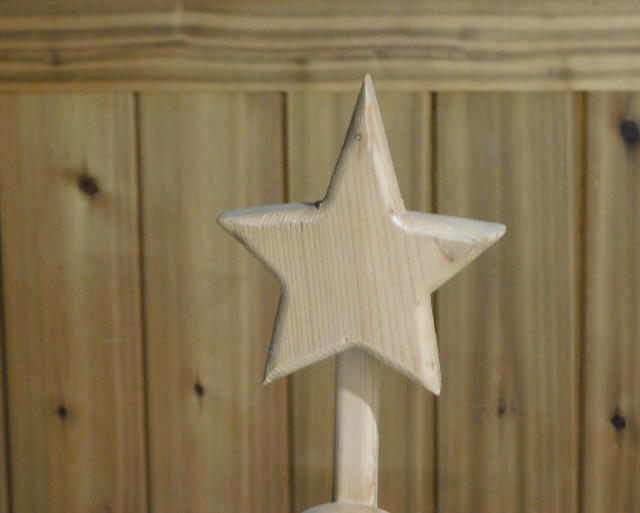
Background is wooden board panelling. In the centre is a five-pointed wooden star, made of different wood than the pine panelling.

Evening Light

Mystery is the place where we can finger the ragged edges of what we know and begin to make peace with what we will not know. (Stephen Jenkinson)

#1

            In my part of the world, days are getting shorter. Sunset begins sooner each day, signalling not only the end of another day but the end of a season. If I wish to continue my cherished evening walks, I shall have to walk in the dark. The summer’s mellow evening light has now shifted to late afternoon, slanting in at a different angle, lower on the horizon.  

Letting go of sunlight each evening is a ritual practice for letting go of much else in life. Whether it happens abruptly as the sun drops behind a mountain, or in a lingering blaze of warm colors (as is common on the prairies where the sky goes on forever), sunset blends awe with melancholy. This one day is almost over and cannot be retrieved, reminding us that our lives too will end. Yet the beauty of the sun’s disappearance is so varied, so evanescent, and so necessary—how could the earth and all its inhabitants continue to live without daily darkness and rest?—that we are cleansed by astonishment.  

The very word life shouts out promise, potential, opportunity, breath, vibrancy. Life has drive and will and force. It continues its changes forever. That which does not change, that does not obey the principle of death and resurrection into a new form, will die most certainly and finally, declaring its essence to be not-life.

The more a thing tends to be permanent, the more lifeless it tends to be.

(Alan Watts)

Sunset has to do with time and change. Celebration and loss, all at once. So we cling to the loveliness, even as we rejoice at the prospect of rest. We gaze at the dance of color and watch the earth around us take off its robes of light, giving way to starlight and moonlight. Who would have it otherwise?

#2

            These days, I’m asking myself how to let go and what might need to be let go. A friend is losing independence, giving up the tasks of caring for herself (when will that be my lot?). Another friendship seems lost entirely as we walk different paths now (shall I stop trying to maintain what was?). The pandemic has taken away both political innocence and a certain social ease (can I find hope again in realistic possibilities?).

 Some once-loved books have ceased to matter; they will be “remaindered” (to use a publisher’s phrase) and turned into something else that can be made with recycled paper. I’m not sure that the memories I will also have to relinquish can be recycled as usefully. There are no cemeteries for books, and photographs of my library end up looking like artifacts of interior decorating. 

Certain shelves of said library remind me that what seemed wise to me once upon a time is now folly, much as teens might look back on their favorite crib toys with a sheepish smile. Not all beliefs continue to sustain, necessary as they may once have been. Circumstances have changed. I have changed. I am now embarrassed to admit that I once had a copy of Total Woman and read it mostly without irony, although I might have felt twinges of critical thinking over the worst of its excesses. As the sun sets on some days, the ending is entirely welcome.

#3

There is a reason that photographers, amateur and professional, have probably all indulged in sunset phases. Melancholy and awe are addictive, yet essential to our humanness. We know very well the flutters of possibility within a new love, and the throbbing ache of a lost love. Regret and satisfaction. Is that reading too much into the result of light passing through more of the atmosphere and hence being scattered by additional particles?

My struggle for words is at an end. Let sunset photos finish this reflection. Each one was taken in a different place and hence calls up different memories, different feelings. I leave them untitled except for numbers, and I invite you, my readers, to let me know which one(s) call to your heart.  

#4
#5
#6
#7
#8
#9
#10

Our Noisy New Neighbors

            Listening to the news each morning on my favourite CBC morning program can be disheartening some days. What with rancorous political debates, hurricanes and typhoons, ongoing wars, and petty acts of violence in my own province, it’s been a great pleasure to make the acquaintance of a pair of blue jays who are now daily visiting our new birdfeeder.

Photo of blue jay sitting on our feeder.

            We’re not real birders. We know very little about most birds, and can recognize only a limited number of birds. However, we have had a couple of bird feeders hanging in our back yard for years now. Mostly they were patronized by sparrows and chickadees, with some nuthatches, the occasional flicker, and, every now and then, a determined magpie trying to get at the peanut butter log. The feeders were far enough away from our kitchen window that we often used binoculars to observe the birds. Every now and then, we did spot blue jays high in the trees; their brilliant blue plumage was so easy to recognize, and so was their distinctive shriek.  

photo of the feeder on our bedroom window, taken from the front yard.

            Then we attached a new feeder directly to a bedroom window and stocked it with black sunflowers seeds and whole peanuts. So far, the seeds remain untouched but it didn’t take long for the local blue jays to discover this new source for a peanut feast. I have been enchanted by their beauty and their cleverness. Once they became accustomed to the surroundings, they became indifferent to our presence in the room, unless we moved too quickly. We could actually stand quite close to watch them.

Another blue jay photo, this one in profile.
While the blue jays don’t mind being watched, they are difficult to photograph. The sight of a camera made them nervous.

            Sometimes, the jays quickly grabbed a peanut and flew away. Other times, he (or she – there’s no way of telling them apart) carefully pinned the peanut to the edge of the wooden feeder with his claws and hammered the shell apart with his beak to get at the peanuts inside. To my amazement, I learned that blue jays have a capacious pouch beneath their beaks. They can simply swallow two whole peanuts and then grab a third in their beak before flying away. Where they stash their peanuts, I don’t know for sure, but the grass under the linden tree in our front yard is now littered with peanut shells. Blue jays, it seems, are messy neighbours.

            Also noisy. I have been startled awake more than once by a blue jay screaming right beside the open bedroom window. When my heart beat returns to normal, I just smile and think, “Enjoy your breakfast, my friend.”

            I choose to face the window for my usual morning exercises and yoga, so I can watch my lovely new friends. Usually, they come one at a time, waiting their turn if necessary, but sometimes two will sit together on the ledge of the feeder, cocking their heads as they choose the next peanut (they prefer them whole, so they can do their own breaking of the shell). Gradually, I am beginning to recognize different patterns in the grey and white of their breast plumage, and the black rings around their necks have slight differences as well. So I’ve concluded that our feeder is being patronized by one couple—they mate for life, according to websites I’ve checked.  

            Although I can see that this new relationship is going to cost us a fair amount of peanut money, I have no regrets. Even on the coldest day of winter, I will happily don boots and coat to go out to replenish the feeder. That sudden flash of blue and the curious black eyes checking me out warm my heart. Go ahead and shriek, if you need to. You are welcome in our yard.

The blue jay cocks his head in curiousity

            Human relationships are considerably more complex, of course, yet I have pondered how we might make sure that all of us are fed, regularly, without embarrassment or struggle. Why do we smile over bird feeders (going to great lengths to develop various feeders to accommodate different beaks and appetites), yet label the human version, often with disdain in our voices, as “soup kitchens”? That may be a ludicrous equivalent: we are not birds and our habitats and needs are far more varied. Still, couldn’t we pay more attention to providing the kind of habitats that would allow us to thrive? And make sure that all of us get more than just randomly served peanuts?

Mumbling Madness

photo of robin against the sky.
There’s never a muffled or slurred note from this fine fellow.

Circumstances determined that I would never become a movie buff. In my childhood, movies were forbidden. That created both suspicion and heightened desire, of course, so in my young adult years, I indulged in binges of movie-watching, all the while maintaining moral scruples about content. But then came marriage and children and a limited budget, followed by years of limited time; movies thus remained in the category of the special, a rare treat, like going to see live theatre. Actually, the latter occurred more often than the former. I did anticipate that in my retirement I would finally catch up on all the movies I’d heard about that I wanted to watch.

            Who would have guessed that in the meantime, mumbled lines would have become the standard of excellence? I will acknowledge that sorting out desirable conversation sounds from background noise has become more difficult for me; otherwise, though, I still have good hearing. So why was it nearly impossible to understand dialogue? It’s hard to get involved in a storyline when none of the characters speak clearly. Who cares about a romantic exchange muttered into the pillows? Heated arguments make no sense when characters speak over each other or otherwise muffle and slur their words.

            According to a recent opinion piece in our local newspaper, such inarticulate dialogue has become de rigueur in the name of realism. A lot of people mumble in real life, and so, the argument goes, to be authentic, actors should also speak without moving lips or jaws or bothering to face the camera.

            I readily agree that there’s lots of mumbling going on these days. Too many messages left on my phone remain unintelligible even after repeated replays; I’ve overheard conversations that might as well have been spoken in another language; lyrics of popular songs are often incoherent except perhaps for one or two phrases endlessly repeated. What’s much worse—one can select one’s entertainment, after all—I’ve struggled to understand health professionals who couldn’t be bothered to enunciate their words. In some cases, I was convinced that even if they removed their masks, I still wouldn’t have had a clue what they were saying.  

            The consequences of all this muttering and slurring of words should give us pause, I think. In the entertainment world, it means that the tales told are “full of sound and fury, / signifying nothing” (Shakespeare, Macbeth). Of necessity, story-lines have to be conveyed through action, which might explain the ever-increasing violence and general aggression in dramas and ever-more dramatic silliness in comedies. Characters can hardly be developed in any depth, if they never say much that can be grasped.

              In the real world, in the various situations that we all negotiate—and this is my real concern—mumbling has the effect of humiliating and excluding far too many people. It is acutely embarrassing to have to ask people to repeat themselves, only to hear the same inarticulate sounds, just with greater volume. Socializing becomes difficult and those important conversations we have to understand in order to buy a license, get a prescription, hear a public speaker (minister, politician, emcee at a wedding or concert), respond to an incipient quarrel seem too daunting to attempt.

            When we are also asked to cope with background music at foreground levels or urban noise or the hubbub of a larger crowd, the work of translating verbal codes into meaning is finally exhausting. Shouted mumbling is no better than quiet mumbling. The frustration of not being able to decipher the words of even those who are trying to be helpful leads inevitably to helplessness and increased withdrawal. Why bother going to the church service or the concert or the memorial or the family gathering only to sit on the sidelines, unable to participate?  

            Much has been said in recent years about inclusivity and the importance of meeting the needs of the vulnerable among us. I agree with that emphasis. We should be encouraged to be kind, to include, to make sure that all people have what they need and can access necessary services. So how can we begin to turn mumbling into an embarrassment for the speaker instead of for the baffled hearer?

Children pick up their speech habits from their caregivers, of course, and are unlikely to alter those without focused effort, both by them and by their teachers. Which translates into yet another obligation placed on our educators. That seems unfair. The movie industry can continue to churn out inarticulate dialogue because closed captioning is available (and is increasingly being used by ever younger populations). In the really important conversations among people who matter to us, subtitles aren’t an option. Lip-reading a mumbler isn’t a successful enterprise, either. Hearing aids amplify sounds, of course, and newer technology can help block out extraneous sounds, but no hearing aid, and no technician at the sound board of a public address system, can fix distorted sounds created by a lazy mouth.

            There’s nothing else to do here, friends, other than giving our lips and tongues some much-needed exercise and learning to enunciate our words. It’s not that hard, and even if it were, wouldn’t it be worth the effort to avoid shutting people out?  

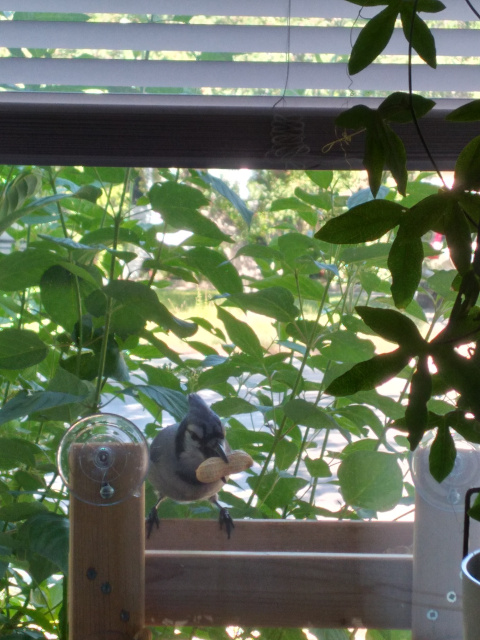
photo of blue jay, peanut in beak, sitting on a bird feeder attached to a window.
The photo may be blurred but there’s nothing out of focus in this blue jay’s shriek when there aren’t enough peanuts in the feeder!

A Feast of Losses

In memory of two women friends

            It would be a happier task to consider my current summer feast of gains: a wonderfully productive garden, thanks to abundant June rains; a week of splendiferous camping with family in the Rockies for the first time since 2019; more socializing in our backyard than we’ve had since before the pandemic began; long bike rides along river trails alternating with walks in the neighbourhood where we can admire creatively designed front yards and check out all the little libraries with surprising finds. It’s been a good summer already, only halfway through July.

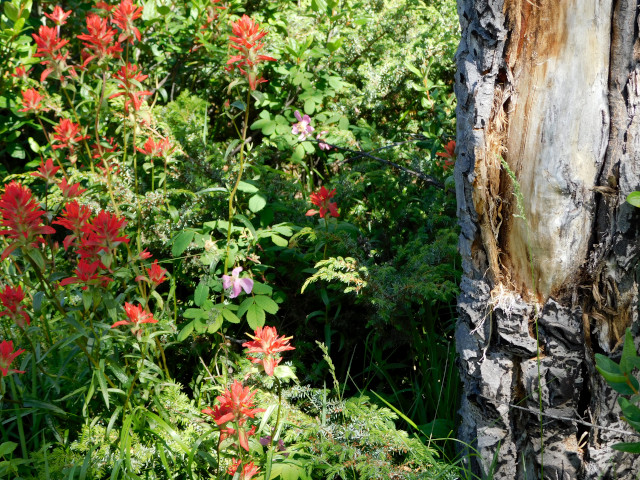
Photo of bright red paintbrush flowers next to a dead tree.

            But underneath the sheer pleasures of being able to watch dances in the park again and pick up ice cream at favourite places is the awareness of a veritable feast of losses, to use Stanley Kunitz’s poignant phrase in “The Layers.” I’m not speaking here of the temporary loss of privileges such as easy socialization, concerts, and parades, not to mention unlimited shopping and dining out, or, more seriously, a secure income. What’s in my heart is the weight of the tenuous balance between life and death, which seems these days to have dipped closer to death.

            As a friend pointed out to me, during a recent, much welcomed dinner together out of doors, it’s not only that we have experienced too many deaths but that those deaths have not been properly book-ended with supportive visits and tender farewells beforehand and immediate, supported grieving through appropriate community rituals afterward. Too many have died, seemingly alone, and many more have grieved alone. That’s loss compounded with loss. We humans were not meant to function thus.

            I belong to a church community—not a large one but it encompasses all age groups—which typically offers a funeral or memorial service of prayers, eulogies, visual memories, a sermon of comfort, carefully selected music, and a luncheon during which stories are told (with tears and laughter), and hugs aplenty are given. Just two months before the pandemic changed everything, I mourned a brother in just such a setting, surrounded not only by immediate family but cousins I hadn’t seen in a long time, friends of my brother whom I’d never met before, a church community whose internal cohesion felt familiar even though it was not my own church community. Death is never easy; loss always leaves a gaping hole, yet the ceremonies of farewell and support gave us strength to move on into continued living, holding our memories tenderly and viewing the world more attentively through tear-washed eyes.   

            But then, as the pandemic changed the world, came more painful losses, now with mourning rituals aborted, hugs absent, even personal presence too much of a risk. Alone in our home, my husband and I mourned an older friend, the kind of man whose quiet contributions made him known as a pillar of the church, a man of wisdom. It was not a surprise, hence the loss still felt like a part of the rhythms of being. But there were other deaths, too, like that of a very young friend, utterly unexpected, tragic in all ways. To watch the ceremony of mourning on a computer screen was woefully inadequate. The pain still remains sharp, the wound unhealed.  

            Other deaths were not directly my loss but belonged to friends who were close, so that their grief became mine as well, yet not properly shared. There were clean, dignified deaths; there were unbearable messy, humiliating deaths. All a part of life unfolding as it will. We humans are fragile and rarely as much in control as we imagine.   

            And then there were two women, each in her own way a mentor to me, although neither would have known that. I got to know them too late in my life to form the kind of long-lasting friendship that I would have cherished, yet even so I learned much from them and valued their presence, their gifts.

            I had grown up in a small, mostly Mennonite community, a conservative, conformist community in which women knew their place and rarely challenged those limits. These two women had grown up in similar circumstances but had not remained in their place. They had resisted limits, examined beliefs, and worked through disadvantages to become women known for their courage and for their kindness and inclusionary love.

            Through a writing group which I led, I learned something of the story of one woman, but not enough. Where had she learned her compassion? How had she lived through her own deep losses? How had she forged a deeper, more open faith than what she had been taught as a child? I may never know, although perhaps the mourning rituals, whenever they do take place, will offer belated answers. I should have asked her when I still had the opportunity.

The story of the other woman had come to me in tiny bits through offhand comments from those who knew her so much better than I did. She was a private woman, despite her eager, participatory presence in our church community. There was a self-effacing, confident groundedness about her that forestalled personal questions. I wish that I had known her much earlier. She could have taught me more about gracious acceptance and courage and tenacity. Her faith was rock solid, yet gentle. When the communal mourning service was finally held, her story was told by her only child, a son who clearly had absorbed his mother’s courage and generosity of spirit, not to mention honesty. There were many tears shed, all necessary for healing.

            If there is something that I can take from this feast of losses, it is a renewed conviction that memorial services are for the living, not the dead. If we do not have them, we feel an additional loss. Such rituals celebrate our interconnectedness. Grief is both private and not private. It is a process that we should not try to avoid or shorten or postpone unnecessarily.

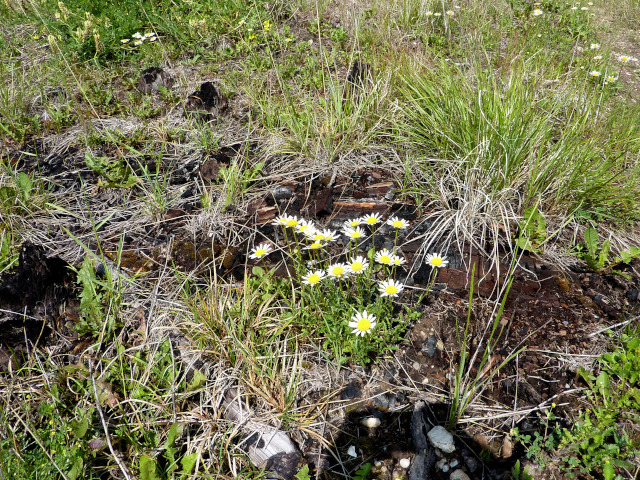
A few white, yellow-centered daisies in the midst of the remains of decayed trees.

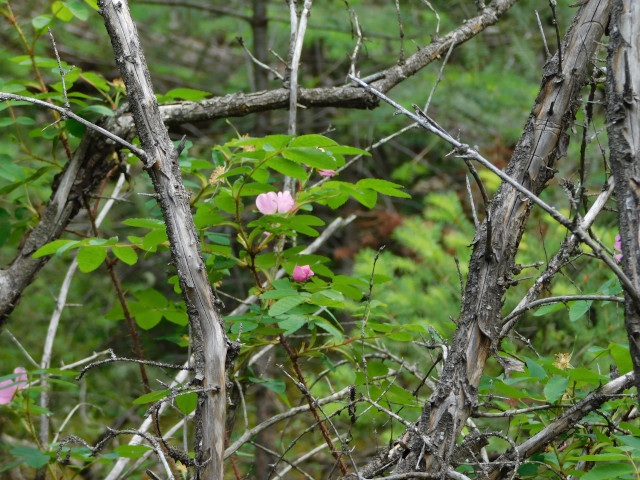
            During this summer’s blessed hiking in the mountains, I saw again the web of life and death through the beautiful new growth of things, next to and in among the dead and deteriorating. A rose is never so beautiful as when it stands next to a dead tree. A feast of losses, indeed, but then feasts are meant to be shared. They nourish, they intensify beauty, they make space for love to grow.

A few tiny wild roses in a tangle of dead branches.

Responsible Discourse

A robin on a dark wire, facing the camera so the red breast is highlighted. The rest of the photo is clear blue sky.
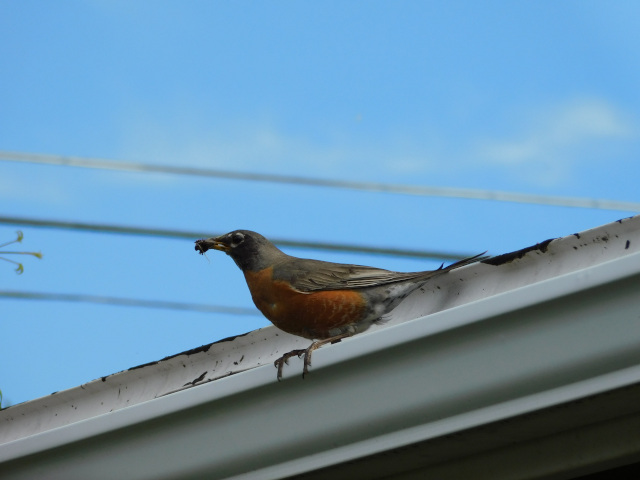
A robin sits on the eaves, a worm in its beak. Some foliage is visible at the edge of the photo.

            This robin “with no Christian name” (see poem below) and his equally nameless mate have built a nest in the clematis vine that shields our patio from the eastern sun and from the curious gaze of passers-by in the back alley. Its density shields the nest just as well from our curious gaze. Our use of the patio will be limited until the young ones begin flying about. Until that time, our garden and lawn serve as an ever-available worm buffet for the growing robin family.

Photo of our patio, with a dense clematis vine along one side, one hanging pot of flowers and a couple of chairs and the edge of a table visible.
A robin stands on the edge of a raised bed in our garden. A worm dangles from his beak.

 In a quixotic, synaptic move, my brain put together my ongoing fretting about discourse (gentle and otherwise), the happily singing robins, and a poem by W.H. Auden – “Their Lonely Betters.” Many years ago, that poem grabbed my attention and eventually prompted me to write a conference paper about language, pretentiously titled “The Morality of Grammar.” Back then, I was much exercised about the changing usage of pronouns. My students were persistently using I rather than me in all the “wrong” places, and I was busy justifying to myself, and to anyone who would listen, my belief that that change was a bad idea.  

That change from me to I now seems a small issue pointlessly pursued in an innocent time, when civility in public discourse could generally be expected, and lies, when exposed, brought suitable disgrace to public figures. I had not yet even heard about disinformation nor understood the power that social media would gain in the not too distant future.

            Auden’s poem, however, has not become irrelevant. If anything, it is more to the point than ever:  

Their Lonely Betters

by W. H. Auden

As I listened from a beach-chair in the shade
To all the noises that my garden made,
It seemed to me only proper that words
Should be withheld from vegetables and birds

A robin with no Christian name ran through
The Robin-Anthem which was all it knew,
And rustling flowers for some third party waited
To say which pairs, if any, should get mated.

Not one of them was capable of lying,
There was not one which knew that it was dying
Or could have with a rhythm or a rhyme
Assumed responsibility for time.

Let them leave language to their lonely betters
Who count some days and long for certain letters;
We, too, make noises when we laugh or weep:
Words are for those with promises to keep.

1950

        It’s a charming picture, is it not? – the poet relaxed in his chair in the garden. Who would not likewise enjoy listening to the sounds of the garden? And who, like the poet, has not longed for letters (or texts or emails) or for certain days to arrive? Which of us has not laughed (a kind of song without a name) or wept (a kind of disturbed inward rustling)? Seemingly alone in his garden, the poet can allude to some painful loss and yet achieve an emotional distance that allows for philosophical speculation.

 What have words to do with all of this? This longing for certain days, this loneliness that is not dispelled by the desired letter (which hasn’t arrived)?  It is easy to conclude at first that the poet is crying inside for his “mate” who isn’t there and might not ever be there. Some kind of promise has been made, in words, which has not been kept.

But the penultimate stanza moves the moment of reflective loneliness in the garden to a broader context. It takes words to tell a lie, and it takes words to articulate the awareness of mortality. Yes, both misinformation and death can be acknowledged through gestures, postures, facial expressions – what we revealingly call “body language.” But there’s more going on here than just emotionally registering loss, of whatever kind. Auden’s deft phrase, “with a rhythm or a rhyme assumed responsibility for time,” underscores the troublesome gift of self-consciousness that is the foundation of human language: words (the speaking aloud of the human capacity for self-awareness) are the articulation of promises.

With words, we promise not only to keep our appointments, to carry out actions, and to listen, but also to understand, to share perceptions, to honor commitments, to keep alive the community that benefits us all. Words depend on the character of their speakers for their informational power and their ability to set consequences in motion. Through words we signal “this is who I am and this is how I will act.” Without promises being kept, whether made implicitly or explicitly, there is no trust. Without trust, Auden insists, we may be still be “better” (a slippery word that here seems to mean “of higher status”) than robins, but we will be lonely. As soon as we move beyond the noise of emotions, we need words, words that can be depended on.

            So let there be not only gentle discourse but what’s more, a discourse of trust. Broken promises are inevitable among fallible humans who are not always in control of their circumstances; nevertheless, we can “take responsibility” for our brokenness and seek to make amends. Words – and people – deserve at least that much.  

Photo of a robin, silhouetted, perched on a chimney. The sky, which takes up most of the space, is cloudy and shades of grey.

Learning a Gentler Discourse

Photo of a pond in a city garden with trees reflected in the water, stones in the foreground. Colors are muted since it was an overcast day. It's a scene made for reflection.

Who would have imagined, a mere twenty years ago, that it would become possible to speak English in two ways so different that the speaker of one would be almost incomprehensible to the speaker of another? I’m not talking about pronunciation differences here or even the accumulation of words borrowed from other languages. Those are common processes as people from different cultures interact with one another and influence one another’s languages.

No, what I’m referring to is a difference marked not by how words sound or which words are chosen. The current, unprecedented divide between two socio-political discourses has more to do with over-arching worldviews than with language, although words and their meanings have definitely been a casualty along the way.

As I’ve tried to understand what has been going on, I was reminded of experiences in my graduate student days (1989 – 1996).  Going back into the classroom after an absence of some 15 years had been traumatic for me. The vocabulary of my beloved discipline of English literature had changed. The way I had once read and written about literature, almost without thought about the process, had now gained a name – “formal criticism” – and been dismissed as naïve and uninformed. Entire clans of “isms” had come to life instead: new criticism, structuralism, deconstruction, psychoanalytical criticism, feminist criticism, queer studies, Marxist criticism, historicism and cultural studies, postcolonial and race studies, and reader response.  I had no choice but to learn what felt like an entirely new language along with its assumptions about the way that the world works and a certain attitude toward writing itself.

One particular class impressed itself in my mind: two students argued heatedly about how to interpret Kurt Vonnegut’s Slaughterhouse Five, a satirical novel about WW2. They offered radically different perspectives (neither of which I now recall – which seems instructive) on the Allied assault on Germany in the last stages of the war. In the manner of grad students, they wielded theoretical relativisms with great verbal skill but little discernible wisdom. The professor, tilted back in his chair as usual, listened until his patience ran out. With a crash, he righted his chair and leaned forward to declare “But Dresden did burn!” There was silence, and then sheepish acknowledgements that yes, that fact was beyond dispute. Therefore, any reading that ignored the burning of the city was invalid.

At the time, I had been appalled at what I saw as an assault on the very notion of truth. But back in that innocent time, we still had facts to fall back on, still had agreed-upon sources of information that were duly vetted before publication. We were learning to acknowledge differing perspectives; we understood that pure objectivity was an ideal only, yet we still believed that some objectivity could be approximated, given sufficient checks and balances.

That is no longer the case. Language seems as fractured and as impossible to mend as it was back in the biblical story of the Tower of Babel. Rebuilding the Tower is hardly an option in a world in which a brick for one side is seen as a sword by the other.

I owe that image of the Tower to an outstanding article on political and social polarization that I would strongly recommend: Jonathan Haidt’s “After Babel: Why the Past Ten Years of American Life Have Been Uniquely Stupid” (The Atlantic, May 2022). Haidt’s analysis is about as balanced as it is possible to be these days; he demonstrates clearly how both the left and right sides of the divide have contributed to the current mess, and then offers suggestions for rebuilding the institutions that make civil politics workable. The tone of the article is gentler than its title might lead you to think. Haidt is interested in rebuilding democracy for the future, not in raising ire.

The story of Babel is the best metaphor I have found for what happened to America in the 2010s., and for the fractured country we now inhabit. Something went terribly wrong, very suddenly. We are disoriented, unable to speak the same language or recognize the same truth. We are cut off from one another and from the past.

Jonathan Haidt

My second recommendation is entirely different: make time to visit gardens, repeatedly.

Photo of a carefully planned and tended vegetable garden surrounded by hedges and trees.
Vegetable gardens, forest gardens, tidy gardens, unplanned gardens – let them all be visited and loved.

Recently, after listening to yet another disturbing newscast, I fled outside and went to sit quietly on a rock beside a haskap bush. As my body relaxed, I began to hear a magnificent chorus of bees, each visiting one small blossom after another. Neither bees nor blossoms required words. There was no animosity. Indeed, without their togetherness, there would be no berries for my future breakfasts, or for the birds.

The discourse of loveliness is fruitful and wonderful. It refuses to take sides and responds to no outrage. All that is necessary for us is to look and listen. Visit a public garden or two, either alone or with other visitors.

An elaborately designed, large city garden with mowed grass, small flower plots, ponds and fountains, and a wide walkway for pedestrians.

Walk through your neighbourhood and stop to chat with a gardener or two. Open your heart to color and scent and design. Remember that the astonishing beauty of flowers and grasses and trees is temporary, yet everlasting. Each flower will die and leave behind a seed or a thousand to become new flowers.

So too we humans will die and leave behind memories, traces of who we once were. Let our gift to the world be gentler words and quiet caring.

Photo of a cemetery with plenty of trees and shrubs and flowers. One might describe it as overgrown.
Visit cemetery gardens – they help us think about what matters, in the end.

Despite our human tendency to read selectively and interpret according to personal assumptions, I remain hopeful that listening to one another’s stories will help us move on from the Tower of Babel in whose wreckage we are now living. It is advisable to choose a variety of story-tellers, and we will need to be prepared to listen to stories we might not like at first. If we can privilege the stories we hear in person from story-tellers whose context we can observe and whose voice we can hear directly without the noise of social media, maybe we can salvage enough bricks to begin building institutions that bring us together.  Along the way, we should never forget to grow gardens.

Close-up photo of a single pink rose.