The Last Posting

            If you haven’t read my previous post – “The Season of ‘All Done’” – please do so before reading any further. This post is its sequel.

Photo of a white crocus in bloom, against stones and an old log.
Photo by Jessie Froese

On January 19, 2019, I began Stones and Flowers with “These Fragments Have I Shored Against My Ruins.” Since then, I have published 109 posts, including this one, the 110th, in which I want to return to the part of “all done” that I only mentioned in the previous post: the choices made with pleasure but now relinquished because it is the right time.

 There was a volunteer position in our church that I loved. For once I was part of a committee in which I truly belonged, where I could serve with genuine pleasure. But then came a time, after about 20 years, when I recognized, reluctantly, that I had by now given the best of my creative energy, and it was time to let someone younger and more energetic take the position. Strange how certain I felt about my decision, and no amount of persuasive argument changed my mind. I was done, and integrity demanded that I say so, clearly.

 My farewell to folk dancing was equally certain – yet also reluctant. The Saskatoon International Folk Dance Club had welcomed me and my husband (neither of us had any prior knowledge or experience of dance), from our first hesitant visit onward. Indeed, we were often urged to participate in dances long before we knew enough to do so without making everyone else in the circle stumble. We became fully involved, learning dances from around the world, performing at community events, joining potlucks and parties for refugees who were always delighted to see that Canadians could learn their dances, albeit not always skillfully. I smile to remember the forthright African woman who told us all that we “sure danced white!” I learned to enter different cultures, even different religious feelings, as the steps and the music became familiar.

Nevertheless, there came a time when it seemed right to say, “all done now.” Many reasons played into that conclusion. None of them matter now, more than a decade later. In any case, by now our bodies have told us clearly that neither Romanian foot stamping nor exuberant Jewish turns are a good idea. I am grateful beyond words, though, that those years of folk dancing enriched my world and enlarged my heart.

Without a doubt, there will come a day when I look at our gardens (front and back) and concede that it is time to say “all done.” That might well be the most difficult of all relinquishments.  I hope that then I can still comfort myself by growing ever more houseplants.  

  What I have learned over the years is that when we stop grasping, stop hanging on in desperation, our now open hands can receive new gifts. That bit of wisdom has been uttered in many places, but I credit C.S. Lewis for the most vivid image of it: a greedy child in a dragon’s lair, overcome with the sheer quantity of gold (The Voyage of the Dawn Treader) and then suffering from a golden bracelet that turned him into a dragon and seemingly can’t be taken off. Somewhere along the way, I heard a visiting preacher work through several Bible stories, pointing out the crucial difference between “gift” and “grasp.” I have forgotten his name but not the sermon.  

 There is so much that could be said about how to live out an awareness of that distinction. It will not be said by me, at least not in this medium. Stones and Flowers will cease to be an active blog after I publish this post. It is time. Seven years is a number of completion in ancient Jewish thinking; I will accept that. At some point, the blog will be deleted. For now I will leave the posts up, possibly for a few months.

Bright red poppies a day before the petals will fall off.

            Finally, thank you to all of my readers. I have loved the challenge of thinking through issues that mattered to me. I have had many enjoyable hours with my camera, trying for just the perfect illustration. My special thanks to the few readers who made a point of responding personally, sometimes often, to some post or other, carrying on the conversation that I had begun. Those conversations have been precious.

May many more conversations continue among you and your friends and neighbours. Community is built by listening and talking and affirming what is good and kind. Farewell.

A mostly beige photo with tiny purple crocuses in the dried grass with a lichen-covered ancient rock in the foreground.

Stones contain eternity; flowers flaunt their fragility.

Both are beautiful.

To live well is to embrace both and all that is in between.

The Season of “All Done”

Taken April 4 – someone was clearly done with winter, never mind that there were still clumps of snow in the bushes nearby.

            Spring in the prairies this year has been a frustrating on-again/off-again affair. Every two or three days of temperatures mild enough to melt snow and quicken buds are followed by yet another snowfall or even snow storm. Even those of us who enjoy winter have had it with snow. Enough already! Our souls are starved for the sight of green leaves and blooming tulips.

            That feeling of “I am so done with this” reminds me of our first granddaughters who were taught some basic sign language long before they could actually say words. Simple gestures performed by pudgy baby fingers are unbearably cute, and my favourite was the sign for “all done.” That most useful phrase told parents when baby had had enough to eat and wished to be freed from the confinement of high chair or whatever other equipment can be used to hold a baby in place. “All Done!”: a quick flick of the hands as if tossing something away or warding off some onslaught. That’s the gesture I want to use toward Mother Nature: I’m all done already. Put the snow away until next November, please!”

            Actually, these days I could write whole lists of things that I’m all done with. Some of them were once chosen with pleasure and hardly deserve the wilful dismissal of the gesture (those will wait for the next posting). Others, unfortunately, whether I initially chose them or not, I have had, and have, no say in their current presence or their long-hoped for ending.

  As illustration, albeit an ambivalent one, take my retirement from university-level teaching. I had certainly chosen the teaching itself; it was never imposed. But at the end, it was not so much that I was truly all done with teaching as that various circumstances combined to make me choose to throw up my hands and dismiss my post. A good friend, now gone (see Stones and Flowers, “The Last Good-bye”) had told me that I would know, deep inside, when it was time to end something, whether a career or a participation in a club or a volunteer position. “If you pay attention,” she said, “and listen to your heart and your body, you’ll know.” And “sometimes,” she added, “it’s only later on that you’ll realize you were really done.” She was right. There came a time when I could acknowledge to myself that I was all done with classroom performances; as for the marking of assignments, that I had been done with long before I actually quit teaching.

            As I walk further and further into the domain known as “old age” or “eldership” (if language must be kept positive), I’m recognizing more frequently those moments of “all done now,”  not as a moment of choice but as a time of reluctant acknowledgement.

 To say aloud, finally, that my body no longer tolerated the degree of discomfort that is intrinsic to camping was bitter. Tenting, at first a financial necessity for us, had become our normal holiday practice, and then a matter of pride as well as pleasure. My soul felt at home in the forests and near the streams, and there was something mysterious and beautiful about being completely, literally, in touch with the earth. I had once felt the aftershock of an earthquake directly underneath my body; I had felt the earth move.

Our last tenting site, in 2022

For so long now, the choice to pitch a tent had been part of my identity. It let the world know that I belonged outdoors. Now that I have said “all done” to our beloved tent, who am I? What is it, precisely, that has been declared “all done”?

            When held up against the large scale of world events, such questions are not exactly silly, just much smaller than I care to admit. Where I sleep remains a matter of choice; I can now afford other options than a tent. In other words, it’s not an issue of survival as it is for far too many people on this earth.

Here I want to say, loudly and clearly, that I am all done with political lying and side-stepping and excuse-making. I am done with the scape-goating of the vulnerable, the manufacturing of enemies, and the endless grasping for power. I am so done with mere posturing and ego-stroking and face-saving. I will not say that I am all done with death because death is an irrevocable part of life on this planet. However—and this is a huge distinction—we can be done with cruel and unnecessary death, stupidly violent death, undignified diminishment of human beings. Why aren’t we? That’s the question my soul cries out repeatedly, while my cowardly self whimpers that I’m all done with listening to the news.

There is another important hand signal for babies: it is the opposite of “all done.” The signal for “more” is not as dramatic as the disdainful flick of the hands for “all done”: fingers are brought together and then the tips are touched. It is a gathering motion, not a tossing away. And that, in one gesture, is the problem of our society. Babies, seemingly, know instinctively when they want “more”—more food, more play, more hugs, more water to drink—just as they know when they’re “all done,” for the time being, with any of the above. Greed is as yet unknown to them.

All those ugly things I said I was done with? they’re the result of too many people who have totally forgotten that the gesture of “more” should have limits. There’s a point when the floor is scattered with toys, many toys, and nearby rooms are piled high with toys, and no child alive can play meaningfully with even a fraction of them all. “All done” should have been signaled a long time ago. Somehow along the journey from babbling baby talk and happy hand clapping, something happened that sidelined self-awareness and good judgment, and now the adult is looking at power and money and influence and attention and just saying repeatedly, “more, More, MORE!”

Yes, I’m all done with “more.” Not that I haven’t vices of my own for which I haven’t always had the wisdom to signal “all done.” My children would point to my libraries and ask about how many more books I really think I need. They would be right. And I’m working on that. The question that troubles me is this: if I had had money enough early enough to get onto that track of wanting more and ever more, would I have had the discipline to say “all done now”? I should think carefully about that before I judge too harshly the choices of others.

Nevertheless, is it too much to ask that collectively we encourage our governments and our social institutions to teach us all the virtues of refusing the lure of endless “more”?

[I am aware that human societies are far more complex and

interconnected than my simplistic distinction between “more”

and “all done” implies. It will take much more than my helpless

 “all done” gestures to bring about change.

For the time being, may I keep my mental picture of a

grandbaby signalling happily “all done!”?]

The Last Good-bye

A winter scene in the prairies with deep snow drifts, an evergreen windbreak and willow shrubs, all casting shadows across the snow.

I had a friend.

The past tense is like a knife in the heart. Not the kind of ragged-edged knife of a friendship fallen apart for reasons that could have been avoided had we each made some effort. No, not that kind of knife. Such jaggedness could not have happened between us. It is instead the apartness of finality and inevitability – Death wielded the knife.

Our friendship began when we were both past the life stages in which bosom friendships usually take root. She was older than I, by a decade, and already retired. Normally those are years in which old friendships (those that have survived) are tenderly nurtured, while newer friendships hover just past the level of acquaintance. It is not easy to build a solid relationship when so much of life has already become memory. Yet within months of our first meetings in the context of a church which both of us had newly joined, we were meeting for long, animated breakfasts, hearing each other’s history for the first time, learning the names of family members we’d probably never meet.

Part of the joy of growing this new friendship was the repeated surprise of discovering strange commonalities. None of my previous and current friends had listened to stones speak (sometimes bringing them home). We both appreciated art, although her taste was more whimsical and eclectic than mine; it was enough for us to recognize in one another a similar eye for the line that seemed initially “off,” the color or shape that surprised, the slant of light that provoked thought.

A few small stones laid out on a small white cloth which rests on dark grey fabric.

While our ethnic origins were totally different—I had only recently learned that there was this whole other kind of Mennonite who had never heard of Wurst and Kielkje—we shared a deep interest in Mennonite history as well as an aversion to the pietism that had changed Anabaptist principles into evangelicalism in many branches of the multi-limbed Mennonite family tree. She’d grown up with that aversion; I had acquired it in the recent decades.

Our family dynamics, both past and present, were very different. Our reading choices overlapped barely half of the time. Yet we met happily in small coffee shops and restaurants, in each other’s backyards, and once in very early spring at Saskatoon’s Forestry Farm to huddle in warm jackets and share a thermos of coffee, just glad to be outdoors. We met also in church committees (good ones and challenging ones), and we knew one another as kindred spirits. We both loved fruit, loved picking berries, loved gardening. We both delighted in dance, a joy she had had all of her life while I’d had to begin learning in my 50s, stubbornly undoing decades of misguided forbiddings that she could scarcely comprehend.

 In her presence, I learned to think about spiritual geography and understood that souls breathe freely in different spaces: I sense the Divine Presence in mountain scenes, the higher the better; she needed wide-open prairies. I cower in the presence of wind—it is alien to me; she smiled with acceptance and possibly a recognition of kinship.  

Anemones gone to seed against a dark green background.

            These days her non-presence is everywhere. I look at an ailing wee plant and wonder if she knows how to make it live well, before recalling that I can’t ask her that. I read a delightful poem about gardening and think, “I’ll send that to her,” only to remember that I can’t. Where she is now is beyond email reach. Someone asks me a difficult question and her words slip from my lips, “I’ll have to think harder about that.”

  Although she never identified herself as a writer, as I do, she knew the power of language. She had always loved words and wielded them with care. Like me, she had kept journals; unlike me, she could separate herself from her written processing of pain and simply destroy what was no longer necessary. She could choose art (paintings, music, poetry, pottery) that nourished her without becoming a collector. There was a minimalist elegance in her home that was warm, not chilly. A guest belonged instantly and felt at ease.

 For many years, she functioned for me as a kind of intuitive editor. Well, she said she was no editor, didn’t know how to do that work. Despite that, I often sent her drafts, sometimes with specific questions about something I knew was off, sometimes with no instructions at all except “please read this.” This blog has come about partly through her encouragement and many a posting has gone to her email inbox before it ever became public. Some times I rejected her suggestions (she didn’t like my stylistic experiments), but more often than not, my writing benefited from her tentative “that paragraph didn’t quite work for me.” I shall always be grateful for those conversations.

            Was she a perfect friend? Of course not. No such entity exists. She would have been the first person to insist that she had flaws, weaknesses. It is strange that we did not agree on what those weaknesses were, at least not often. Is that not what friends are for? to tell us that to which we otherwise remain blind? She was my wise woman friend, yet ironically, her final gift to me has been to point out, by omission, what processes of good-bye are essential. 

  I shall light some farewell candles with other people, despite your prohibition, my friend, because grief in solitude and in private is a stifled grief. I shall bring flowers to share with others who were blessed by your presence because flowers matter to the living, not the dead.

            And I hereby offer these words to the world in your memory.

A memorial of some kind on black steps, with several candles, three teddy bears and two long stemmed roses.

Eight Things I Want Politicians to Say – and Mean

A quiet scene in late fall when the leaves have fallen. A shallow lake with a mossy shore line.

            Writing blog posts has not been at the top of my agenda lately. It’s been difficult to see beauty around me, although I know that it is there – always. However, when worry about the implosion of democracy in our southern neighbour is so intense, I feel more like throwing stones than being quiet enough to listen to them. It does not help that we Canadians are in the midst of a federal election (more political speeches!).

So between the campaign here in our country, and constant news bulletins from elsewhere, I began focusing less on issues and more on language. What are they all saying? What am I hearing and what am I not hearing? It was the latter category that caught my attention. In the whirlwind of words designed to create an impression rather than inform, some vital things are not being said – by anyone.

            Herewith eight sentences that I would like to hear our leaders say out loud and honestly: the first four are my own wish-list, and begin as ideas or emotions that I tried to translate into specific sentences, and the second four are the simple sentences that Chief Inspector Gamache of Louise Penny’s justly famous murder mysteries offers to his new recruits.

    • Some deep awareness of, and even kinship with, the natural world. Gardening would count but even better is a willingness to spend time alone in the woods (without a cell phone). Maybe “I am nourished by other kinds of life on Planet Earth.”
    • A recognition of mortality and a willingness to admit that death will come, often after increasing vulnerability and physical limitations. Perhaps, “After my death, I want the good that I have done to matter.”
    • A capacity to experience genuine gratitude when a personal need has been met by someone else. “Thank you. I needed that.”
    • An awareness of a higher power, a spiritual dimension in human existence that shows itself in a free admission of human powerlessness. Perhaps “I am not in control.”

    And here are the four statements that Inspector Gamache insists will bring wisdom:

    • “I don’t know. “
    • “I need help.”
    • “I’m sorry.”
    • “I was wrong.”

    I cannot remember hearing a politician speak any of those second four statements. I would be deeply impressed if I did, because it would indicate that that individual could take responsibility for messes made and did not have grandiose ideas of his/her own importance. Furthermore, such utterances would demonstrate considerable courage, not to mention humility.

    I could vote for such an individual, and then pray often that she/he could survive the trials of holding office.

    A single wooden bench and a weathered sign post by a trail in the woods in fall.


    “There are four things that lead to wisdom. You ready for them?’
    She nodded, wondering when the police work would begin.
    “They are four sentences we learn to say, and mean.” Gamache held up his hand as a fist and raised a finger with each point. “I don’t know. I need help. I’m sorry. I was wrong’.” (Louise Penny in Still Life)

    The Mountain Still Stands

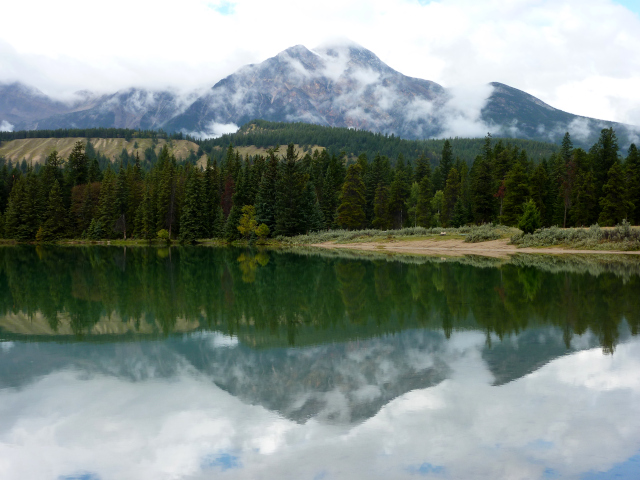
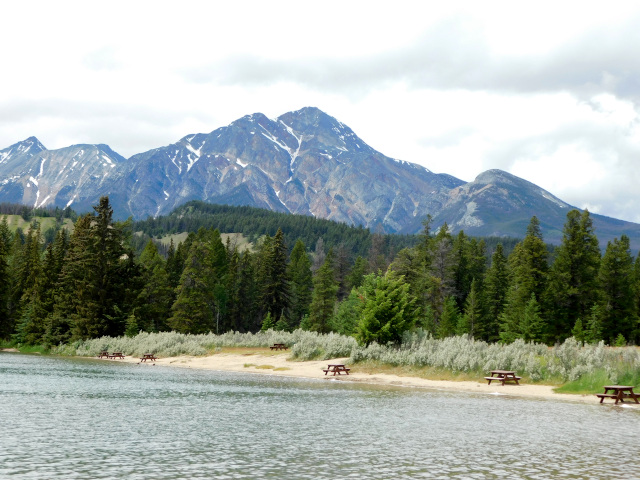
    Photo of Pyramid Mt. in Jasper. The mountain is beautifully reflected in a small lake.

                The above photo is one of dozens of photos that I’ve taken of Pyramid Mountain in Jasper, Alberta. It’s so distinctive, and so dominant that even the most desultory of tourists driving through the small mountain town will learn its name and identify it on photos years later.

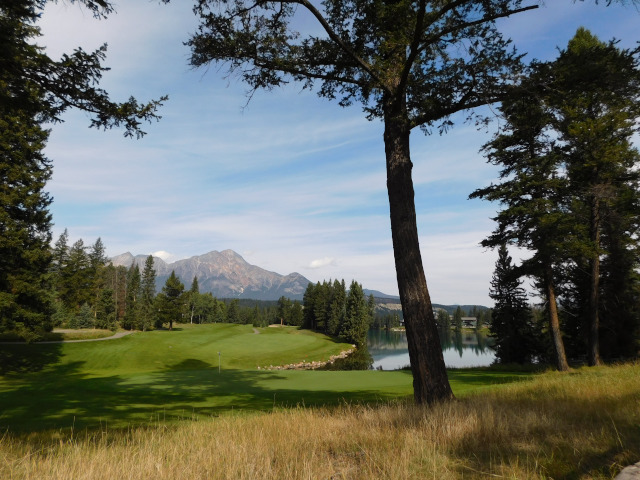
    Pyramid Mt. is in the background in this photo. The foreground is part of the golf course near Jasper Park Lodge.

                When I arrived in Jasper in the summer of 1968 as a university student hoping to earn next year’s tuition, I was lonely. I’d never lived that far from home before. Pyramid Mt was the first mountain whose name I was given, and I quickly came to think of it as a friend. It was always there – solid and beautiful. I won’t say “unchanging” because a major part of its charm was that it never looked exactly the same. The mountain’s iron-red rock caught the light of the sun, or the moon, from all angles and refracted it into grandeur.  I was fascinated anew every time I walked “home” after work to my half of a double bed in a tiny bedroom on the crowded upper floor of an old house (most houses in Jasper had been converted to making as much money as possible in the summer tourist season).

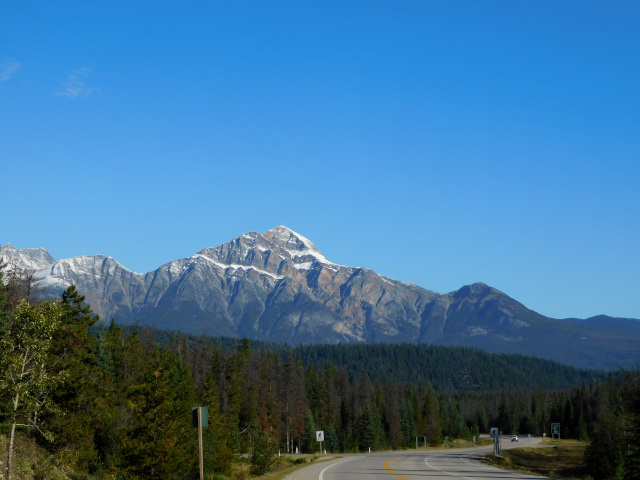
                In the decades since living in the magnificent and beneficent presence of Pyramid Mt., I have revisited the town many times. Each time the drive along the Yellowhead Hwy feels like a journey home from the minute I recognize Pyramid’s backside, which is a non-descript gray; only intimate familiarity allows recognition from that angle. As we near the town itself, there is Pyramid, ever reassuring, warm as only stone can be.

    Pyramid Mt. against a cloudy sky with the beach at Lake Annette in the foreground. The reddish rock is particularly obvious in those photo.

                The ubiquitous cartoon image of a guru sitting on the top of a mountain, dispensing wisdom, is a modern belittlement of an ancient habit of looking up to the hills for divine guidance. As a familiar line from the Book of the Psalms puts it, “I will lift up my eyes to the hills / From where does my help come?” It is not mere happenstance that we describe a powerful awareness of transcendence as a “mountain-top” experience.

    Which came first, I wonder, our experiences of the rarified atmosphere so far above sea level or the influence of powerful myths in various religions that equate mountain tops with divine revelation? Moses did receive the Ten Commandments at the top of Mt. Sinai, and long before that, the ancient Hebrew patriarch Abraham was ordered by Yahweh to take his son up onto a mountain, where he learned a dramatic lesson about trust and about the abomination of human sacrifice.

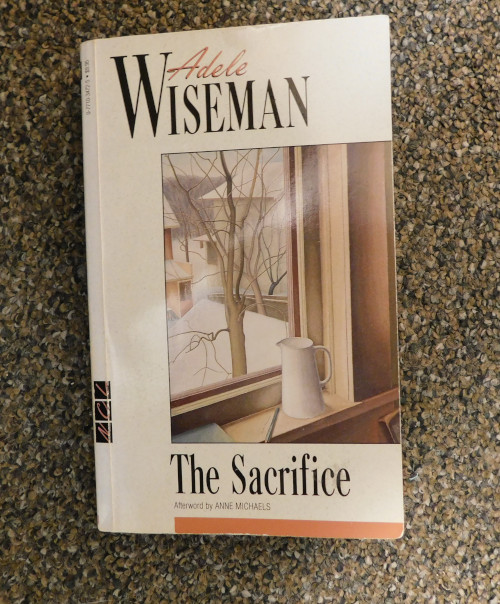
    Photo of the book cover of Adele Wiseman's The Sacrifice.

    In a disturbing, yet hopeful, reworking of that old story, The Sacrifice by Adele Wiseman invites us to pay attention to our own uses of narratives. When I first read the novel, I was aghast at the tragedy at the heart of it, and even more so after I learned just how utterly taboo it is in Jewish teaching to take a life. The various interpretations of the novel that I read in preparation for teaching the novel left me unsatisfied. All of them seemed baffled by the shocking contradiction between an elderly Jew devoted to Torah and deeply in love with God, and an act of killing for seemingly no discernible reason.

    I read and reread, noting the obviously symbolic names of Abraham and Sarah and their son Isaac, not to mention daughter-in-law Ruth and grandson Moses. Echoes of the Book of Genesis were everywhere. The modern Abraham and Sarah and their son are refugees, having fled their country after losing two sons in a pogrom in Europe. To see them settle in a Canadian city and begin to make friends was heartening. Until the story turns deeply troubling.

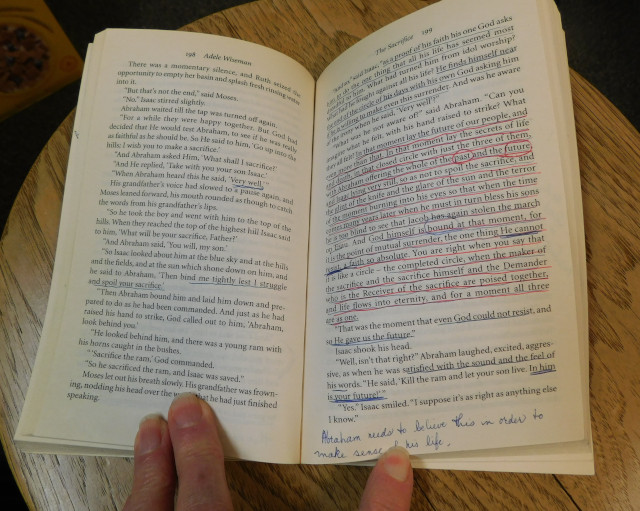
    The book is open and the text is heavily underlined. Comments have been added in the margin.

                There is a mountain in that unnamed city where the family chooses to settle. It is not at all like Pyramid Mt., more like a high hill, yet it figures largely in Sarah’s imagination, especially after Isaac’s death. It is a disturbing mountain, perhaps malevolent. On it stands an asylum for the insane. It is not a source of wisdom, nor yet of friendship; it just stands there, hinting at some significance, waiting for its time to offer wisdom out of suffering.   

                At the end of the novel, grandson Moses, now almost a man, finally ascends the mountain to visit his once-loved grandfather who has been living in the asylum for years. In their awkward conversation, Abraham attempts to reclaim his role as a voice of wisdom, but it is with painful humility that he mutters, “I could have blessed you and left you. I could have loved you.” To whom, wonders Moses, was Abraham speaking? Not seemingly to him, but both blessing and love are offered to him anyway. There is an awakening here of some kind, an enlightenment. 

                The thought came to me eventually that Abraham’s tragic mistake was in claiming the Biblical story of Abraham as his own, believing that he could control God’s blessing on him and give meaning to his own suffering through reliving the ancient stories. Long before he was guilty of murder, he was guilty of spiritual pride, of grasping that which should have been given, or not, as the case might be.

    That thought gave me my first academic paper, which is far less important to me now than the truth that Wiseman explored through her novel: we need to be cautious about the stories that we claim as ours, that we choose to live out—and we do live by stories, whether we recognize them or not. Myths (in the original sense of deep stories that explain humanity’s role in the world) are powerful; they shape us even more than we shape them. It behooves us to ask ourselves frequently: what are the consequences of using this story to give meaning? what kind of person does this story make us? Wayne Booth in The Company We Keep asked it differently, “is this book, this story, the kind of company that is good for me? Who am I when I am with this [book] friend?”

    What are the consequences of using this story to give meaning?

    What kind of person does this story make us?

    The mountain still stands, whether it be a friend or a dangerous other. In my mind, Pyramid Mt. counsels love, for all people, for all of creation.

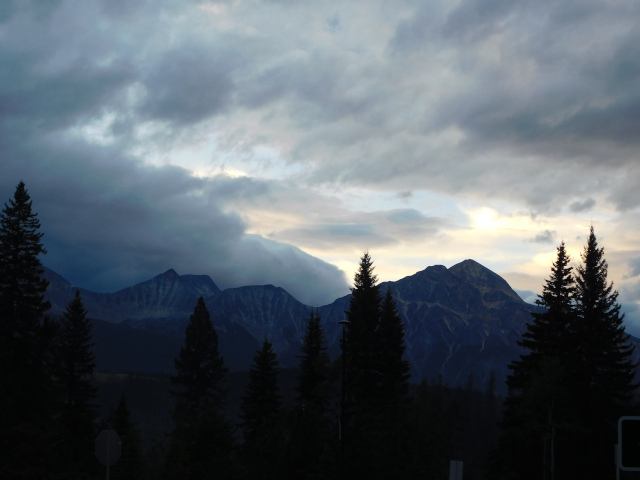
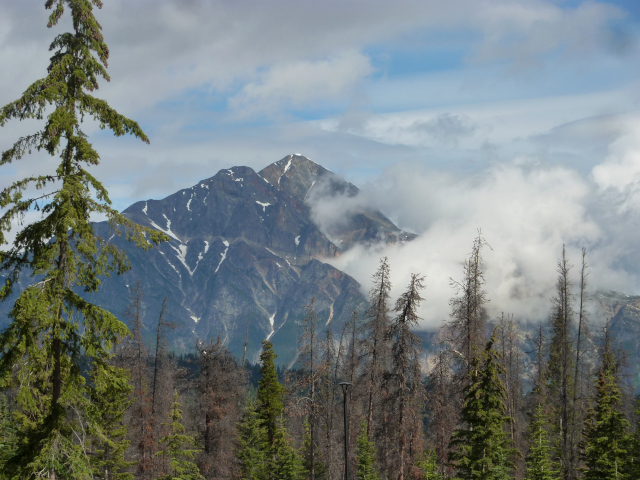
    Pyramid Mt. with spruce trees in the foreground. A few clouds nestle up against the mountain about halfway down.