A Christmas Wish List for My Readers

Writing a blog, which I’ve done for almost four years now, is a lonely affair. I’m not complaining, since writing is almost always a lonely pursuit. Every now and then, though, I do think more particularly about my readers and try to imagine where you might live, or what we might talk about if we could have coffee together someplace interesting–in your country or mine.

Writing about Christmas is an additional challenge because of all the designated holidays that I am familiar with, this one has been written about and sung about and indulged in and celebrated more than any other. Surely everything that can be said about Christmas, concerning whichever grand narrative you choose to focus on, has been said – many times over. A wish list, on the other, can be new every year.

Unfortunately, these days the world seems locked into so many conflicts and stupid flirtations with apocalyptic scenarios that the very act of creating a wish list seems frivolous. One could, of course, go big and like one of my grandchildren, add to the list “the moon.” Why not? Why not ask for the utterly unlikely, such as world peace?

Instead, I will retreat as I often do to the small things, for they matter more than we think: it is out of little actions that our habits of mind are formed, and it is out of our habits of mind that we make the big decisions and the crucial speeches that can change the world. Well, our own small spheres at least.

So, the list:

At least once, in the days before and after Christmas, I wish for you the time to watch an entire sunrise, preferably in a place without street lights and power lines. In my part of the world, the days are very short now, and the sun rises after breakfast, as it were. Take a cup of coffee or cocoa with you and watch the subtle first hints of color transform themselves into a blaze of glory. It is always a miracle, especially when the nights have been long and dark.

I wish for you two uninterrupted hours or more in which to curl up in a comfy chair or wide window seat where you can let yourself become utterly absorbed in a good novel. Preferably a classic or a young adult book that will bring you into a world that has a stable moral centre and in which a happy ending can be anticipated.

I wish for you many warm hugs and I-love-you’s. There might be gifts involved as well, but they aren’t that necessary, are they?

I hope that in your home, your office, your favorite hang-out, there are flowering plants. In my world, that’s most likely to be poinsettias, but maybe you’ll be lucky enough to be near a spectacular amaryllis in full bloom. Or maybe where you live, there are gorgeous flowering shrubs outdoors. Let there be someplace where you can smell the earth and savor the complexity of petals with their heavenly tints.

And this last wish might seem perverse or more like an admonition than a wish: I hope that there is at least one opportunity for a phone call or an in-person meeting in which you can say, “I’m sorry,” and be heard and still feel safe. We are none of us faultless. Without a doubt, there are individuals who need to hear an apology that will open up possibilities for better understanding. Christmas inevitably contains some tough stuff; it’s the fall-out, I suspect, from over-wrought expectations of all sorts. I wish for you one interval of time, however brief, in which hope can arise and love increase.

Merry Christmas and a Happy New Year!

In Memory of Those Who Are Still with Us – Even When They’re Not

            In our church calendar, the last Sunday before Advent is called “In Memoriam.” Part of the morning service is given to remembering all those who were part of the church community, however tangentially, who have died in the previous year. As each name is read, together with their relations, a candle is lit. Gradually the darkened sanctuary is warm with candlelight. We sit in quietness, remembering, perhaps allowing a few tears to slip down our cheeks. But it is good. All these beloved should not be forgotten, for they have played a part in our lives.

            These days of Novemberish darkness, when the prairie world where I live has turned into a monochrome study of the color of dead foliage, I am paying more attention to small items of beauty indoors. Besides the satisfaction provided by ever-generous houseplants, I have been given joy by what I’m going to call “memory pieces.” There are other people, besides our family and friends, who should not be forgotten.

            Years ago, in our first visit to the Black Hills of South Dakota, the closest grocery store to our campground was in Keystone, the tourist town next to Mt. Rushmore. Amidst a host of typical souvenir shops with all manner of kitsch, from the mildly amusing to the downright offensive, we discovered one shop (called The Indians) that was owned and run by Indigenous artists and entrepreneurs. There were some cheaper articles (rent has to be paid, after all), but mostly the shelves were stocked with beautiful indigenous art work from all over the USA. Our hearts were quieted, our sense of justice gratified.

As Mennonite pacifists, we had found the ubiquitous gun culture displayed on t-shirts, gun holsters, posters, etc., deeply disturbing. As life-long hikers in the Canadian Rockies, we were more dismayed than astonished at what the sculptors (aka dynamiters) had done to Mt. Rushmore, formerly a sacred mountain for the Arapaho, Cheyenne and Lakota Sioux peoples. The official name of the sculpture is “Shrine of Democracy.” Given that the establishment of American democracy required the violent displacement of Indigenous peoples, the name seems bitterly ironic.

Years later, when we revisited the Black Hills, we spent almost all our time hiking  through mostly unspoiled territory, but we did take time to revisit “The Indians” art store in Keystone because I wanted to purchase a few more items to take home with us – items of remembrance. Remembrance of those who are still with us, despite past efforts to erase, or at least forget, their presence.

One of those little glass dishes now sits by our kitchen sink as a soap dish, adding color along with sanitation. Every time I rinse soap residue from the pebbles, I am touched again by the loveliness of the glass work.

The pebbles themselves are a memory of a quiet afternoon on the beach of Beacon Hill Park, Victoria, BC.  It was late summer; the grass was a uniform dry brown, the flower beds looked disheveled, listless. They wanted to go to sleep for the winter, but it was still too hot. So we chose not to explore the park. Instead, we went down to the ocean beach, planted our bums near some driftwood and ran our fingers through the sand, picking up tiny rocks to admire their uniqueness.  

There is something about touching stone, whether it be a boulder or a pebble or something in between, that feels like eternity. Celtic mystics have written about the “thin places” on earth, where the mystery of the divine Other draws near. Where our human selves become small and insignificant, yet also miraculous and exultant. Pebbles are not usually considered such thin places; they’re just pebbles.

Until they are chosen as memorials.

I prefer pebbles to grandiose sculptures.

One Door and Only One

              From somewhere in my memory, a fragment of a children’s song from my Sunday School days surfaced, unbidden:

One door, and only one          One door, and only one
And yet its sides are two,         And yet its sides are two,
Inside and outside,                  I’m on the inside,
On which side are you?          On which side are you?

I didn’t remember the rest of the lyrics; this bit might have been all that we sang. A quick internet search, though, revealed other verses, with equally stark choices. “One Lord and only one” offered the “right way [or] wrong way,” and “one Book and only one” put the singers in “the good place or the bad place.” I’m glad that as a child I didn’t sing about the good place and the bad place because I was already plenty worried about place.    

I hadn’t heard the arrogant certainty of the tone, nor had I paid attention to the astonishing gap between that dichotomy of choice and a God whom we believed to be the Creator of a world with mind-blowing variety and breadth. To be clear, the small agricultural community where I grew up, where almost everyone attended church (the choice of two churches was hardly a choice at all with their minimal differences), had given me no real awareness of a vast universe with infinite galaxies and equally infinite complexity in the tiniest clusters of cells. That came later.

Then I had obediently pointed to myself for “I’m on the inside” and to unknown others for “on which side are you?” while trying to stifle the persistent inner fear that I was probably not on the right side of the door.  

 Very likely, the song writer’s intent was to reassure children that all would be well if  they were given clear answers about how the world worked, both now and hereafter. I’m choosing also to assume that the song writer had not considered the long-term consequences of such direct, uncompromising “othering” of everyone who didn’t speak of God in precisely the same way or didn’t even believe in God. After all, this was a simple child’s song, with a very catchy, bouncy tune.  

            The appeal of the door as a metaphor is understandable. A door does indeed have two sides and in a wild rainstorm or a blizzard, the obviously welcoming place is inside. Who, after a long journey, hasn’t arrived to stand at a door and knocked hopefully? When that door is flung open, warmth rushing out to envelope the traveler even before arms offer hugs, all the travails of the journey are forgotten. Then again, another scenario is possible: the house lights are off, the door remains firmly closed.

Doors are, by definition, openings in walls, in buildings, in enclosed gardens, in institutional offices, and so on.  They are a very visible symbol of inclusion and exclusion. They offer a way in, or, if necessary, also a way out.

 When the persistent little ditty of “one door and only one” refused to leave my mind, I began looking at doors. I drove along streets in our neighborhood and others. Camera in hand, I stared at doors – so many styles and colors, so many different yards leading up to those doors. Such astonishing variety in just the doors, let alone the atmosphere that must have been behind those doors, or the greetings that would have spilled out in so many languages.

            This is not the venue to explore fully the nuances of inclusion and exclusion, either sociological or theological, although I do want to mention one book (no regular reader here will be surprised!), Myroslav Volf’s Exclusion and Embrace, which is the best book I’ve ever read on the human need to form supportive communities and the divine imperative to keep those communities open-doored.  Volf writes as the Christian he is, but he points out that all world religions speak of love and the grace of welcoming strangers.

As I have pondered the meaning of the door, with its implied walls and enclosed spaces, I remembered an experience I had years ago, touring the ruins of St. Boniface Cathedral in Winnipeg with other family members. The cathedral, built in 1905-1908, had been badly burned in 1968. Its surviving outer walls had been left as a monument of an old architectural style, and a new church had been built in 1972, partially inside the ruins.

As we walked through the ruins, I began to linger, wanting to be alone, suddenly aware of a Presence. Light was everywhere, including within me.

People had worshipped on this site since 1818 (the ruined St. Boniface Cathedral was the third one built there); over the generations, they had expressed their faith through beautiful architecture as well as through songs and homilies and sacraments. Now the façade and walls stood open to the light and the wind. The solid beauty of the rock belonged to the outdoor gardens and to the open sky. That felt right. It included me, protestant that I am.

            These days as the rockets fall, hurled out of the hatred and fear spawned by the cruelties of centuries, I wish there were fewer fences and more open doors. I wish that the necessary doors (and they are always necessary to keep out insects and unwanted animals and the wind and the rain and . . . . ) could be openings into welcome and understanding. I wish that we could stop dividing complex issues and multiple needs into either/or, good/bad. Even as I recognize that evil does exist and must be dealt with, I wish that we could find enough humility to listen better and to recognize our common human yearnings for love and security. I don’t know how to end a political/religious conflict that is already bathed in the blood of thousands. At least in my neighborhood, I want to learn a gentler language and leave a door open wide enough so that the possibility of community can be glimpsed on both sides.

The Solace of Solitude and Silence

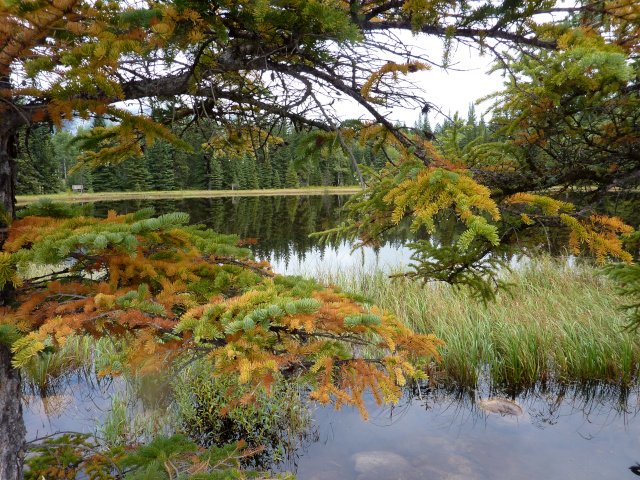
Photo of Lake Annette with evergreen branches in the foreground. Reflection in the lake is perfect.

            Some places mysteriously become part of the structure of the heart, as much as valves and arteries and veins, though undetectable by ECGs. Jasper, Alberta, at first just a pretty place to work for the summer and make money off generous tourists, turned into a heart dwelling before I understood what had happened.

Lake Annette, in the photo above, was definitely part of that process. Even on my first day in Jasper, as I sorted out what my job was going to be and where I was going to live, I felt wrapped around by the beauty of the mountains. My heart had been wooed already in childhood when I had traveled once or twice through the Rockies. Now, in my first young adult adventures away from home, I found more than grandeur or adventure.

Slowly but surely the quality of silence inherent in the rough gathering of stone and water and pine and spruce drew me in, offering a solitude of soul I think I’d been longing for all along. Oh, I hiked with friends and explored the trails and lesser lakes around Jasper; we borrowed bicycles and rejoiced in our developing stamina; we swung gently on the playground swings in evenings off and watched the sun disappear in a way that it never did on the prairies.

 Much as I loved sharing all these moments with friends, and then with a boyfriend, I treasured the times of aloneness when I belonged to the landscape and to myself. Expectations gone. Fearfulness dismissed. I was learning how to breathe and be. To smile and to be happy. Ach, that word is over-used and inadequate here. I was exalted, exultant.

            I took the photo above just a few years ago, at the tail end of a road trip in the last days of summer. I had retired by then, metaphorically speaking also in the last days of summer, becoming mellower, less driven, more practiced in the art of resting in silence, never imagining then how important that art would be in the summer of 2023.  

We visited Lake Annette again last summer, in 2022. Jasper is, thank God, still a small mountain town. Still dependent on tourists and skiers and hikers, but not over-developed and commercialized past the point of help. The mighty Athabasca River and the surrounding mountains have limited the growth of the town to where it is now and has been for decades. There are signs enough of wealth and privilege, but the hiking trails remain accessible to all, never mind how expensive or ratty the boots of the hikers may be. The campgrounds now boast more massive RVs than simple backpacker tents, but there are still plenty of those tents, with bicycles nearby.

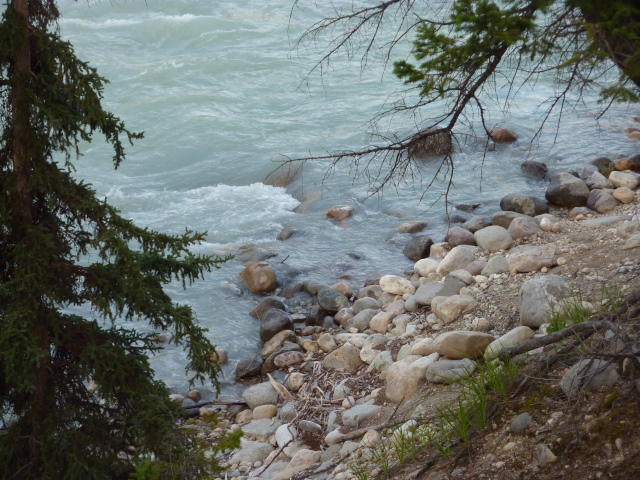
Many of my once favorite trails are now too busy for my liking (the Valley of Five Lakes is practically standing room only on a lovely summer day), yet there are still reflection-perfect ponds near half-forgotten trails where crowds of marsh marigolds celebrate in joy and the shyer wood lilies lurk in shade. There is also plenty of space along the rocky edge of the river where one may be alone to meditate and turn over small stones in the hand. Hours pass unnoticed while inner voices go quiet against the immortal voice of the river. 

Photo of the Athabasca River, focus on the rocky edge of the river.

In this summer when all travel became impossible for me, let alone the usual stay in the Rockies, I have needed all the fortitude I could muster to practice contentment with much solitude indoors. However, that mysterious grace in the universe that drops the right book off the shelf into hands that had expected nothing is still at work. Anam Cara by John O’Donohue had been given to me by a dear friend decades ago. I think I read it then; I don’t remember if I finished it. I was probably not ready for its Celtic mysticism. Now, after having sat, practically invisible, on my bookshelf for who knows how many years, it demanded to be read.

And read it I did. With increasing interest and pen in hand for underlining. I am grateful, if not quite grateful enough yet to bless the weeks and weeks of enforced bed rest that led me to pick up Anam Cara. The section titled “Aging: An Invitation to New Solitude” might once have terrified me. Now, flat in bed for more hours in the day than I once would have thought endurable, I could read this without being frightened: “A new quietness settles on the outer frame of your active life, on the work that you have done, the family that you have raised, and the role that you have played. Your life takes on a greater stillness and solitude.”  I doubt that O’Donohue was thinking of the kind of enforced stillness that I was enduring.

Nevertheless, I could see his point that we often “miss out on the great treasures of our lives because we are so restless. In our minds we are always elsewhere. We are seldom in the place where we stand [or we lie!] and in the time that is now.” Between the regrets over the past and the worries of the future, O’Donohue observes, we have little energy left for savoring what is in front of us.

I’m inclined to counter with an argument that we find our meaning in life through learning to recognize divine guidance in the past and setting our goals for the future. There is a time and place for revisiting past mistakes and offering apologies, for instance, just as there is a time and place for resolving to do better in the future and even making promises that can’t be fulfilled in the now.

As always, a single viewpoint doesn’t show us the whole scene, let alone what may be found in the next valley beyond the hill we’re now climbing. Which, I think, O’Donohue understood better than I do. So I grant him the final words.

Stillness is vital to the world of the soul. If, as you age, you become more still, you will discover that stillness can be a great companion. The fragments of your life will have time to unify, and the places where your soul-shelter is wounded or broken will have time to knit and heal. You will be able to return to yourself.

John O’Donohue

Broken People

            My opening photo was taken about a year ago during a visit with a friend in Victoria, BC. It soon became my phone’s background, and I have repeatedly contemplated the interplay of lines, the range of textures, and the subtle dance of muted colors. From the froth of the grass fronds to the mysterious black bulk of the forest and down to the dry grass, lit by the last bright rays of sunlight, the scene delights me. The V-ripples of the few ducks are an unexpected gift; I had focused on colors and clouds, not ducks.

            A life-long prairie dweller, I was an awed visitor here, marvelling that late September could offer such a visual feast for the eyes. All that water, salt water at that. Would one ever tire of it?

            Now in another summer, and still held captive by persistent pain (an angry sciatic nerve, if you must have specifics – see previous post), I see this photo every time I pick up my phone. It comforts me as I try to accept my current status as a broken person. Not fully functional.

            In the last weeks, I have had more than enough time to think about that “not fully functional,” suboptimal condition. I have pondered the ways that humans enter that state:

  1. We are made sick through viruses, bacteria, or harmful substances. Fortunately, Western medicine has become quite adept at treating diseases, discovering causes, finding medicines, developing vaccines, improving hygiene, etc.
  2. We are injured through accident or others’ malevolent actions. Here, too, we have remedies; trained first responders, skilled surgeons and therapists, inventors of mechanical aids of all kinds, and rehab specialists. We can do something about injuries, at least the physical ones.
  3. We are broken—through age that wears out parts, through misuse that makes our organs miserable, through initial genetic misfirings, through . . . . ? We can detect brokenness, in most cases, but have trouble seeing causes, or can’t tell where physical breakage has led to emotional breakage, or the other way around. It’s taken us far too long to recognize consequences of trauma and/or abuse. We’re also not very good at distinguishing between brokenness and difference (should we be talking about a continuum?)

The unknown is frustrating in all three categories, never mind that the categories overlap and won’t stay sorted. Just find the problem and fix it, fast—that’s the mantra of our culture. It has not served me well this time around.

      Then, in my quiet, sometimes lonely, pain-ridden hours came the gift of a book recommendation, serendipitously from the friend whom I’d been visiting when I took the photo that opens this posting. With the quirkiness of grace, the book’s title was The Giver.

      Yet more—it wasn’t The Giver that I really needed to read (although I loved it), but the companion novel that Lois Lowry wrote: Gathering Blue. In that imaginary world, one small scamp of a lying, thieving boy who’s been cuffed and yelled at and beaten and starved, travels from his village—where survival is all that matters and everyone grabs what is available and fights for what is not, and anyone who is sick or injured is promptly dragged to the Field of Leavings to die—yes, this wild little boy named Matt goes off to the “far beyond” in search of a blue-dyeing plant for the only friend who’s ever shown him kindness, and finds a wholly different Village he calls “the place of Broken People.”

      Upon his return with the desired plants and a strange, blind man (resident of the Village of Broken People), Matt is at a loss to describe this place where he was immediately welcomed and cared for after his arduous journey through the Forest. “Them be all broken, them people,” he said, “But there be plenty of food. And it’s quiet-like and nice.”

      When his friend, Kira, a girl with a bad leg from birth (saved from immediate death only by a determined mother who refuses to let the village expose the infant as would be the usual practice), questions Matt further, he shrugs in bewilderment: “Like you. Some don’t walk good. Some be broken in other ways. Not all. But lots. Do you think it makes them quiet and nice, to be broken?” Kira does not know how to answer. Her mother had taught her, “pain makes you strong.” But this tale of people who rescued strangers like the blind man now before her and tended them until they healed baffled her. No one in her village would have ever done that, let alone even known how.

      Lowry, however, does not offer the easy answer that Matt seems to grasp at, that being broken makes people nice. There are other characters in the novel who have let pain and loss turn them cruel and even more ruthless in their fight to survive and gain power.

      In the end, Gathering Blue offers simply the metaphor of the rare blue dye made from woad, which can be found only in the “Village of Healing.” As the blind man explains, his pronouns crucially changing, “There is always someone to lean on . . . Or a pair of strong hands for those who have none. . . . They help each other . . . we help each other.” It is left to us readers to consider how, in our world, we might move from the awed “they help each other” to the voice of belonging: “we help each other. . . . we are like a family.” Both those who are broken and those who are not.

The village of healing has existed a long time. . . . Wounded people still come. But now it is beginning to change, because children have been born there and are growing up. So we have strong healthy young people among us. And we have others who have found us and stayed because they wanted to share our way of life.”

Lois Lowry

The View from My Bed

            It’s a limited view, of course. The prone position, at least indoors, doesn’t offer much to look at. In the last many days (I’ve lost count), the pain of a nasty back episode has necessitated almost continual bed rest. I would have been pleased with a skylight—clouds and stars both draw the human spirit upward and outward. 

            So: the wise ones among us, who ponder the meaning of life, agree that pain is not only  an inevitable part of life but also a great teacher of wisdom. I am not a sage, just an unwilling, and uncomfortable observer of the dogwood branches, caught in the relentless prairie wind, sweeping back and forth across the window, making shadow patterns on the curtains. Every now and then, a blue jay, sometimes wet from our nearby bird bath, comes to the bird feeder to ponder the day’s offerings and then hammer open peanut shells with his/her beak. Then the jay is gone again, until the next visit. Wisdom remains elusive.

            Nevertheless, I have learned a few things in the past month:

            It is prudent to select your confidantes carefully when you choose to talk about back pain (or colds, or any common human ailment). Unwanted advice is immediately and freely given, especially by those who know little about you or the problem. While in my worst days, I would have tried any magical brew—so I said in my desperation— I do want to believe that common sense would have come to my rescue and prevented outright silliness. Better to turn complete hermit and take a vow of silence than be regaled with others’ tales of suffering and/or miraculous cures.

            I learned that the familiar number scale for measuring pain—on a scale of 1 to 10, how would you rate your pain?—doesn’t convey enough information. I offered my physiotherapist (who knows me well enough to interpret my moods) a new scale: stiff upper lip toleration of discomfort; winces and grimaces; moans, groans, and muttered imprecations; uncontrolled sobbing; and at the top end, screams. It’s a sliding scale, of course, because what evoked a bare grimace early on might later provoke sobs of weary despair.

            I discovered that the most important task of a health care worker, at whatever level, is to be kind. It’s that simple. Kind enough to listen. Lack of kindness doubles pain and deepens the loneliness that already surrounds the sufferer, who dwells in a separate country, the land of Oz, as Nora Gallagher describes it in Moonlight Sonata in the Mayo Clinic.

            In another time, that was the book that gave me comfort, that spoke words that I could hear and understand.

This time it was Marilynne Robinson’s Lila, not a book about illness at all or anything remotely close to my situation. I did not grow up as an orphan; I have always known who my parents are. I have never been homeless or lived as an itinerant worker. I have not known the kind of depressed economy that makes work in a whorehouse a reasonable alternative to starvation.

            But something about Lila’s strange encounter with an old preacher in a small town held my attention. He saw her as a fellow human being with innate dignity and extended to her, not only incredible kindness, but also grace. He lived his theology, fully prepared to question all of his erudite Calvinist doctrine rather than cause Lila any distress. And the possibility of such all-embracing grace was what I needed to hear.

For chronic pain has a way of involving body, soul, and spirit. It pulls together into one overwhelming sensation all of the stress and all of the guilt over hurtful mistakes and complicated relationships and all of the existential worries and whatever else is stewing around in the mind. That entire mess needs to be accepted and offered grace.

            Reading Lila was a serendipitous choice, because the final bit of wisdom that being helpless in pain gave me was a new awareness of how difficult life must be for those who don’t have an address, who don’t have easy access to medical care, who couldn’t imagine paying for additional services like physiotherapy or even any necessary medication. I’ve had lots of time to ponder the privileges available to some and not to others.

Lila ended with some hope, I’m glad to say, while remaining realistic and thoughtful. My own involuntary journey into the land of Oz seems headed toward the exit (still too far away for my liking), for which I’m more grateful than I know how to say. I have also not walked alone. That is an incredible gift.

Start Growing Jade

            Start growing jade when you’re young. Jade grows slowly.

I have two baby jades that volunteered to grow on their own, each from a leaf that had fallen from a mature plant. Now, some 3 years later, the initial leaves are still green, albeit increasingly wrinkled, and the baby plants are still tiny, having achieved a full inch at last. I doubt that I will live long enough to see those babies graduate to bigger pots. 

photo of tiny jade plant.

            Why do I even bother to keep them? For whom am I nurturing these little lovelies? Will the earth still be habitable when they have grown to a more stately height?

As well you might ask why human babies are so adored in nursing homes. One never grows too old to feel the tug of cuteness or to smile automatically at baby giggles. Who hasn’t been awed by the slender bones of a wee kitten – never mind whether one will ever be present to be soothed by the purring of the grown cat?  

I have asked myself if that’s what hope looks like: simply loving an inch-high jade plant. Or deciding to buy and plant a slow-growing Japanese maple tree in a yard that, given the usual odds, you won’t be able to take care of for longer than a few more years. One response to global-sized despair is to think small.

 The past weeks have been a season of despondency for me (yes, in the middle of spring with its happy colors). I am not unfamiliar with the grey shades of depression, although I can usually name precipitating circumstances. This time there is no one nameable circumstance that I can address and so find my way up from the bottom of the well. The malaise is general, diffused, phantom-like, perhaps a common characteristic of our Zeitgeist. These are perilous times.

 No, not perilous so much as just plain mean-spirited, quarrelsome, relentlessly factional, as if humanity has forgotten how to work together to solve perilous problems, simply retreating instead behind tribalism’s walls. I cannot find the energy to respond in any useful, public way.

Except to meditate on my jade plants and bid them grow as it is in their nature to grow. To rephrase Emily Dickinson’s “Hope is the Thing with Feathers,” hope is the thing with leaves, and then branches and therefore also sturdy stems, even trunks. There will be a grown-up jade someday. It will say, “I basked in the sun and sipped a little water, now and then. That is all.”  And it is enough.

 We who have language and compassion can also share the water and the sun and food. And give away a baby jade.

It’s all a matter of paying attention, being awake in the present moment, and not expecting a huge payoff. The magic in this world seems to work in whispers and small kindnesses.

Charles de Lint

Easter Gifts

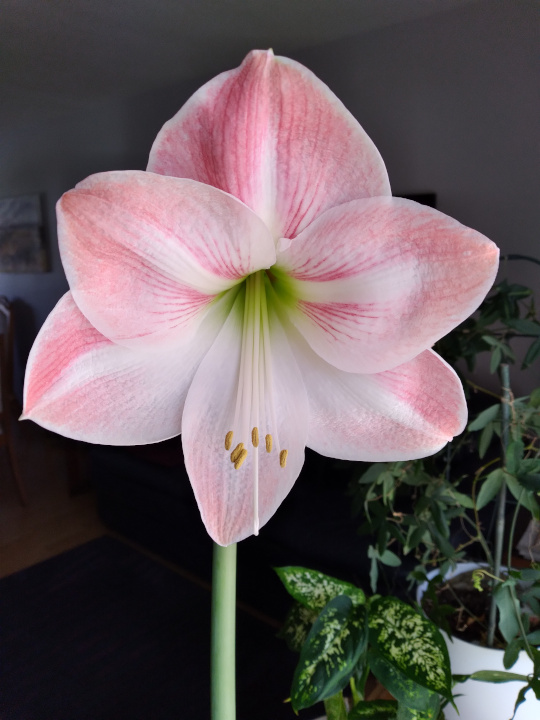
Photo of a single amaryllis, newly opened. It is mostly pink with the lower three petals partly white.

This was an unexpected gift for Easter—well, sort of. The first of three, it opened fully only two days after Easter. I have not yet learned the art of caring for amaryllis in such a way that I can plan the likely date of flowering; that this one came so close to Easter was a blessed surprise.

All during Holy Week, I watched the developing bud with intense hope, praying that it would open in time to delight our visiting grandchildren. My disappointment is eased by remembering their eager faces as they speculated just when that swelling bud would begin to divide itself and when the fattest one would finally spread wide to the sun. I did send them pictures! Too bad the photo didn’t capture a subtle glitter on the topmost petals that is visible only in certain angles of light.

The perfect symmetry of this huge flower (6 inches across and slightly taller than that) fascinates me; it draws my eye from the darkest pink streaks down into the verdant green of the throat where the ovary is hidden. The stamens (male) hold the pollen on the anther at the end of the filament; the pistil in the centre (female) has the pollen receptor, or the stigma, at the end of the style. In this photo, the stigma has not yet opened out and curved up to receive pollen. The ovary, which becomes the seed holder in a fertilized flower, develops just a bit later as the flower begins to wilt.

All of that information is courtesy of several websites that I read through before beginning to write. It had not been at all necessary for simply meditating on such exquisite beauty. Gazing at the lines, the color shading, the texture, the balance of the whole—which is so much more than the assembly of the individual parts—created silence within me. Words became unnecessary. Thought itself held still.

Strangely, looking at the photo does not provoke the same response; it simply calls forth a memory of the silence. Perhaps the difference lies in the absence of the light. For the flower seems to hold light inside itself, as if the petals breathe in light as we breathe in air. In their presence, the heart too gains light and lightness.

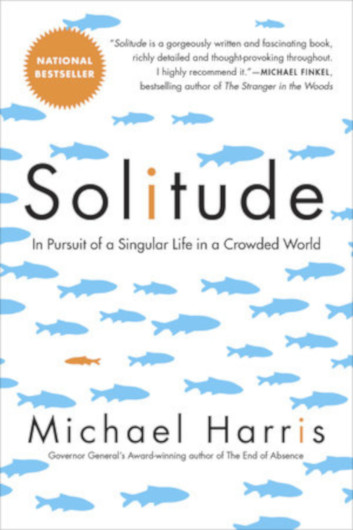
Serendipitously, as the amaryllis readied itself to display glory, a book nudged itself into my notice: Solitude by Michael Harris. I no longer remember who or what highlighted the title for me, but its subtitle—In Pursuit of a Singular Life in a Crowded World—demanded attention.

Photo of book cover.

Full disclosure here: there is no doubt that in my case, this book is preaching to the choir; I have ever been a lover of solitude and am usually happy to be in the company of my own thoughts. It is lovely, though, to be told that my lifelong habit of daydreaming, a habit generally dismissed as a waste of time and a self-indulgent laziness, is actually a virtue. Indeed, Harris argues that it is absolutely essential for creativity and for a healthy identity.

One can be instructed in society; one is inspired only in solitude

Johann Wolfgang von Goethe

   I do not yet know what remedies Harris will offer to a world seemingly permanently hooked on online distractions, because, as of this writing, I am only a quarter of the way through the book. Already I’m prepared to recommend it to one and all. One early chapter all by itself – “What is solitude for?” – is sufficient to justify the book. Harris answers that question with three items: new ideas (creativity requires solitude), an understanding of self, and closeness to others. To the likely objection that the last benefit is counter-intuitive, Harris explains, “The ability to be alone, . . . is anything but a rejection of close bonds. It’s an affirmation of those bonds on the most essential level. To be happily alone is to affirm one’s faith in the love of others.”

To be happily alone is to affirm one’s faith in the love of others.

Michael Harris

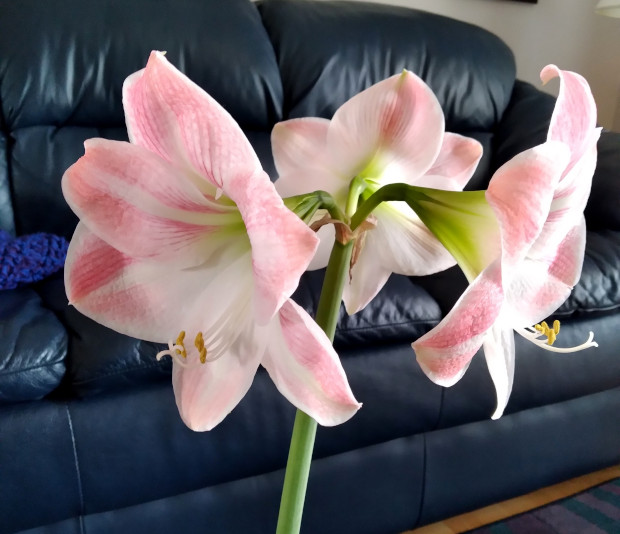
So, then, two Easter gifts have come my way: flowers and a book. I am grateful.  

photo of the three amaryllis flowers, all wide open.

Consoled by a Smile

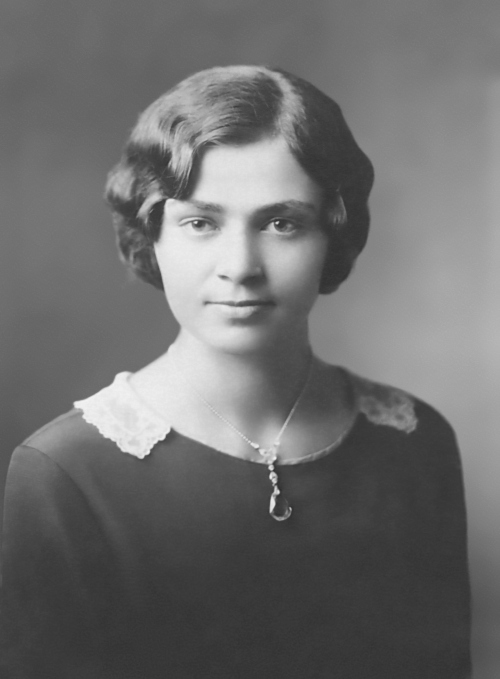
Photo of my mother. Her hair is dark, carefully waved back from her face in the style of the early 1930s. She wears a simple dark dress with a small lace color and a pendant. Her eyes have a clear gaze and her mouth looks as if she might smile but she doesn't quite smile. Her skin appears flawless.

            According to an entry in my father’s diary, my mother gave this studio photo of herself to my father for Christmas in 1931. They had been courting for a few months by then (discreetly, of course, in deference to her strict preacher father), and would marry in October 1934. With about ten dollars in my father’s pocket and with a single cow (or was it two?) in tow behind the buggy, they rode off to a small homestead to begin a dairy farm and their life together. Their first home, a mere shack furnished with apple boxes for chairs, was so drafty their blankets froze to the wall in the winter nights.  

 As the late-born youngest in the family, I was granted only glimpses of the courageous, hopeful woman in this photo, although I do recognize the intelligent humor in my mother’s eyes. The years of trauma in her childhood had left their legacy: she had been only six when the Russian Revolutions tore apart the Mennonite villages in the area now known as Ukraine; she had been twelve when her family fled to Canada as refugees in 1923. In the charmed early years of their marriage, it would have been possible to forget painful memories and ignore immediate hardships in the joy of beginning anew. Much research since then has made it clear that forgetting is not that easy.  

What I remember mostly clearly about her in my growing-up years and later was her focus on endless work on the farm, persistent fearfulness and constant worrying, an unhappy strain of judgmentalism, and eventually repeated illnesses and depressive episodes, none of which I even began to understand until I was an adult with children of my own. Then, dimly grasping the wisdom of playwright Joanna Glass—“If we are women, we think back through our mothers”—I began to research my people’s history and my family’s history.

 What I learned is material for other blogs, or more likely for unpublished stories for our children and grandchildren. Here I wish to take delight in that soft, Mona-Lisa smile on my mother’s face. My childhood self never realized that my mother was beautiful and gifted and strong. This photo reassures me that she was all of those, perhaps never more so than in her older years when she struggled against the darkness with not much help. For sure, her family doctor knew too little about trauma’s long-lasting effects on the body and mind, and her church was too inclined to blame depression and frightened anger on a lack of faith. The former prescribed drugs, and the latter repentance and prayer. Both were likely unaware of the unhelpfulness of their assumptions about women, yet both meant well—of that I’m fairly certain. It seems pointless now to point fingers back into the past, using knowledge that was then not available.

Nevertheless, she persisted. Not consistently, not always obviously, sometimes counter-productively. Artistic gifts suppressed and desires dismissed eventually turn bitter. When responsibility for her elder care fell mostly on my shoulders, I was frequently resentful and frustrated. I had even less to offer her than those institutions to which she had looked for help. I simply did not understand, either her needs or my own.

Against those memories, I now treasure earlier glimpses of my mother, and I choose to celebrate the gifts that I did see in her: her artist’s eye for color in fabric and in flowers, her instinct for words, her innate generosity, the twinkle in her eyes (a family trait).  

That smile, so barely there? I think it’s love, finding a place in her heart. The commitment is growing, the trust increasing. It is the joy of youth (she is 20 years old), daring to reach toward the future. I did not know her then, but I did see that self, every now and then, in the stories she sometimes told, in the pictures she shared with me. I believe, with Madeleine L’Engle that “the great thing about getting older is that you do not lose all the other ages you have been.” That lovely young woman did not wholly disappear, after all.

The great thing about getting older is that you do not lose all the other ages you have been.

Madeleine L’Engle

  In the on-going processing of memories and learning to understand something about all those other ages I have been, I have been encouraged by reading memoirs. One of the best I’ve read is novelist Elizabeth Hay’s All Things Consoled. All stories of human selves are worth hearing and pondering; very few of them are as beautifully articulated as this one.

[Photo from https://www.penguinrandomhouse.ca/books/572851/all-things-consoled-by-elizabeth-hay/9780771039751%5D

Its primary chronological focus is Hay’s year or more of being primary care-giver for her elderly parents whom she moved to a nearby seniors residence/care home. As part of that story, Hay also includes a history of her parents, which serves as background for Hay’s own childhood. She makes all her “characters” (family members, friends) wonderfully human; every chapter reveals greater complexities in the larger Hay family and demonstrates the extent to which we all are shaped and bound (and enlarged) by the relationships that have knit us into the people we become.

Photo of the book cover of All Things Consoled.

Although Hay does not minimize the achingly tense dynamics between her and her parents, she tells their stories and hers with love. Regardless of what might have gone wrong in the past, Hay celebrates her parents’ achievements, seeking to understand without glossing over failures. Such gracious acceptance is what I want to learn. That and the capacity to listen well which is so often the good writer’s gift – and the good healer’s gift.

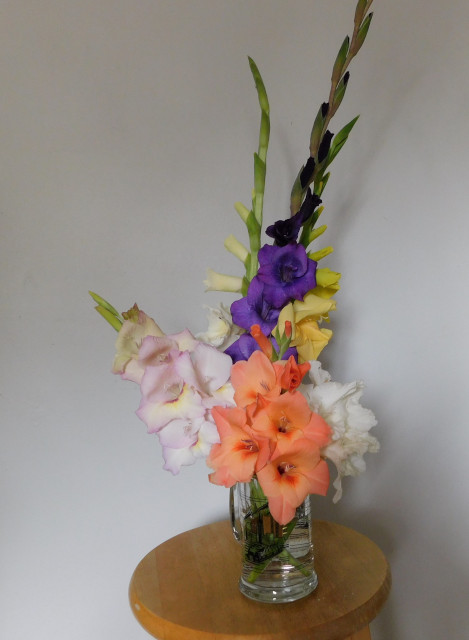
Photo of a bouquet of gladiola
One of my mother’s favorite flowers was gladioli. I grow them often, in memory and for my own pleasure.

The Mountain Still Stands

Photo of Pyramid Mt. in Jasper. The mountain is beautifully reflected in a small lake.

            The above photo is one of dozens of photos that I’ve taken of Pyramid Mountain in Jasper, Alberta. It’s so distinctive, and so dominant that even the most desultory of tourists driving through the small mountain town will learn its name and identify it on photos years later.

Pyramid Mt. is in the background in this photo. The foreground is part of the golf course near Jasper Park Lodge.

            When I arrived in Jasper in the summer of 1968 as a university student hoping to earn next year’s tuition, I was lonely. I’d never lived that far from home before. Pyramid Mt was the first mountain whose name I was given, and I quickly came to think of it as a friend. It was always there – solid and beautiful. I won’t say “unchanging” because a major part of its charm was that it never looked exactly the same. The mountain’s iron-red rock caught the light of the sun, or the moon, from all angles and refracted it into grandeur.  I was fascinated anew every time I walked “home” after work to my half of a double bed in a tiny bedroom on the crowded upper floor of an old house (most houses in Jasper had been converted to making as much money as possible in the summer tourist season).

            In the decades since living in the magnificent and beneficent presence of Pyramid Mt., I have revisited the town many times. Each time the drive along the Yellowhead Hwy feels like a journey home from the minute I recognize Pyramid’s backside, which is a non-descript gray; only intimate familiarity allows recognition from that angle. As we near the town itself, there is Pyramid, ever reassuring, warm as only stone can be.

Pyramid Mt. against a cloudy sky with the beach at Lake Annette in the foreground. The reddish rock is particularly obvious in those photo.

            The ubiquitous cartoon image of a guru sitting on the top of a mountain, dispensing wisdom, is a modern belittlement of an ancient habit of looking up to the hills for divine guidance. As a familiar line from the Book of the Psalms puts it, “I will lift up my eyes to the hills / From where does my help come?” It is not mere happenstance that we describe a powerful awareness of transcendence as a “mountain-top” experience.

Which came first, I wonder, our experiences of the rarified atmosphere so far above sea level or the influence of powerful myths in various religions that equate mountain tops with divine revelation? Moses did receive the Ten Commandments at the top of Mt. Sinai, and long before that, the ancient Hebrew patriarch Abraham was ordered by Yahweh to take his son up onto a mountain, where he learned a dramatic lesson about trust and about the abomination of human sacrifice.

Photo of the book cover of Adele Wiseman's The Sacrifice.

In a disturbing, yet hopeful, reworking of that old story, The Sacrifice by Adele Wiseman invites us to pay attention to our own uses of narratives. When I first read the novel, I was aghast at the tragedy at the heart of it, and even more so after I learned just how utterly taboo it is in Jewish teaching to take a life. The various interpretations of the novel that I read in preparation for teaching the novel left me unsatisfied. All of them seemed baffled by the shocking contradiction between an elderly Jew devoted to Torah and deeply in love with God, and an act of killing for seemingly no discernible reason.

I read and reread, noting the obviously symbolic names of Abraham and Sarah and their son Isaac, not to mention daughter-in-law Ruth and grandson Moses. Echoes of the Book of Genesis were everywhere. The modern Abraham and Sarah and their son are refugees, having fled their country after losing two sons in a pogrom in Europe. To see them settle in a Canadian city and begin to make friends was heartening. Until the story turns deeply troubling.

The book is open and the text is heavily underlined. Comments have been added in the margin.

            There is a mountain in that unnamed city where the family chooses to settle. It is not at all like Pyramid Mt., more like a high hill, yet it figures largely in Sarah’s imagination, especially after Isaac’s death. It is a disturbing mountain, perhaps malevolent. On it stands an asylum for the insane. It is not a source of wisdom, nor yet of friendship; it just stands there, hinting at some significance, waiting for its time to offer wisdom out of suffering.   

            At the end of the novel, grandson Moses, now almost a man, finally ascends the mountain to visit his once-loved grandfather who has been living in the asylum for years. In their awkward conversation, Abraham attempts to reclaim his role as a voice of wisdom, but it is with painful humility that he mutters, “I could have blessed you and left you. I could have loved you.” To whom, wonders Moses, was Abraham speaking? Not seemingly to him, but both blessing and love are offered to him anyway. There is an awakening here of some kind, an enlightenment. 

            The thought came to me eventually that Abraham’s tragic mistake was in claiming the Biblical story of Abraham as his own, believing that he could control God’s blessing on him and give meaning to his own suffering through reliving the ancient stories. Long before he was guilty of murder, he was guilty of spiritual pride, of grasping that which should have been given, or not, as the case might be.

That thought gave me my first academic paper, which is far less important to me now than the truth that Wiseman explored through her novel: we need to be cautious about the stories that we claim as ours, that we choose to live out—and we do live by stories, whether we recognize them or not. Myths (in the original sense of deep stories that explain humanity’s role in the world) are powerful; they shape us even more than we shape them. It behooves us to ask ourselves frequently: what are the consequences of using this story to give meaning? what kind of person does this story make us? Wayne Booth in The Company We Keep asked it differently, “is this book, this story, the kind of company that is good for me? Who am I when I am with this [book] friend?”

What are the consequences of using this story to give meaning?

What kind of person does this story make us?

The mountain still stands, whether it be a friend or a dangerous other. In my mind, Pyramid Mt. counsels love, for all people, for all of creation.

Pyramid Mt. with spruce trees in the foreground. A few clouds nestle up against the mountain about halfway down.