Pineapples and Jigsaw Puzzles

It is a serious thing

just to be alive

on this fresh morning

in the broken world. (Mary Oliver)

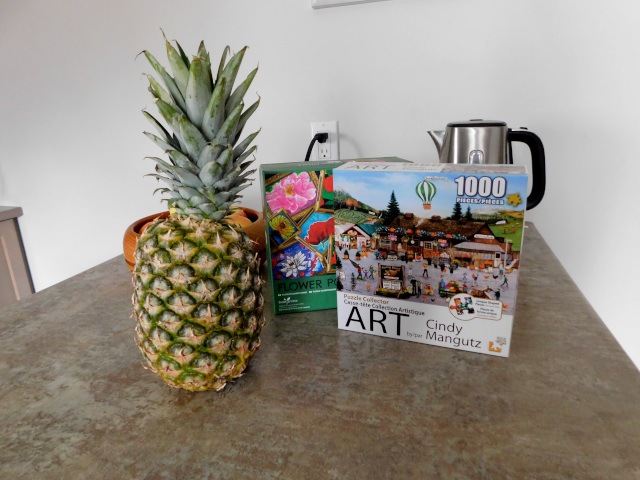
A kitchen table with an electric kettle just visible in the background. A large fresh pineapple sits in the foreground beside two puzzles boxes.

Cutting up pineapples is inherently messy and time-consuming. That means everyone has an opinion on how it should be done.

A recent observation from a guest (yes, we are beginning to have those!)—“okay, that’s neater than the way I do it, but I can do it faster”—provoked me into a defensive “and why, precisely, should I do it faster? Just so that I can get it done and then move onto something else that I will also do as fast as possible just to get it done?”  

If everything I do in a day is done just to get it done, what have I done that was joyous in the doing?

Putting together jigsaw puzzles has somehow raised the same question.

I must be one of those rare people who prefer doing jigsaw puzzles alone. There’s a story that needs to be told here in self-defense. As a late-born (and therefore rather solitary) child on a farm, I didn’t have many opportunities to acquire necessary social skills. Mostly I played alone, when chores were finished. I was probably at least 13 when the first jigsaw puzzle ever came into my hands as a gift from a distant aunt.

The picture was one of those English cottages set in deep dark woods on the verge of autumn. It took me many long evenings before I got those 500 pieces into the right places. I was so absorbed I knew nothing of passing time until ordered to put out my light and get to bed. I admired the finished product for days, not wanting to take it apart, ever. Until the desire to put it together again won out.  

Years later, in the family of the man who became my husband, I discovered that jigsaw puzzles were a family activity. Everybody gathered around to put pieces together. It wasn’t exactly a process I would describe as driven, but the plan was definitely to get it done. Meanwhile, stories were told, gossip was shared, snacks were fetched. Each person worked on one area and rejoiced when it could be attached to the whole. Sometimes it took a couple of evenings out of a weekend family gathering. That’s when I first noted the loss I felt when I saw that someone else had finished what I’d been working on.

There’s a reason that jigsaw puzzles became so popular during the early days of the pandemic. When all the world is falling apart and we’re denied our usual social distractions, the putting together of pieces to make something beautiful is soothing. It feels creative without the agony of actual creation. It gives us control, and meaning: we begin with chaos—a heap of fragments in a box—and end with a perfect order in which each tiny piece fits into its place.

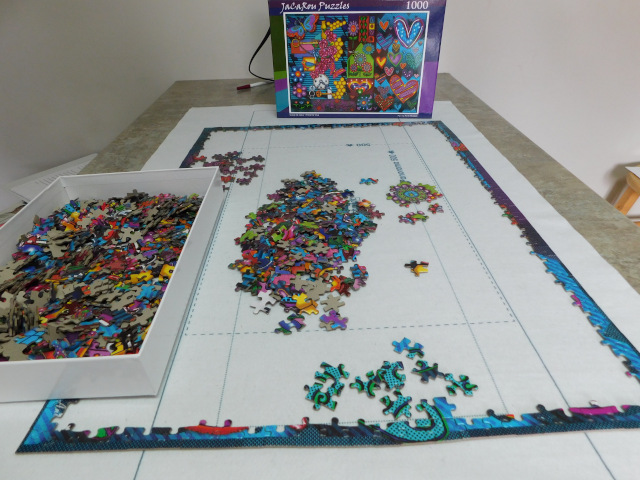
A brightly colored jigsaw puzzle is in its early stage of being put together. The outside pieces are in place; there's a heap of pieces in the middle of the puzzle mat and even more pieces in the box at the side. The box cover with the picture of many brightly colored hearts sits upright in the background.

For me, the putting together is the whole point. I own it all, both the chaos and the order. It is the doing I delight in; the “done” part is a form of good-bye.

Which is why I recently responded to a casual offer—“would you like us to help you get your puzzle finished?”—with a stammering, awkward refusal. It was a gracious social gesture, an entirely laudable wish to do something together, but just for a moment, I felt as if something that was mine was about to be taken away from me, as if the goal had co-opted the process.

My dilemma had a solution that made sense to me: I offered a different puzzle, still in its box. If I know from the get-go that the puzzle will be a communal effort, I happily join the being together, which is, in the end, even better than the putting together. Actually, the putting together becomes a different process when many eyes and hands find order in the midst of chaos. It is useful to be reminded, especially these days, that shared fragments are much less fragmented, less chaotic.  

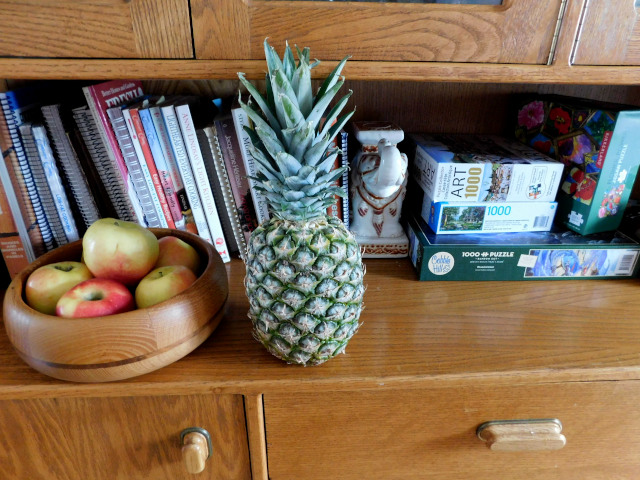
A whole pineapple in the foreground beside a wooden bowl of apples, on the  shelf of an oak china cabinet. In the background are several recipe books, a china elephant serving as book end and a few puzzles.

If I am to be happy with pineapples and jigsaw puzzles—and all manner of doings—I shall have to practice sorting out the doing from the done, and which is important when.

Working together with other people requires me to let go almost entirely of the final product. It may or may not be what I had envisioned. My perfectionism (sometimes a virtue, sometimes a grievous fault) needs to be held in check during the doing and completely set aside for the done. What matters is the warmth of shared effort, the laughter, the swapping of stories, the mutual encouragement. It helps me to see two processes at once: the task at hand which needs to get done, and the happy work of building friendships which needs doing even more (and luckily never arrives at a state of doneness).  

When working alone on a task, I hope for wisdom to know just how important it really is to get it done. Is efficiency what matters? Is this just to get it done and out of the way? How often shall I let that urgency spoil the intrinsic pleasures of the doing? Surely I can take time oftener to feel the evanescent tickle of soap bubbles in the dish water, the soft yieldedness of bread dough taking shape under my hands, the miracle of color in cut fruit, the crumbling of soil in my fingers as I transfer a trembling wisp of a pansy into the next size of pot.

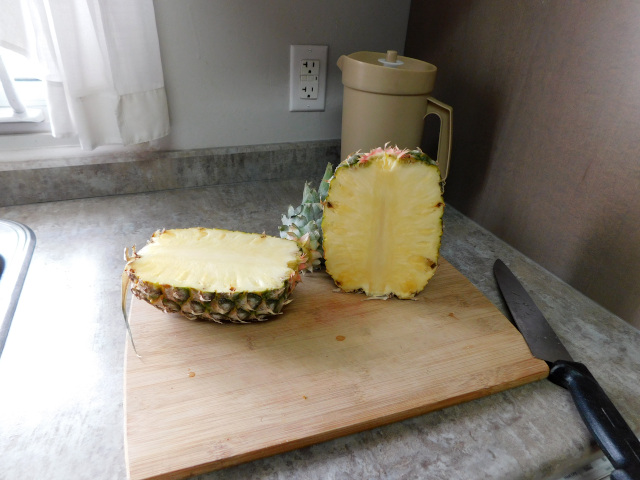
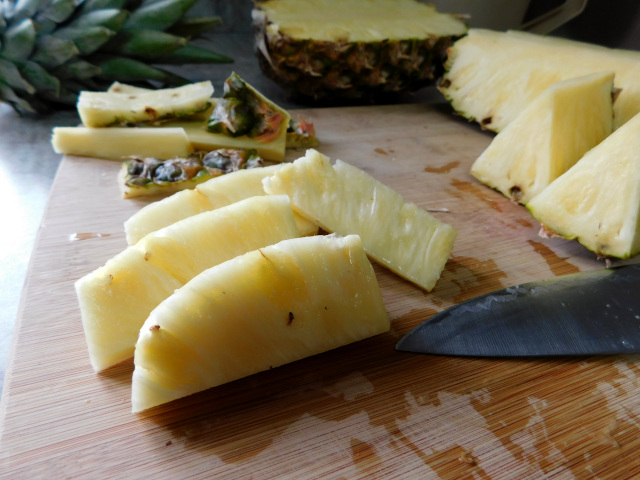
Close-up of cut pineapple chunks on a wooden cutting board, the tip of heavy knife visible in the bottom right corner.

A pox on getting it all done just to get it done! A life lived deeply might be just as full as the life lived headlong forward.

Containing Annoyance

            On any continuum of fury, annoyance sits near the gentler end. Annoyance is our response to some slight loss of control or disappointed expectation: the two hours assigned to an important task were wasted because of missing parts and a malfunctioning tool; a craft project meant to delight a small child disintegrated into tangled threads; a short errand became an ordeal thanks to elusive parking spots and a badly signed detour. We can all add our own examples. I daresay a thousand gizmos and a million advertisements have offered to hold back the tsunamis of annoyance in our lives.

 Odd that I so readily connect annoyance to things rather than people. Really, it’s other people who disappoint and frustrate us more and oftener than poorly designed things. Yet my tolerance for people who annoy me is considerably greater than for things that annoy me. Nothing flares my temper quite like the vacuum cleaner that will not suck, or the pill bottle that refuses to be opened.

 Lately, that un-openable bottle has come to stand for what will turn into an obsession if I do not contain it sensibly. Contain – the word sums up the problem.   

            It’s an ancient one: humanoids have always fashioned containers for carrying and storing food, tools, treasures. There is no doing without containers. The more we have and make, the more we need containers. From hollow stones and woven baskets to carved bowls and on toward metal chests with ropes, we have contained our way to our current avalanche of plastics and paper, unfortunately made worse by the pandemic’s take-out meals and online shopping.

 But it is not environmental considerations that I want to think about right now, even though those considerations should move us way past annoyance all the way to rage over our garbage-strewn planet.

 No, what troubles me is my own garbage-strewn mind, for I keep letting small vexations prompt unreasonable anger.

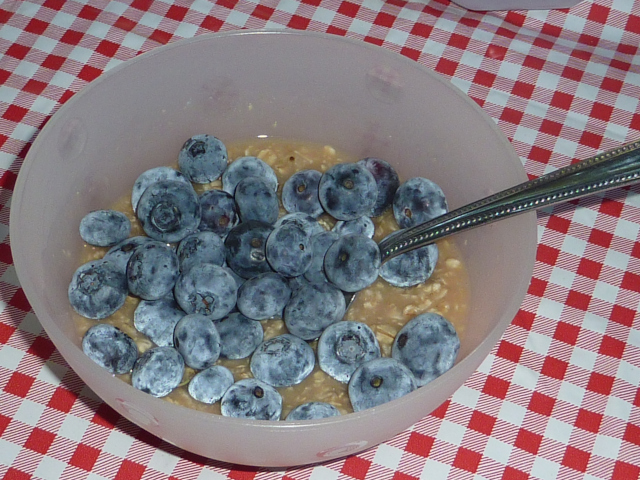
photo of a bowl of oatmeal topped with a generous helping of fresh blueberries.

            Take blueberries, for instance. I love them. Their mating with yogurt and granola (or oatmeal) for breakfast is made in heaven. But blueberries will not grow in my garden. Believe me, I’ve tried. And wild blueberries don’t appear in the environs of Saskatoon, either. Hence my need to buy – which means containers. Once upon a time, frozen blueberries could be purchased in lightweight plastic bags, simply sealed. All it took was a scissors to snip off the top ¼ inch and some device to tie the bag thereafter. No problem.

            Then someone, intent on claiming as much shelf space as possible, invented stand-up bags. Sturdy bastards they are, as they were meant to be. Now my arthritic hands are supposed to tear off the top strip, then somehow grasp the minimally remaining edge to force open the zipper—yes, these “bags” come with their own zipper requiring more manufacturing. Having achieved my breakfast, I am expected to re-zip the stiff bag so that it stays shut and doesn’t spill the rest of the berries on the way back to the freezer compartment where it claims space beyond reason.

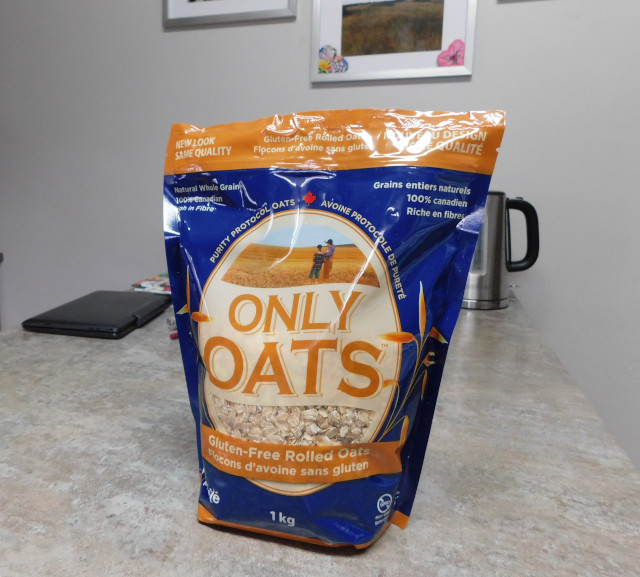
 Similar bags now contain flour, rolled oats, and all manner of staple goods. I frequently imagine a vengeful kind of afterlife in which the designers and makers of those damned stand-up bags are forced to measure—accurately!—flour and starch and rice for an eternity. It’s awkward to pour anything from those bags and even more difficult to scoop out from without spilling.  

I now avoid frustration by cutting the bags open below the zipper; I can then cleanly transfer the contents to a glass canister or some other stable, non-disposable container. Frozen berries are put into small Ziploc freezer bags which are plastic and do have their own zippers, but at least they’re reusable multiple times over, and their zippers are easier to manage.  

            Am I becoming a crusty senior citizen, whose tolerance for small physical demands is decreasing? Perhaps.

            Another shift in grocery packaging likewise stoked annoyance. Decades ago, we discovered a small bulk food store that sold a wide selection of basic baking and cooking ingredients for reasonable prices. The local owners bought goods in bulk and sold them in small or medium bags that were completely see-through, entirely flexible, and durable. We bought all manner of nuts and flours and pastas and spices there. The bags were tied with tiny strips of sticky paper that were easy to undo; thereafter I re-closed them with whatever baggie ties we already had. It was simple. The bags were small enough and flexible enough that they claimed no more space in the cupboard or freezer than was their due. I have washed and reused the bags for decades; they’re almost everlasting.

Then the beloved bulk food store changed its packaging to brittle, cheap, mostly unrecyclable rigid containers. They sat nicely on the shelves, yes, and I could see the contents, but they were beastly to open and worse to reclose and claimed the same greedy space whether they were full and almost empty. We have not been back to the store again.

It did not improve my mood to see grocery stores shut down their bulk food sections when the pandemic began and likewise stock their shelves with those miserable square plastic abominations. I still vividly recall the day that I failed to resnap the lid of a newly opened container of sunflower seeds, precisely as required; I spilled the entire contents into the fridge and onto the floor.  

 The unfortunate conjunction of changes in packaging and loss of dexterity due to arthritis has turned me into a curmudgeon. Call it a refusal to acknowledge the aging process, if you must. Or a failure to manage frustration, which could be blamed on COVID loneliness. I’m less inclined to fret about the sources of my irritation than about a way out of the downward spiral.

            These words are being written in Lent, the season of conscious awareness of life and death that precedes Easter, the most important holiday for Christians.

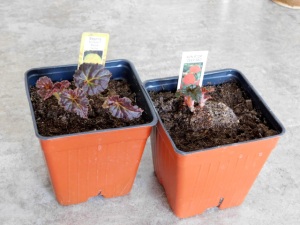
photo of two small begonia plants, just barely leafing out.

I have been watching in wonder as my seemingly dry, lifeless begonia tubers are now eagerly responding to warmth and light with the first intricate leaves. They will yet produce flower buds which will open into the brilliant colors begonias are known for. Those dry tubers contained life and the promise of beauty.

As so many symbols of Easter do. The shell of the egg, whether painted or no, contains (or did contain) that which nourishes life. Indeed, if I wish to return to the realm of the inorganic, I think of decorative boxes containing chocolates which sometimes contain delectable fillings, pretty baskets containing eggs that contain desired somethings. The most powerful symbol of all, the empty tomb, speaks to the transformation of death into new life. Life cannot be contained; it will burst forth, it will begin anew.

            I have moved from the ridiculous (ridiculously trivial, that is) to the sublime. Can I contain both in one posting? Why not? If I can remember to focus on the “contained” rather than the containers, and then, whenever possible, choose that which offers life rather than more inanimate garbage, annoyances should lose some of their power to annoy. I could also choose to advocate for better containers, but that is another project.               
We Need a New Word

Words are slippery.

They mean what they mean, yes, but they mean always within a context, and contexts change.

            As a child of the Protestant Reformation, a descendant of Mennonites (a radical branch of that Protestant Reformation), and a wordsmith, I’ve been thinking a lot lately about our political language. What on earth happened to protest since the 1500s? Why could I be proud of my religious heritage, yet so much on edge and unhappy now?
The verb “protest” has become more noun than verb. One doesn’t pro-tést these days – one joins a pró-test, and that changes more than just pronunciation and grammatical function.

 So: protest as a verb. It differs from object and from disagree. To disagree means, according to Oxford Dictionary, to “hold a different opinion.” In other words, you and I don’t think the same way about some idea or some thing or some action: cement is a better surface for an urban driveway than asphalt. There are good reasons on either side of that disagreement (cost, labor, endurance) but moral implications are absent.   

To object means, again according to Oxford, to express or feel opposition or disapproval or reluctance. That’s stronger than to disagree because emotion is involved. Whatever happens in the discussion, the one who is objecting feels hurt or offended or even appalled. That would be the distinction that my editing self would make. When my late father used to introduce me to his acquaintances as the “baby of the family,” never mind that I was already an adult with children of my own, I objected strenuously. It felt belittling to me, although I’m willing to concede now that he meant it as affection. We disagreed on the meaning of “baby” and I objected to his application of it.  

But to protest is to bring in not only emotion but moral judgment. Here I’m reaching back in time to try to recover the meaning of the word before it became a noun that means an official demonstration against government or some other powerful institution or leader. That’s the primary meaning now. Even in that noun form, perhaps especially in that form, the word carries the weight of moral judgment. A protest (noun) occurs because enough people judge some action morally wrong. It’s deemed unjust, unfair.

 If we’re talking about unfairness or injustice, it follows that the protester is in a position of less power than the person or institution against which the protest has been made. The protestor may be a direct recipient of the unjust action or maybe not. Many protests have been launched on behalf of those who had no voice or influence. The common thread is the moral judgment. This or that action is just wrong; it violates a law or some accepted standard of behaviour.

 There is something else about the verb “protest” that we seem, as a nation, to have forgotten entirely: it is intended to persuade. The very fact that the objection raised is morally justified assumes that the one who protests and the one against whom the protest is made share (or should share) a common ethical standard. The concept of injustice makes no sense without an accepted definition of justice.  Martin Luther, who inadvertently began the Protestant Reformation, appealed to the standard of the Bible and the tenets of Christianity when he protested against several actions of Roman Catholic clergy. His initial intention was first open discussion, then persuasion, based on a common faith.  

(Generally speaking, it is, of course, possible that the objection has been made in bad faith and is not morally justified; equally possible is that those whose behaviour has been objectionable do not have any ethical standards to which one can appeal. Neither case invalidates the protest’s initial purpose of persuasion. I insist that the ideal not be forgotten.) 

            By this point, given the current political climate, all sorts of righteous stances are doubtless being claimed by my readers, not to mention fervent disagreements with my definition of “protest.”

 So I will retreat temporarily into a simple illustration taken from my teaching years. A student was unhappy with an assigned grade; she felt certain that I had marked her paper unfairly because I was prejudiced against her. That is a moral problem. While some subjectivity is always a factor in marking essays, outright unfairness is unacceptable, not only to students but also to university administrators and department heads.   

As long as my student expressed her opinion courteously and presented evidence for her accusation, she was completely within her rights and could hope to be persuasive. My role was either to offer a reasonable explanation of the grade or to acknowledge her point and re-evaluate the paper (and/or ask a colleague to evaluate it). Either way, we should have been able to end the discussion with our dignity intact. Indeed, it could have been the beginning of an improved relationship.  

 However, if she had insulted me as a person and added threats of character assassination or even worse, she would have crossed a line between protest and blackmail—“you do this or I will ruin you.”  That is not yet physical violence, but it is violence. Her protest would have given up the moral high ground and become intimidation, thus turning the interaction into a power struggle, which leaves no one’s dignity intact, and makes an improved relationship very difficult, indeed. 

 When Martin Luther King, Jr., and Gandhi before him, insisted that any and all protests should remain non-violent, in language and in action, they were aiming at persuasion, which seeks to make clear what the relevant moral principles are and appeals to both a common humanity and a common acceptance of those moral principles. This is not to say that protests against long-standing evils such as slavery are easy. By no means. Many, perhaps most, slave-owners saw the protest marches as intolerable uppity behaviour by those whom God had made to be their slaves. As long as the marchers refused to turn their protest into rebellion, they kept the moral high ground and underlined the principle of a common humanity, something the slave owners had consistently denied. 

            I indicated earlier that I was a descendant of Mennonites, first known as Anabaptists, who refused to bear arms and developed a strong code of pacifism. Other groups like the Quakers have also chosen non-violence. That does not rule out protest. To speak up against unfairness and injustice, even oppression, is a moral obligation, especially if the speaking up is not for oneself but for those who cannot speak up.

But the way of peace refuses violence in all its forms, and seeks reconciliation. That is the ideal. I cannot speak for Quakers but I know that Mennonites have not always avoided violence, either on the national stage or in their own families. The teaching remains, though, challenging us to seek actively to make peace.

 I confess that I am congenitally disposed to avoid even legitimate protest. I will write letters to my elected representatives (not very often), but I do not march or carry signs. My preference is to “guard each man’s dignity and save each man’s pride,” to quote from a 1970’s Christian worship song.  Other cultures value the “saving of face” which is simply a different metaphor for the kind of agreement that allows for gracious exits from the conflict.

            Is that always possible? I don’t know. Some situations do present themselves as inherently impossible, yet I have read many inspiring stories of people who have suffered much rather than use violence and have ultimately brought about lasting change. Stephan A. Schwartz argues that social changes attempted through revolution and violence generally do not last as long as those social changes created through non-violent means. He lists several examples, including universal education, abolition of slavery in countries such as Britain, universal health care. Remember the old saying, “a man convinced against his will is of the same opinion still”?

As Stephen Berg wrote in “Deer in the Mist,” “insisting on angels drives angels away.” Or as I heard in a sermon many decades ago, the way of spiritual grace is always a matter of “gift,” not “grasp.”

Everything real, happens first,
out of sight, in the far away furnaces of courage
which are fueled, not by passion, but love.
(Stephen Berg)

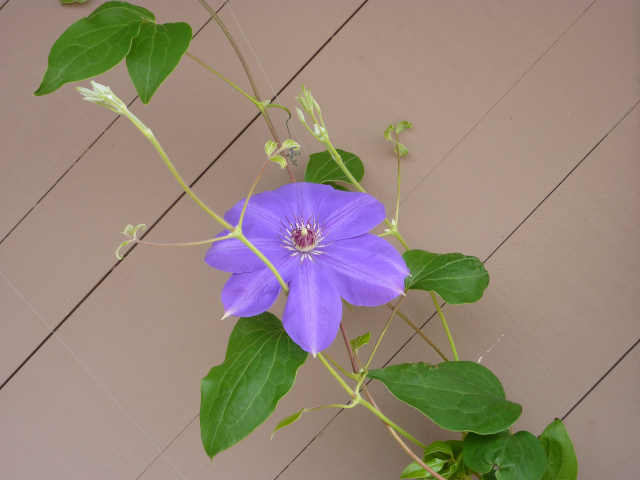
Photo of a single clematis vine climbing up a wall with seemingly nothing to cling to. There is one lovely mauve flower.

A Story in Five Rings

            No, this is not a story about the Olympics. It’s a love story, an ordinary one. Many couples could tell it, I guess, except that no two love stories are exactly the same.    

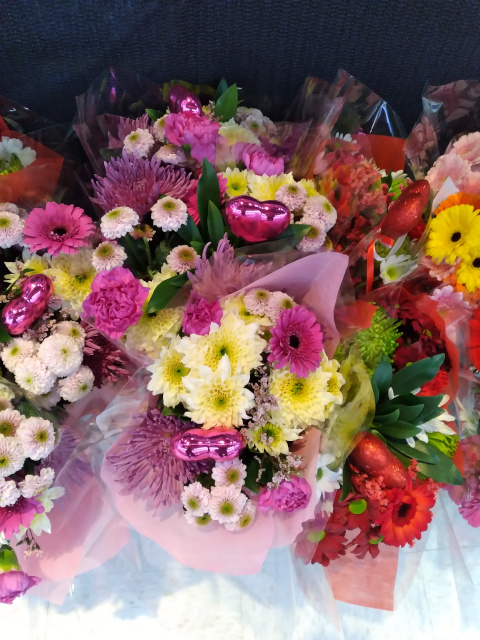
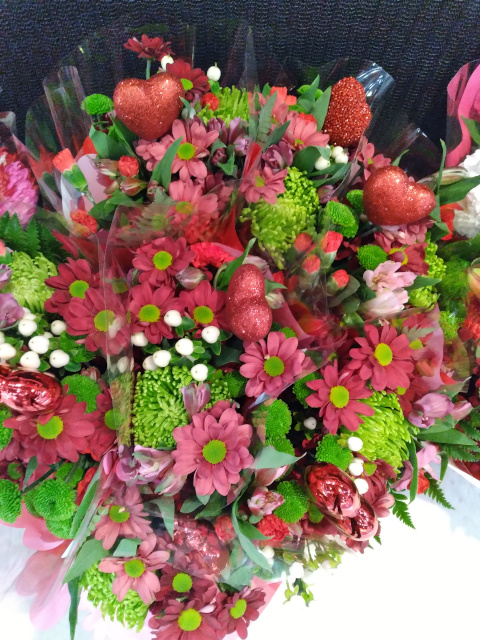
Photo of a Valentine's Day bouquet with a mixture of mostly pink flowers but some red and one yellow. Flowers are mostly mums.

            Western love stories have typically followed familiar plots: 1) two kindred spirits fall in love, face and overcome obstacles, marry and “live happily ever after”; 2) follows plot 1, but adds more obstacles after the wedding, which a) may be overcome and lead to a renewal of the happy ending, or b) may not be overcome and lead to an unhappy divorce, or to affairs, or to divorce and then remarriage for an eventual “happily ever after” ending; 3) either version 1 or 2a is continued into old age with even more obstacles to be overcome. In all variations, some major drama is needed to make the story novel-worthy or memoir-worthy. Add WW2 or clashing cultures (see Romeo and Juliet) or national borders or cancer or Alzheimer’s or a pandemic or death or . . . .

 But this story is made of plain stuff-of-life events—the kind that cause no gasps and raise no eyebrows. Yet I would insist that no lasting relationship is ordinary to the ones who live it. For them, the story in five rings (or three or four or many) is a jewel of great worth.  

The first ring – May 3, 1968  

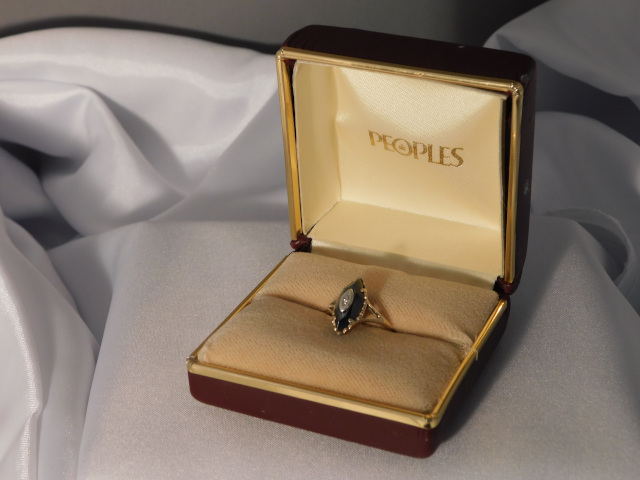
Photo of a ring box with my black diamond ring.

            It was an early birthday gift, given just before I left for a summer job in another province. That was our first experience of letter-writing instead of dates. Our years-long “ordinary” friendship had only months ago deepened into romantic love. No dramatic “falling in love,” no electric glance across the room from a stranger, just increasing warmth in the familiarity of being comfortable together.  

Promise rings hadn’t been officially invented yet, although high school rings were often exchanged (we had not done that). Nothing was actually promised over that black diamond ring, not that I recall. Nevertheless, I quickly discovered why lovers give one another rings, besides to make their commitment more public. A ring is always there, always beautiful. Always a silent affirmation: we love and are loved. That is always a miracle.  

It’s been decades now since I’ve worn it. The thin gold band proved too delicate to tolerate the chores of a household and garden, and the black diamond itself, with its tiny gold clasps, too likely to get caught in sweaters or in fine baby hair. Still, it has not lost its worth as a symbol of our beginning love, even after its place of honor on my left hand was taken by a symbol of much deeper commitment.

The second ring and the third: April 15, 1970 and August 28, 1970.

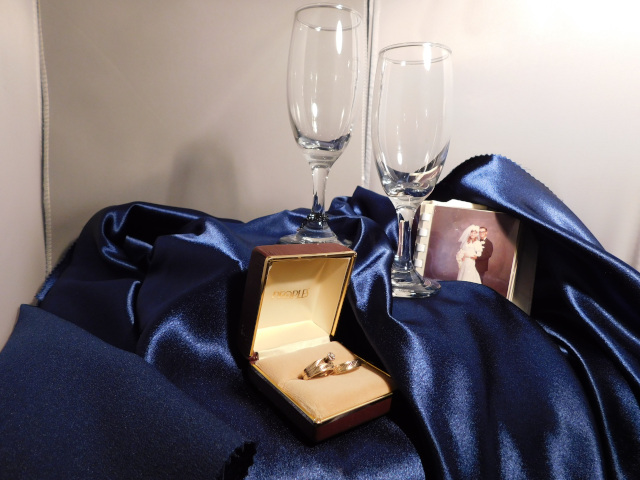
            My engagement ring and my wedding ring were welded together within weeks of our wedding day, after I had caught my hand in a heavy door as I rushed to my university class, and bent both rings badly. I could have taken that as an omen. I didn’t.  

 The engagement ring had been slipped on my finger several days after a long evening spent in a 1958 Chev, parked in a favorite spot by the river. We talked about our future. Both of us were going to be university students in fall, each living on a shoestring budget. No doubt we remember the evening differently: at what point did our half-spoken dream change into a definite plan to share our shoestrings? I couldn’t say.  

Surely it was foolish to become engaged in the middle of exams at the end of my third year of university. I still smile when I remember sitting in some stifling exam room, tension palpable everywhere, and staring in astonishment at the diamond ring on my finger. It’s a wonder I could focus on the exam at all.  

 We began our life together on one scholarship plus one student loan, in a furnished basement suite. We were so confident in our love, so sure that we knew exactly what we were doing and that we were mature enough to face whatever difficulties came. Oh, yes, we did say that. We had no illusions that life “happily ever after” was going to be simple or certain. Of course, there would be tough times. I know now that we had not grasped at all what “tough” would feel like or how long it might hang around.  

That’s a good thing, actually. Love is known best in the midst of loving, not in the fear of what might be. Strength is found in the doing and recognized later in the remembering.   

With this ring, I thee wed

            We exchanged wedding bands in a small church service in the summer of 1970. I was so very happy and proud. We loved and were loved.

Over the years we had to learn to straighten bent conversations and adjust attitudes as we got our rings straightened and strengthened when work or accident tested the gold. No marriage escapes stresses. Those “tough times” we’d been so confident we could handle? They came in guises we hadn’t anticipated. There were some very dark days, when we seemed to be functioning in separate spheres, partly because we were each adapting to new roles on the basis of different family backgrounds.

It is not easy to shift from being single independent adults to being parents of our own children (though they brought us so much joy). Nor was it easy for me to become more responsible for my parents—a change that called for considerably more maturity and self-awareness than I had. A return to graduate studies added more stress and demands on my time. Were we to do it all again, we would make some other choices and seek out more support.  

The fourth ring: August 28, 1995       

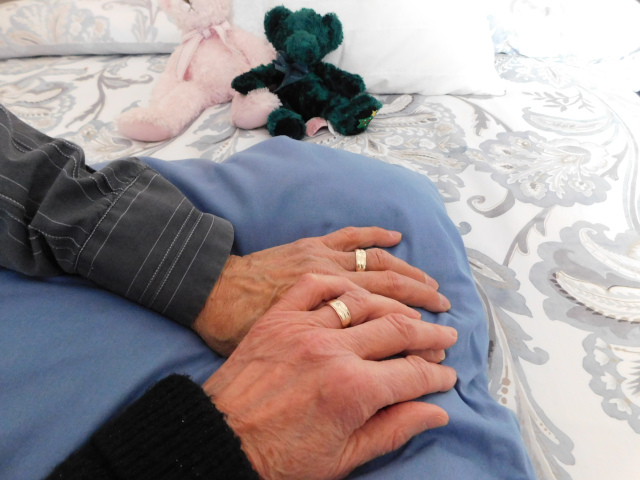
Photo of both our left hands with focus on our wedding bands.

Twenty-five years after our wedding, we went shopping together for new wedding bands. My husband’s ring had worn too thin through years of hard work to tolerate any more straightening; mine also needed repair. It was not only the rings that needed repair. We had traveled a rough road, and it was time to re-evaluate who we were together, and to renew our commitment to love and be loved. Our new wedding rings were simpler, also much wider and stronger, appropriate for our resolve to walk on together in however many years we were granted.

 We have now passed the fifty-year mark of our marriage. It came in the middle of the first pandemic year and right after major cancer surgery for me. Tough times? Yes, indeed. Good times? Absolutely.  

Birthday ring, May 24, 2021

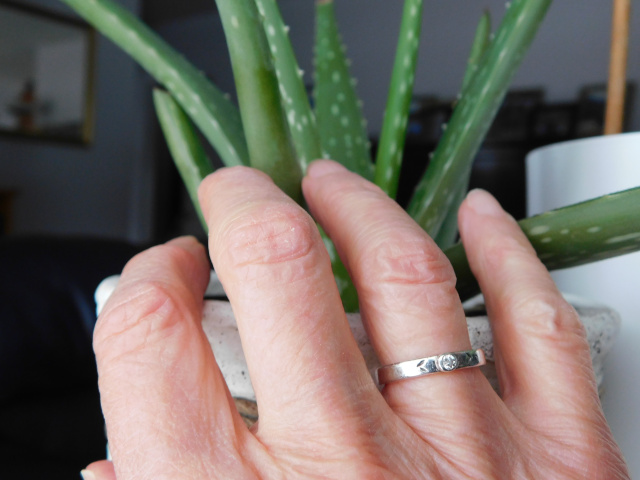
Photo of my hand, next to an aloe vera plant. Focus is on the silver ring on my right hand.

            Although it was a so-called special birthday, the number being somehow significant, I hadn’t expected anything particular. We had had no celebratory parties in the pandemic years. It was enough to have an occasional lovely dinner for two in our house or in the backyard, grateful for our health and for being together. As for gifts? We have what we need, really. Why add more stuff?

 So the ring was a total surprise, yet the longer I wear it, the more meaningful it becomes. It’s silver, not gold, a softer metal, easier to shape I’m told, and comfortable on my arthritic hands. It was made by a local silversmith, who creates jewelry in her spare time. In the years since my husband took up the hobby of making chain maille jewelry, we have learned to appreciate the work and community of local artisans. It is an honor for me to wear this ring.  

In the midst of recent “tough times,” it matters more than ever that commitment has lasted, that the circle of love is there. I’ve heard love defined as an act of the will as much as a feeling; a policy decision as well as a relationship. I agree.  

Love is an act of the will, a policy decision, a long commitment in the same direction.

The story of five rings has an ordinary plot—first dates, engagement, marriage, jobs, children, grandchildren, retirement. Its moments of joy and glory, like those at the Olympics, are made possible through hard work and self-discipline, evident in thousands of ordinary small actions. It’s a story that has been told in some form or another in millions of families, I am sure. Yet every story matters to the ones who live it.

Happy Valentine’s Day to my friend and lover of almost 52 years!

Love is known best in the midst of loving, not in the fear of what might be. Strength is found in the doing and recognized later in the remembering.   

Thinking About Report Cards

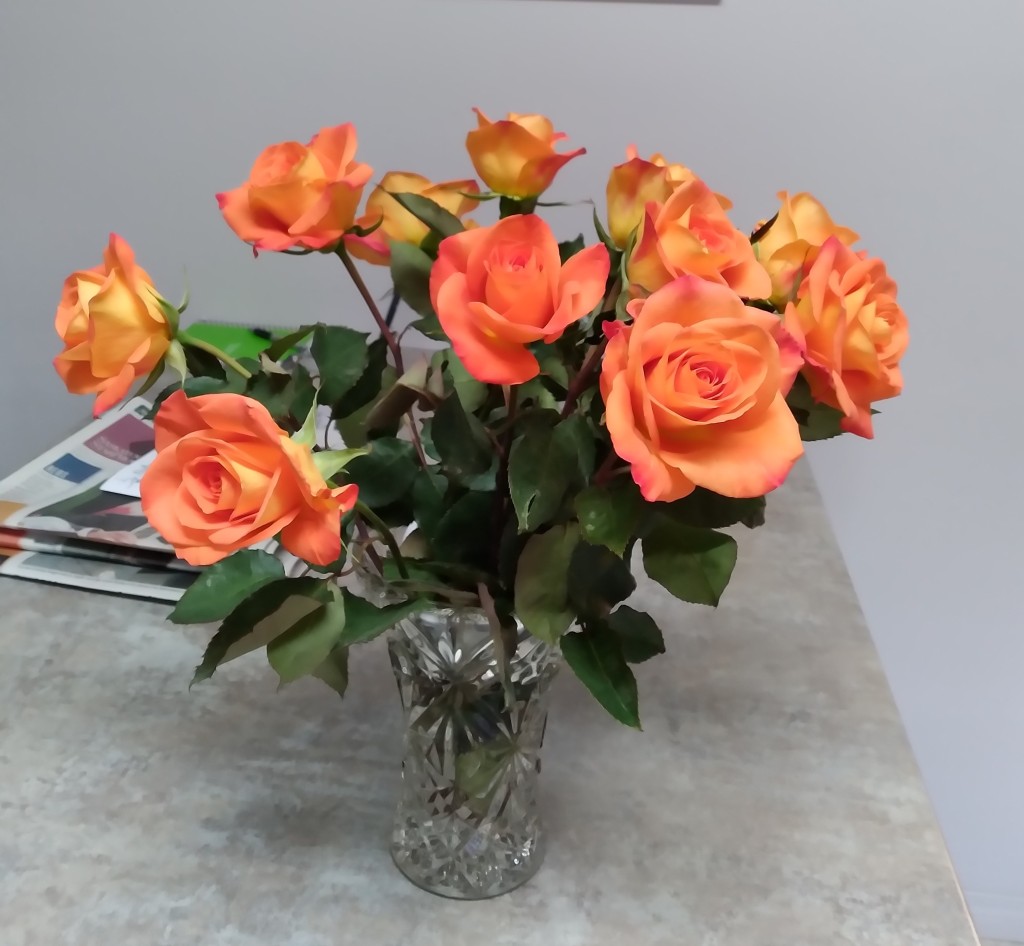
photo of a vase of a dozen coral roses

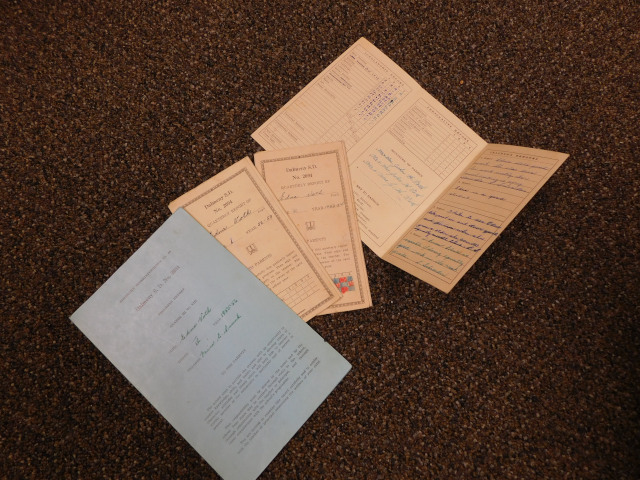
A prowl through a file cabinet drawer, long untouched, revealed a collection of report cards with my name on them (Grades 1 – 12). Oh, my. There were some blunt comments from teachers about my hopeless handwriting—that mattered in those days—and inconsistent work habits, and one anomalous observation on the Grade 3 report card that perhaps as I grew older I would take part more in outdoor sports.

photo of my report cards from Grades 1 - 4.

Remember those report cards, and the trauma of taking them home? Those were the days when children could fail their grade and be asked to repeat it. I was never seriously concerned about that possibility, yet still anxious about what I might have to take home to be signed. Would the report card be good enough that I wouldn’t get any reprimands? My siblings and I were expected to do well in our studies and to conform to strict standards of behaviour. And where there is a clear expectation, there is also the possibility of failing to meet it.  

Which raises two questions, I suppose, with wide application: how clear and reasonable is the expectation? how fair and appropriate is the evaluation?  That bygone teacher who bemoaned my lack of participation in softball had known nothing about the daily hours I spent outdoors walking, exploring, doing farm chores, playing with animals, helping in the garden, even reading in secret places in the nearby bushes. She could not have known that for me solitude in the natural world felt infinitely safer than the ball diamond.   

And I began thinking about the edginess in our societies these days.  I use the plural form of “society” because ever-present social media have created separate cultural groups whose component parts span continents, and because the pandemic has encouraged the creation of very small sub-societies along with huge online silos of rigidly held opinions. No longer do the report cards, in whatever form they take, come only once a year.  

 We live now with evaluations all the time: some are formal, such as work performance reviews, grades on particular projects, peer reviews of publishable articles, demotions or promotions, professional degrees, trade certifications; some are informal, such as the disappointment or delight on someone’s face, a welcome invitation to a social occasion or utter silence from former friends, thousands of likes or brutal online bullying, a stunning bouquet delivered at the door or a package of dog poop left on the porch, acceptance or rejection. There is not much point in railing about the unfairness of evaluation itself—who can ever really grasp everything about someone else’s circumstances or motives?—because we simply cannot manage without evaluations, both great and small.  To be realistic here, I should admit that we have always been living with evaluations; they are nothing new.

 Do we not get quotes for prospective building projects or home renovations? Each business that submits a quote will be evaluated. Do we not develop friendships with former strangers on the basis of our judgment of their trustworthiness and compatibility? Do we not evaluate the politicians who present themselves for office and call for our votes? It’s important that we take time to decide whether trust is justified or not. Will we listen to the cold call we just got on the phone, or slam the receiver on yet another bogus message about credit cards? (It is really too bad that cell phones have no slam option). Will we respond warmly to the chatty clerk or resist what feels like too much sales pressure?

There are degrees of judgmentalism, of course. Some of us are suspicious, automatically assuming that others’ motives must be nefarious at worst, self-interested at best; some of us are more open, assuming that others are well-meaning until we are clearly proved wrong. I am using the personal plural “we” and “us” rather freely here to underline the fact that none of us is entirely one kind of person or the other. Our motives are not consistent; our behaviour is not consistent; our tolerance of risk varies; our ability to learn and change is always there.

 Herein lies the importance of report cards. They do not function only to regulate who is allowed to proceed and who is not qualified for some task (and I know of no society that does not have some such structure for organizing itself). For now, think instead of the personal value for the recipient of the report card, whether it be an actual document with an official seal on it or not.  

  The phrase that comes to my mind is Canadian novelist Adele Wiseman’s description of Abraham, the key character in The Sacrifice. He has visualized himself as a very important man in his small Jewish community; he may be just the local butcher but he’s also a keen student of Torah, a master story-teller, a man of wisdom who “knows” that God has a special role for him. He is, after all, Abraham (and Wiseman gives him no surname). But there comes a moment in a terrible family conflict when the angry words of his daughter-in-law become a “mirror flipped up in his face and he himself stood revealed as he was to another, a stranger. . . (The Sacrifice 316, emphasis mine).  

  That is the function of evaluations. How can we know ourselves without the reactions of others? Child psychologists speak of the importance of parents mirroring the infant’s efforts to communicate. The return smile and the verbal echoes tell the little one that she/he matters. Ditto for the clapping games and the singing and the hugging. The babe is busy discovering a self through parental affection—a process that remains mysterious, despite all the books and much documented experience.  

 This discovering of a self, shaping a self? I understand far too little to hold forth on it with any wisdom. What I do know is that, necessary as unflattering report cards are now and then, equally necessary, in far greater measure, is affirmation of the various selves that we live out in our daily lives—affirmation that is needed in both the giving and the receiving.  

 In these days of way too much judgment and far too many anonymous “report cards” circulating online like some virus worse than COVID, perhaps the best thing we can do is to flip up a gentler mirror that reflects respect: “I see you, and you are a human being of great worth.”

I wish I could show you

when you are lonely

or in darkness

the astonishing light

of your own being.

            (Hafiz)

Photo of a single coral rose.

A Tipping Point

Mano’s Restaurant in Saskatoon

            I will apologize, at once, for an inexcusable pun in my title—I mean “tipping” as in voluntarily adding money to a restaurant bill to pay the server directly. At the same time, I do also mean that we might just have reached a point when we can recognize that tipping is a demeaning, demoralizing, exploitative practice that needs to end.

Now after that provocative statement, I should write a proper introduction and ease all my readers into a topic that requires gentleness and diplomacy:

            Some weeks ago now, on CBC’s The Current I heard Matt Galloway interview Corey Mintz, a chef, a restaurant critic and an author, concerning his latest book The Next Supper: The End of Restaurants as We Knew Them, and What Comes After. Mintz begins with the plain fact that restaurants are among the businesses most affected by the pandemic. All of a sudden, we Canadians, who typically eat out rather often, who can barely imagine getting together with friends without visiting some coffee shop, bar, or restaurant, couldn’t visit any of those places except to take out food to eat at home, with only our household. It was a terrific shock to our system. Now that health restrictions have eased, in some places, and dining out is possible again, owners are having trouble finding staff. That would indicate that something’s wrong. Perhaps plenty of things.

 As I listened to Galloway and Mintz talk about what it’s like to work as a cook or as a server or as an owner, I remembered my own years-long experience as a restaurant server, first in summers only so I could pay for my university education, then full-time for a few years because other jobs proved unattainable and the rent needed to be paid. That meant serving the public, trying to adhere to the principle of “the customer is always right” (although I knew very well that customers could be foolish, ignorant, and downright mean), and depending on the tips to make ends meet. Even then, even when I walked home with pockets heavy from collected change—and bills—I had hated the practice of tipping.

            Here’s why I felt that way, and there’s no ranking order to my objections:

            It allowed my various bosses to pay me the minimum wage without regard to how much experience I had, how efficient I might be in getting the work done, or how willing I was to do the backroom jobs (making salads, cleaning work stations, cleaning the ice cream dispenser, etc.) that not only earned me no tips but reduced the time I could have spent on the floor earning tips. According to Corey Mintz, in some provinces, wage laws allow restaurants to pay even less than minimum wage because of tipping. In fact, Mintz talked about high-end restaurants that don’t pay their staff at all; they “allow” them the “privilege” of working in the establishment, leaving them entirely dependent on the generosity of patrons. This is demeaning. As Mintz pointed out, we wouldn’t dream of paying our dentists or electricians in that fashion. It is utterly unprofessional. Isn’t it time that we recognized that serving food and wine to the public is also a profession and worthy of dignity?

Tipping corrupts the relationship between server and served. I did not initially understand that because my first job was in a private businessmen’s club (and yes, it was only men back then) where tipping was automatic and official. A percentage was added to all bills and given to the wait-staff as part of their paycheque. So I could treat all customers with respect and offer good service, simply because that was my job, not because it might garner more tips. Not until I got into a hotel dining-room, and later into a nightclub, did I realize how quickly servers learn to evaluate all customers according to their tipping potential. The best service is offered to those who are deemed to be well-off and sophisticated. The customer who hesitantly chooses the cheapest item on the menu will not be served with the same alacrity and promptness as the customer who begins with a pricey wine. I was often ashamed of the way that I viewed people as tip-dispensers or tip-withholders, but it seemed inevitable.

 Because customers are tip-dispensers, servers are tempted to see one another as competition rather than as allies. I witnessed angry arguments over who got which section of the dining-room, nasty allegations of tip-stealing off the tables (back when cash was the primary method of payment), refusals to assist other servers unless some portion of the tip was surrendered. There were quarrels when servers lied about their take to avoid sharing more of it with the cooks or bartenders or busboys, not to mention the assumption that one did not report tips on income tax forms. All of that, too, was demeaning.

  Of the deep embarrassment of receiving an exorbitant tip from someone too drunk to tell the difference between a dollar bill and twenty dollar bill, I would prefer to say little. My shame is even deeper when I remember the brief weeks in a nightclub when I gave in to the temptation to overcharge obstreperous and obnoxious customers. My friend and fellow server first suggested it as a way of getting back at customers who were rude and difficult. I gave the subversive practice its name – “an aggravation charge.” It was of no financial benefit to us because the bills were paid to the house, yet it allowed us to feel, briefly, as if we had some agency, some way of redressing the frustrations of having to be obsequious to the most boorish of customers. While strictly speaking, this had nothing to do with tipping, I see now that it was part and parcel of the lack of dignity that with which servers were generally treated then. According to Mintz, that lack of dignity is still the issue. Tipping, after all, had its origins in the days of slavery when one would throw a coin at a slave and demand a dance or other favour.

 In the years after my server days, I dutifully tipped whenever I ate out and encouraged whatever companion I was with to do likewise. What is far more important to me is that I didn’t forget what I had learned backstage in the restaurant. It was my duty – no, my privilege – to treat servers fairly and respectfully. They were fellow human beings who were sharing their time and skills with me, never mind the corruptions of the system which hired and paid them (as little as possible, of course).

            If, in my city, a restaurant was established that made tipping obsolete and paid its staff appropriately, I would happily patronize it – when I’m ready to return to eating out. There is a particular pleasure in savouring a meal without having had to cook it or serve it or feel obligated to help in someone else’s kitchen. All of those are tasks that I have happily done; it’s part of the privilege of living with others and sharing food with friends and extended family. Nevertheless, the joy of eating out and having what Mintz calls a “magical evening” is worth enough that I believe we should extend dignity to all the skilled people who can make it happen. They are professionals, or are on their way to becoming professionals, and I would be glad to know that they have been adequately trained and are paid with a decent salary.

No work is insignificant. All labour that uplifts humanity has dignity and importance and should be undertaken with painstaking excellence.

Martin Luther King, Jr.


Mano’s Restaurant, taken before the dinner hour.

A Bookish Christmas

Photo of an ornament on a Christmas tree.

            My friend gave me an ornament for Christmas, years ago. It’s a tiny wooden stack of books with a teacup on the side. I thought it was perfect; as teachers of English literature, we both knew that Christmas and books go together.

Books are excellent gifts – they offer whole new worlds to dwell in, just when the season and the typical Canadian prairie weather make the very thought of a good book and a comfy reading spot irresistible. Add a hot beverage, preferably a hot rum toddy, and all’s well.

 The connection between Christmas and books was made for me in elementary school. I remember mostly school and church concerts, ending always with those familiar brown paper bags containing peanuts in the shell, candies, a chocolate or two, and an orange. I also remember one car-in-the-ditch-in-a-snowstorm episode; huge Christmas trees in our farmhouse living-room, decorated with homemade ornaments (strings of popcorn, gold-painted walnut shells), a very few presents under the tree, but always plenty of food, including all kinds of traditional cookies.

At school, each classroom had a Christmas box; we drew a name of a classmate and bought a present. That was more stressful than exciting because I worried about asking for money to buy something; money was not given out easily. Besides, I had absorbed my mother’s fear that whatever I bought wouldn’t be good enough.

  Yet there was one golden moment, probably in Grade 4 or 5. I received a book! Could that have been my first? It seems so. In the next few weeks, I must have reread Little Women by Louisa May Alcott several times. And I reread it in subsequent years, too, until the beautiful hard cover became quite shabby. And each time my tears welled up at the scenes of Beth’s death and Jo’s refusal of Laurie.

  I have received many books as gifts since then, always welcomed. There’s something magical about unwrapping a book – what will it be? what kind of world will I be able enter? Will this be a treasured book that I will reread and reread?

 In memory of that gift, I offer to all my readers, not actual books, but book suggestions. Maybe one of these books will invite you into a world that you needed to visit or wanted to visit or didn’t even know that you would be delighted in. I hope so.

            Herewith my eclectic offerings, chosen for various reasons, listed in no particular order, with brief comments:

Guy Gavriel Kay’s Tigana. Not quite the best fantasy ever written (that honor is still held by The Lord of the Rings), but very close. Gavriel Kay creates detailed, coherent worlds with memorable characters and causes worth fighting for. Make sure you begin this one when you will be uninterruptible because the world of Tigana is hard to leave.

Nora Gallagher’s Moonlight Sonata in the Mayo Clinic. The realm of undiagnosed serious illness is not one we willingly enter, yet this memoir drew me in, repeatedly, initially because her spiritual journey was shared so honestly. On my third or fourth reading, during my own illness, her key metaphor of living in the Land of Oz made complete sense. Perhaps not recommended to those who work in health care because their familiarity with that world can blunt the effect of Gallagher’s excellent prose.

Lawrence Hill’s Any Known Blood. I could recommend other novels by Hill, but this is the one I read most recently. His exploration of five generations of one family is both tender and searing; by the fifth Langston Cane, the pigmentation is more white than black, yet the racism is still felt bone deep. It is a troubling tale, yet the strength of the human spirit and existence of genuine goodness is always there.

Richard Wagamese’s For Joshua. This memoir by one of Canada’s best known Indigenous writers is a record not only of what it’s like to fall and fall again, but also of the possibility of getting up again and living through and past the pain. It’s also a story of what it’s like to fail as a parent and yet have something to give to the next generation.

Ken Wilbur’s A Brief History of Everything. For those who want an intellectual challenge, enjoy exploring immense ideas, and delight in imagining what might be possible. Wilbur is a well-recognized philosopher and writer on transpersonal psychology. He can be incredibly dense and theoretical, but this book is accessible and leavened with a quixotic sense of humor. For me, it was a wonderful discovery.  

Kathryn Mannix’s With the End in Mind: Dying, Death, and Wisdom in an Age of Denial. The title is daunting, isn’t it? Even downright off-putting. To my surprise, I was captivated from the beginning. Mannix is a palliative care physician and she shares willingly the wisdom her patients have taught her. She’s also a compelling writer. Each vignette will hold your heart.

Barbara Brown Taylor’s Holy Envy: Finding God in the Faith of Others. Part memoir, part theology – maybe more memoir than anything else. Taylor is the only writer I know who can publish whole books of sermons and be completely readable, engrossing even. In this book, Taylor, a former Episcopalian priest, recounts her experiences in the university classroom teaching introductory religious studies courses. She does field trips, lots of them, and she and her students explore other religions, each from his or her own context of faith or not-faith. It’s an honest book, and a hopeful one. A peace-making book, in fact.

Sara Maitland’s A Joyful Theology. Yes, it is a book of theology, but it’s written by a novelist with a strong sense of story and a marvellous style. It was the “joyful” bit of her title that piqued my curiosity and then I was charmed by her willingness to revisit Christian doctrine in the light of recent astrophysics and mathematics. She handles both the Bible and human discoveries with thoughtfulness, even reverence. 

Anne Perry’s The Face of a Stranger. Which is the first in a very long series of detective novels set in Victorian times and featuring the complex figure of Detective William Monk. Perry’s novels have taken me through the pandemic, offering a blessed escape from the stresses of a polarized, anxious world. Perry’s novels do follow the genre template of detective novels and her own patterns of character interaction and methods of building suspense. However, her detailed depiction of Victorian life, her analysis of characters, and her passionate exploration of social issues have kept me hooked and will keep me hooked, I suspect, until I’ve read them all.

So there you are – a few recommendations among the many, many that I would gladly offer.

I would like to wish all my readers a very Merry Christmas and a Happy New Year.

Another photo of the ornament described in the beginning

What on earth could be more luxurious than a sofa, a book, and a cup of coffee? . . . Was ever anything so civil?

Anthony Trollope

The Privilege of Paying Taxes

Photo of bridge with dramatic span, and cars crossing the bridge. Mountains in the background.

            He was a former refugee, having arrived in Canada after years in a refugee camp. Now he, with his family, was settled in Regina, speaking English with increasing confidence, earning money at a steady job, and planning to begin his own business in the future. I heard him interviewed on CBC Radio’s Morning Edition about two years ago, and remember still the joy and pride in his voice as he expressed gratitude for being welcomed in Canada and assisted by government agencies. He said—and his words startled me—“I can pay taxes now. That makes me feel good.”

            “I can pay taxes.” When do we ever hear that, especially with such a lilt of happiness?

            It helps to imagine probable circumstances. Whether it was civil war or drug lords or religious fanaticism that made life untenable, he had fled, leaving behind his home, his culture, his extended family, his small business, his connections, his religious community, his language, and his ability to earn money. I am myself a daughter of refugees who came to Canada in the 1920s. I have heard stories of hardships, fear, and loss before, yet I was still moved to hear his gratitude for safety and new opportunities.  

            What makes such a transition from destitution to hope possible? That is worth thinking about.  

            These days we’re hearing about unfathomable losses in the wake of flooding and mud slides, overwhelmed water treatment plants, bridges washed out, farms destroyed. For sure, there are many kind people helping in small and big ways, sharing their homes, bringing in feed for the cattle, driving their boats through the streets to rescue the stranded. However, what will make eventual recovery possible is massive funding and other assistance from governments. Military personnel have come in to help with rescues and begin reconstruction. What individuals cannot do alone can be done by organizations created to take care of the needs of the many. And guess what? Those organizations have been established by governments at various levels and are funded by tax money, of one sort or another, as well as generous personal or corporate giving.

            Just when human beings understood that cooperation would improve survival rates, I’m not sure. As far back as we have any evidence, humans have lived in community and have shared resources and skills and energy. Hundreds of years before unions and insurance companies, craft guilds were formed to establish prices for goods, to look after the widows and children of craftsmen who died, and to set standards of excellence. Someone had to administer the funds and someone else had to make sure that there was no corruption. That was in the days when governments (monarchs, actually) funded their appropriation wars with the “spoils of war,” and rewarded their chief warriors with expropriated land and captured women. Feudal landowners took their share of the crops and in exchange made sure that their knights protected the serfs from marauding bands. It was a quid pro quo society where might made right.

            We need not go into the long history of democracy during which, bit by bit, one law after another, some nation states gradually moved toward a society in which laws gained ascendency over the whims of monarchs, and more people got a say in what those laws regulated. Experience over centuries made it clear that a “free” market functions best where ownership of property is enshrined in law, and contracts made can be enforced without resorting to private armies and intimidation. And bit by bit, regulated taxes replaced government seizure of resources as a revenue base.

            Are current democratic governments without fault? Absolutely not. Any human institution on the face of the earth is imperfect and, as we would say today, vulnerable to hacking. Nevertheless, without government institutions (which we hold accountable in every election and through various oversight bodies), we would have no social safety nets, no universal health care system (for all its flaws), no regulated pension plans, no national or provincial parks. Our roads and bridges and railway lines and electrical systems and water treatment plants are either built by government or regulated by government.

            So by all means, let’s pay our taxes. Go ahead and examine tax laws. Ask questions of your representatives in your provincial legislature and in the federal parliament. Check out what your local city council members or your reeves of rural municipalities are doing. No one is above temptation, and it’s often too easy to waste public funds. Those who manage public purses should be accountable to the people on whose behalf they are managing those purses. On the other hand, without public money to begin with, they can do no good for us all.

Let’s pay our taxes cheerfully.

            Let’s pay our taxes and do so cheerfully and willingly. We might disagree among ourselves about what exactly should be managed by the private sector and what should be controlled by public institutions. That will always be an ongoing discussion, and indeed, should be an ongoing discussion.

            However, can we please put an end to the popular assumption that paying taxes is a great evil to be avoided at all costs, including our personal integrity? What might happen to our public discourse if we could actually change attitudes here? What if every child heard their parents say with gratitude, “we can pay taxes!” For the alternative is not being able to earn an adequate living.

            Actually, there is yet another alternative, and it’s the one that has left so many people suspicious and bitter. That’s earning enough money to pay an accountant to find enough loopholes and tax shelters (as if taxes are a terrible storm that would destroy everything) to avoid paying taxes and thus living off the “largesse” of those who have fewer options. The truth is that no matter how much money you earn, or how hard you work to earn it, you can earn it because the laws of the land, enforced by governments, have made it possible, safely and predictably, to exchange property and goods and services for a profit.

            I wish that I knew the name of the refugee whom I heard years ago exulting over the privilege of paying taxes. I would like to thank him for his practical perspective and his gratitude for all that he had received. May his business prosper and may his children receive many opportunities to follow their father’s model of graciousness.

What We Can Choose – Part Two

Photo of a trail leading to a rickety wooden bridge over a creek in the forest.

            This reflection will not be obvious. It considers not the what, but the how and the why and the what happens next. Those are often not obvious at all, partly because our culture has cast the language of choice in the individual mode. I am convinced that that can be misleading. There is no such thing as an entirely “personal” choice.

Shelves of packages of candies, taken in  a London Drugs store.

Let’s start with the trivial: which candy I choose to spend my dimes on (oops, not dimes—dollars!) can hardly matter in the grand scheme of human endeavour. The world seems indifferent to such a choice, even to whether I choose candy at all or potato chips (much more likely – I dislike candy). Yet as soon as we back away from a single bag of candy, the scene changes.

Store owners stock only those candies that sell; the more often I and others opt for lemon drops, the more likely it is that stores will stock them. That then determines what factories produce, and if making lemon drops has deleterious effects on the health of factory workers, then my utterly trivial choice matters. The more candy I eat, the more likely it is that the sugar overdose will affect my health, beginning with my teeth. My health, as it happens, is important to more people than just me.

I could also talk about what I choose to do with the now empty wrapper. Does it end up in the ditch at the roadside? or on the sidewalk beside a park? Out of what was that wrapper made? What was its overall cost?  

Even in the most trivial choices, I am in the midst of a whole web of connections with other human beings.

Shelves of different breakfast cereals, also taken in London Drugs.

Consider another seemingly simple choice: what shall I have for breakfast? Someday, archaeologists will draw conclusions about our culture based on packaging debris that survives beneath the rubble of centuries. Be it Frosted Flakes, or granola, or bacon and eggs, or smoothies with startling ingredients, every selection affects which business grows and which does not, which animals and plants are grown and which are not, which divisions of our health care institutions are overworked and which are not, which tracts of land are cared for adequately and which are not (see Michael Pollen’s The Omnivore’s Dilemma).

 The how and why of all our small choices together reveal our tastes, our values, even the causes for which we’ll be prepared to march in the streets. All of those choices have been created in the crucible of our multiple contexts, some of which have been given (perhaps most) and some of which we have chosen, each choice determining to some degree what follows.

Some choices are made without thought, the variables having been sorted out long ago: I need no conscious decision to walk by the candy store without pausing; I will, however, linger by the camping supply store and linger even longer by the book store window.

 Other choices are far more difficult. Why did I leave one church and eventually settle on a different one? Indeed, why have I chosen to continue to identify myself as Christian? (The initial identification as such was hardly a genuine choice, not where I grew up.) To answer those questions would require long stories, which call for a different venue than this blog.

The point I want to make here is that the choice was not personal except in the sense that I was the one who had to make it. In the end, my choice to leave a church I’d been part of for decades was the result of the influence of people (and some books) who invited me into different perspectives and other people who made it increasingly difficult to remain. No doubt my choice likewise affected others. Just how many or how much, I don’t know beyond the fact that some friendships ended.  

 Since we cannot know all the intricate ways in which our smallest choices might affect so many other people, the least we can do is to remain aware that our choices are both personal and not personal. That is, we do have to choose, many, many times a day even; I am the person whose foot pushes down on the brake or the accelerator—no one else does that for me. At the same time, every choice I make is not only the result of all the overlapping circumstances of my life but will then also affect later choices of mine and of others. Every effect becomes itself a cause.

 In our current climate of anxiety over the pandemic and dire political and climatic circumstances, perhaps two principles could and should be kept in mind. One is that sooner or later our choices (even the trivial ones) will enter the territory of values; they will become moral choices. As C.S. Lewis once insisted, all of our decisions, both trivial and momentous, will make us more of a certain kind of person, and who we become matters a great deal.

“I’ve been considering the phrase ‘all my relations for some time now. . . . It points to the truth that we are all related, that we are all connected, that we all belong to each other. . . . ALL my relations. That means every person, just as it means every rock, mineral, blade of grass, and creature. We live because everything else does.”

Richard Wagamese

 The other principle is connected to the previous one: the well-being of others should come first. That is such a huge statement that it has already filled libraries with books as philosophers and theologians and thinkers of all kinds have struggled to work out the relationship between our instinctive—and necessary—care for ourselves and our equally necessary care for others.

If we look out only for Number One, the society around us is likely to become, or least seem, more hostile. When unchecked selfishness is pursued in high office, the entire country becomes a less liveable place. Jesus once said, “Do unto others as you would have others do unto you” and also “those who would save their own souls must first give them away.” Other religions base their rules of conduct on the same principle, albeit worded in slightly different ways.

 If religious reasoning is not your preference, then scientific analysis will lead you to a similar conclusion. It turns out that human infants do not thrive without love (nor, for that matter, do adults), and societies in which altruistic behaviour is encouraged offer better and more satisfying living conditions.

Robert Frost’s famous poem “Two ways diverged in a yellow wood” concludes with “I took the one less travelled by / and that has made all the difference.” Generations of school children absorbed the lesson that we should be brave individuals and choose to be non-conformists. I would argue that had the narrator chosen the more travelled road, it would still have made all the difference. Choices do that.

A mountain trail, but it's narrow and half over-grown. Only a small sign beside it reassures the hiker that this is an actual trail through the forest.

Oh, I kept the first for another day!

Yet knowing how way leads on to way,

I doubted if I should ever come back.

Robert Frost

What We Can Choose – an exercise in the obvious


Landscape with ocean and mountains very much in the background. In the foreground is a high bluff with dry grasses, one lone small crooked tree and a wooden fence that angles from the bottom left-hand corner to the middle of the right hand. The photo is a combination of wide vistas and a fence that draws a clear boundary between dried-up lawn and wild grasses.

To begin at the beginning—and I said this would be obvious—we did not choose to be born. Or to be born as a human being. However you view the world that you know, whatever framework of meaning you might use to contemplate your momentous birth, you were most definitely not the one who decided that you would be a human and not a tadpole or a poodle or a grizzly bear.

It follows that you also did not decide what hormones would be dominant in the microscopic wiggly something that was your first shape. So one of the first pieces of your identity, which usually determines the kind of name you get, was not your choice. Okay, changing names is an option; even changing gender is now possible. What is not possible to change is what you came into the world with in the first place.

 Ditto for your parents and your surroundings. You did not choose the year of your birth or the location. You did not choose the economic situation of your mother (or her relationship to your father), the color of your skin, your genetic make-up, your biological relatives, your first language, the culture in which you practiced that language, your first notions of spirituality. None of those momentous determiners out of which come so much of what makes you who you are were chosen by you. Not one.  

 So we cannot logically claim credit for any of those momentous determiners of our identity. Nor can we blame ourselves or anyone else, for what was not ever chosen, by us or them.  

 Am I belabouring the obvious here? Yes, I am. Because too many discussions—in our public squares, in our courts, in our governments, in our living rooms—ignore the obvious. Should a child born in a refugee camp or in city slums be despised for being poor? No. She did not choose poverty. Should the child with millions in her bank account before she can count to ten be respected for that very fact? No. She did not choose it or earn it. Should the dark-skinned individual be blamed for her skin? Or be made into a curiosity because of her kinky hair? No, absolutely not.  

 Let me be specific and personal. I do not deserve praise or blame for being a woman or being light-skinned or even for being born into a family and culture that valued hard work and education. Whatever advantages were granted to me simply because of where and when I was born were indeed mine to use or not to use, but I need to remember two facts. One is that not everyone comes into the world with similar choices available; two is that I actually had considerably less choice in many ways than I once imagined. I could not, for example, as a teenager in a small Mennonite town, have chosen to become Muslim—that was not within the range of possibility for me until I was in my thirties or forties probably, once I had actually met Muslims and learned something about Islam.

 We tend to treat religion and sometimes politics as well as if those stances can be freely chosen from a wide spectrum of offerings. Not so. It would, for example, have been actually impossible for someone living in Shakespeare’s time to become an atheist. The very concept had not yet taken shape. One could be Catholic or Protestant—that choice had become available, probably within Shakespeare’s living memory. Mostly, though, one was what one had been born to.  

 To imagine that it is readily possible to choose from many religions is a modern idea not often sufficiently qualified by the fact that our initial worldview, through which we view all subsequent options, is given to us before we are old enough to choose anything. I would argue that “choosing” our political views is equally contingent upon the culture in which we have first learned to think politically and the political surroundings to which we have been subsequently exposed. Surely that fact should temper any impulses we might have to label the “other” party as the enemy or to see ourselves as supremely righteous and clever for belonging to “our” party. Not that changing a political stance is impossible, nor that converting to another faith is impossible. Clearly not. As Viktor Frankl wrote, “Between stimulus and response there is a space. In that space is our power to choose our response.” Nevertheless, an acknowledgement of contingencies that shape habitual responses could help to defuse tense conversations.

Between stimulus and response there is a space. In that space is our power to choose our response.

Victor Frankl

 Popular metaphors regarding the philosophically fraught business of choosing include the well-used image of “playing the hand that we were dealt.” When playing poker or bridge or even solitaire, our ability to choose is severely limited, not only by the cards that are actually in our hand for each round of play but also by the rules of the game. Moreover, how we play our cards will depend on who else is sitting around the table (are they highly competitive, poor losers, cheaters, family members, strangers?) and what the stakes might be (are we playing for peanuts, or laughs, or hundred dollar bills?).

 Theoretical speculation and playful metaphors aside, may I ask as politely as I can, what is going on in the current intensity of political and racial language, all amid an insistence on “freedom of choice”? As if everyone has available all manner of choices.  

Let me try to illustrate: it is highly unlikely that I will choose my response to a police officer on my front step from an infinite list of options because the very fact that I have a front step on which the officer can stand already rules out quite a few possibilities, such as an immediate fear of eviction. The additional fact that it is highly likely the officer will have the same color of skin as I do rules out more possibilities. I will still probably feel real fear, but it will be fear that someone I love has been hurt in an accident, not fear that I’m about to be arrested for something I may or may not have done. In other words, I enter a particular event out of my own context, shaped by various givens, and by the experiences I have lived through before that moment, only some of which I could have chosen.   

  I belong to the Boomer generation; that means that my economic opportunities will have been different than those of my parents and different again from those of my children, and of my grandchildren. My parents were immigrants, so it’s no surprise that I learned the virtues of hard work and education. Then again, my parents were Mennonite and I was a girl, which means that the value of hard work applied but the value of education would have been tempered by certain assumptions about women’s place in the world. Could I have, as a teen, decided I was going to be Christian missionary? Yes, definitely. That option was endorsed by pretty well everyone I knew. Could I have decided to become a politician and hope to become premier of the province? Not in my wildest dreams. Could such options have opened up for me later in my adult years? Possibly, but with great difficulty.

 Buried beneath the obvious limits set by culture and religion and language and economic opportunity is the shaping of the individual personality which unfolds in a mysterious symbiotic process of givens and choices, each of which exercises influence on future choices and even on the terms in which memories are recalled. Psychologists have studied these variables since psychology became a recognized science. Long before that, though, parents have agonized over causes and effects ever since Adam and Eve somehow ended up with a devout and biddable shepherd and a jealous gardener turned murderer.

In other words, we do all have choices to make, important choices, which we make within a range of possibilities, choices for which we are responsible. I’m not arguing for complete determinism, just pointing out the inevitable limits of free will – limits that should curb our judgmental impulses and intemperate rhetoric.

Photo of forest on Vancouver Island but the trees are low except for one scrubby evergreen bent by prevailing winds to a 45 degree angle. In lower right hand corner is a path.

The good news, as I see it, is that if we choose to, we can expand our range of possibilities. While it’s true that we were all gifted with the worldview through which we first tried to make sense of who we were, we can choose to widen that worldview, just by letting ourselves hear other stories. I can dismiss as nonsense your belief that houses should be always immaculate, for instance, or I can ask to hear your story about how that belief came to be yours. In the process of telling and listening, both of us could adjust our perspectives.

  I admit that our capacity to absorb new information is limited. It is not possible to know everything and to hear everyone’s story with sympathetic mind. The first action is limited by the sheer abundance of stuff to know, and the second is limited by one’s emotional and imaginative capacity, which has not been developed equally in all children. Nevertheless, each story I listen to with as open a mind as I can manage will exercise my imaginative faculties and enlarge my perspective.

 Then perhaps I can learn to defer judgment or animosity until I have heard more of the story. That’s a choice that becomes ever more available as I practice it.     

To be continued.  . . . .      

Later afternoon sun on the ocean in the background. Foreground is the author staring through the trees at the ocean, leaning against a bench.