A Gift for Christmas

Photo of cross-country skiing park with hoar frost on the trees and evergreens.

What gift shall I give my readers for Christmas this year? It hasn’t been an easy year, this 2024. Not for any one except the ultra rich perhaps, and then only if you calculate “ease” in terms of dollars or rubles or pesos or whatever currency you will. What with political tensions, economic uncertainties, and storms of all sorts with all sorts of consequences for those who got in the way, the year has been a challenge, indeed.

I do not want to offer a wordy post. The world has heard more than enough words already, not many of which offered hope or even kindness.

Photo of hoar frost on trees, with a little library in the foregrounds.

What I want to offer is the gift of beauty. The kind of beauty that is free, if we have eyes to see. The city of Saskatoon, where I live, has been granted at least two good snow storms even before the official first day of winter. The world here is overlaid with white. In the last two days, weather conditions were perfect for the forming of hoar frost. All is white now, even the thinnest blade of grass and forgotten mitten in the backyard.

Close-up photo of shrub with all branches covered in frost
Close-up of evergreen branches heavy with snow and frost.

If I may, I would also like to offer just a tiny bit of inspiration for the New Year. Resolutions have never been my schtick; I think good habits are formed slowly, with repetition and as a result of both careful thought and growing need, not at the behest of the calendar. However, this year I intend to begin a gratitude journal, a simple exercise of beginning the day (or the afternoon!) with a brief naming of something for which I am grateful. If it brings me all of a few minutes of gladness of heart, then that is already a gift.

May your Christmas be beautiful. Thank you to all my readers.

A tall elm tree with a huge canopy of branches, all white against a blue sky.

Hand-made and Heart-felt: my companion coffee mug

            The gift was given so long ago that I cannot name the day or the occasion. I do remember the giver and something about the maker. I was in my early 20s. The giver was my brother, and the maker was a friend of his, an older woman. She was a kindly potter who understood many things—that I learned later through hearsay, for I remember meeting her only once, in her studio. Perhaps, though, I have only imagined that meeting.

photo of the mug, a small plate with a muffin, a magazine, a linen napkin, and reading glasses.

            The mug was not notable for its beauty, for it was squat and brownish. In those days, had it been left to my choice, I’d have picked something more elegant, like a Blue Mountain pottery piece, then much in vogue and now found only in thrift shops and on collectors’ shelves. What I did notice at once was how the mug felt in my hands. It belonged there – completely. Something about the shape suited my hands, fit the pattern of my holding. I soon discovered that its shape also kept the coffee hot longer, something that mattered to me then already. My coffee addiction developed early.

 In the first years we had together, my mug and I spent many hours in university classrooms. I remember plunking the empty mug in the bottom of my capacious book bag which I schlepped to campus day after day. The mug came with me because I had been inducted, in my second undergraduate year, into the pleasure of long seminar classes. My first one (on Shakespeare) always began with the professor’s ritual of plugging in an electric kettle to begin the process of making coffee, then asking a few “questions to boil water by.” (Yes, it was instant coffee, brand now forgotten – I was addicted to coffee but not yet choosy about what kind.)  Once the coffee had been made, we settled down to work on the serious questions for the day.

 No doubt, the mug was used often in later years, post-university, when babies came to complete our family and transform us from carefree twenty-somethings into responsible thirty-somethings, preoccupied with the weight of parenting and church involvement and bills and house-owning. I have no clear visual memories of the mug during those years, although I am certain that I would have used it regularly. It had been a comfortable (and comforting) companion from the beginning of its days with me. That would not have changed regardless of how busy and distracted I might have been.

 Then came the days of teaching, with an interlude of further graduate studies, and then teaching again – until eventual retirement. My first “offices” on campus were miniscule and temporary. Embedded in my memory are long days of solitude in a tiny carrel in the library, cherished because it had a door and a lock. That meant that I could leave books there, of course, but more importantly, my typewriter (remember those??) and my coffee mug. To this day, sentences flow more easily when my favourite mug sits at hand.

            After I gained a more permanent office in the gracious spaces of St. Thomas More College, where I taught for 19 years, my warm brown mug lived in my office.

photo of my office in STM College. The mug is visible on the desk, and in the background are many books on shelves and a computer monitor.

It came with me to the various classrooms I taught in. Often the coffee was barely lukewarm by the end of the class, and little of it had actually been consumed. What mattered was that I had it in my hand or nearby on the desk. I was convinced that I was then more relaxed and that my students participated more readily in the kinds of discussion on good literature that gave me the “teaching highs” I valued so much.  Perhaps even now, more than 12 years since my retirement, former students remember me with coffee mug in hand. I rather hope so.

These days, that mug, now over 50 years old, lives only in our home. I guard it carefully when we have houseguests, lest it find itself in strange hands. Silly, isn’t it? Surely a mug knows nothing of whose hands fit around its inviting shape. And a washed mug is always ready for the next use by whoever picks it up. But we have a relationship, I insist. It’s so close a tie that even my liking for a particular travel mug that I have now used for some 15 years doesn’t rival it.  

  Its particular virtues? I think the circumstances of its making, in a small pottery studio in a garage of a suburban home in Edmonton, are important. The potter was a gentle woman, an artist, aware of the aches of living, aware of the frequent unfairnesses that hide in the best of places. She did her work with love, that’s certain. Each mug, each piece of pottery was made for its unique self. In the words of poet Gerard Manley Hopkins, my mug had its unique, living character, had its “inscape” from the beginning, and all the various stages of life that it has shared with me have only deepened that “inscape.”  

 Some day, one of our children will have to decide what becomes of that mug. Having survived so many years already, still uncracked and unchipped, despite an occasional fall to the floor, it is unlikely that it will ever be broken, certainly not by me.  

As I ponder its long life—and it is now so imbued with coffee flavors that it cannot be used for tea or hot chocolate or water—I recognize that it has given me one other pleasure: a lifelong appreciation for good pottery. When we travel, we are apt to find small galleries and craft markets (both indoors and outdoors) where we peruse the handmade items, and think about the love with which the items have been made. We have a small collection of handmade pottery mugs now, so that we can share our pleasure with family and guests.

            This Christmas I will once again dunk my homemade peppernuts into my coffee, served always in the perfect mug.  It was made in love, given in love, received gratefully with love.

Photo of the same kitchen table, with the mug now more prominent. Beside is a small bowl full of peppernut cookies,, a napkin, and teapot.
That is a teapot, yes, indeed. It happens to be more photogenic than any coffee pot that I own. Believe me, there is no tea in the beloved mug.

Grounded

“It turns out that groundedness requires actual ground.” (Jenny Odell)

            The words startled me. “Being grounded” is such a common phrase, often used vaguely with feel-good associations, although it still means generally good sense and balance. Odell’s abrupt return to literalness jolted that worn out metaphor straight back to its original earthiness, which then prompted me to consider what kind of ground I personally required for being “grounded.”

Two kinds of ground, I concluded: one was dirt itself, dirt on my hands, on my knees, underneath my fingernails, as I tended the plants I loved. That dirtiness I shall return to sometime in another posting. The other ground is less immediate – quite distant, in fact. It depends on sight rather than touch. I need to see a long, long way, toward the far horizon, where the earth gently touches sky. Then my very self is reduced to smallness even as I stand anchored on the ground beneath my feet.  

View of the ocean in Victoria, BC. Overcast sky with late afternoon colors.

The connection to the first kind of grounding—dirt—I have long understood as vital to my well-being. I am a gardener and gardening is not optional. The second kind of grounding—a move into mystery through infinite expansion of view—I have also always loved but not understood as being, simultaneously, a solidness of footing, as much emotional as physical. The first is a function of doing, which lures the soul into forgetfulness through the simple and absorbing tasks of touching. The second is a function of being, in which the self disappears into pure perception.

 There are landscapes that feel like home, and landscapes that are foreign. Born and raised on the prairies, I am not naturally akin to the ocean. I own cross-country skis and hiking boots, not the accoutrements of living next to water (canoes, boats, sails, life jackets, anchors). While I have canoed, a little, and ridden in the occasional boat and on a ferry, I remain a tourist by the sea, not a native. Walking on a beach feels exotic. It’s an adventure, not a home-coming.

Yet the distant horizon slows my breath and steadies me. It is beautiful – that insubstantial meeting of air and water. I cannot gauge distance. Who I am matters nothing; I am infinitely small. Except that I remain the still point of perspective. My feet stand on ground, sand, rock. The foundation is there, and from that foundation all human endeavour is exposed as temporal, conditional, while both rock and sand – and water – are forever.

Mostly sky with brown prairie hills.

            Fortunately for me, the actual ground required for emotional and spiritual grounding does not have to be at the edge of a body of water. Prairie landscapes, in which I am at home, also offer magnificent distance, a forever postponed horizon. Accompanied so often by equally endless wind that blows trivial concerns out of mind and heart, the untouched prairie offers a different kind of solidity that pays no heed to individual ego. I am small here as well, and perhaps even more vulnerable. There’s no place to hide. But then also no need to hide. Blessedly, my various identities and loyalties matter little against an overwhelming awareness of Otherness.

More than ever, I know that I belong to Earth. I am human, I am fallible. Though I stand alone in the moment, I know that I am not alone. My smallness is not demeaning; it is humbling and comforting all at the same time. 

Harney Peak in South Dakota. Many smaller mountains in the distance, in a bluish haze.

            There is a third landscape through which expanded horizons foster inner balance. It does require a definite physical commitment and an immediate experience of several kinds of literal ground along the way. Truth be told, this is the one that speaks most intimately to my heart. To stand at the top of a mountain pass, from which the eye can see across miles and miles of rock and soil, is to know oneself insignificant yet joyfully exultant in that diminishment. The very air one breathes is thin, and the line between the earthly and the heavenly no longer discernible.

            [Can pettiness and cruelty and selfishness stand against so much beauty? I wonder, could we require all politicians seeking office to spend two weeks living on actual ground and surviving on limited rations? Two weeks is probably not nearly enough but it could be a beginning. And I’m not sure if those two weeks should be spent in complete solitude or accompanied by an appropriate guide. Perhaps two weeks of each? Repeated regularly throughout the term of office?]

 Lest you be tempted to think that the view of the ocean from the penthouse suite would do just as well and require little effort or that the view of the mountains can be achieved from an airplane window or an abominable skywalk thrusting itself where it has no business to be, let me clarify: the ground beneath your feet is not optional.

Trail on Mt. Revelstoke in BC. The slope is rocky and a lone figure stands on the trail silhouetted against the sky, with more mountains in the distance.

 The power of the seascape is strengthened by the pebbles your fingers caress after your bum has wriggled into a comfy place on the sand. The vast prairie sky demands also the prickly grass underfoot and the whirring grasshoppers that fling themselves against your legs. Any soul-ish benefit the vista of the mountains might offer happens only after your boots first found balance on many rocks and tree roots. Let there be no glass and brick between you and the scents of the scene. If you would be grounded, the majesty of far-seeing cannot be turned into a saleable “view.”

Another photo of the beach in Victoria, BC. This time more of the beach is visible with plenty of driftwood.

            Groundedness requires actual ground – always.

A Gardener’s Lament – and Praise

            A year of neglect is all it takes, I now know, for a garden to lose its joy. Growth will continue, of course, Grow is what gardens do. Unchecked, unweeded, unpruned growth, however, is not the kind of beauty that gardeners aim for.

I had been looking forward to this summer, rejoicing in restored health, anticipating a summer of reclamation: joy in fresh veggies that I could once again harvest myself, pleasure in picking berries, and deep satisfaction in rejuvenating a run-wild perennial flower garden.

Photo of our front yard with brick patio and two diverging paths. Lots of green foliage and not much in the way of flowers. One shrub has almost covered a window.

            That all happened, for sure, but so did a succession of unexpected losses.   

            The first was among the lilies. Decades ago, even before we turned our once boring lawn-only front yard into mostly garden, I had begun growing lilies. Previous owners had bequeathed me some tough, grow-everywhere tiger lilies. I added more lilies, plenty of them. One of my favorites was “Lilium – University of Saskatchewan,” bred for university’s centennial in 2007, proudly bearing the colors of white, gold and green. Altogether the lilies had formed a stand-up chorus around our bird bath in our front yard and a more subdued pink border in the shade of our back yard.  

Photo of many white lilies and some orange ones.

 I vaguely remember hearing about an infestation of the red lily beetle, but paid little attention. This spring, a friend noticed the invading red lily beetles in my front yard lilies, and explained that to deal with the voracious little pests (also part of the natural world, I admit), I would have to find all the eggs and grubs and squish them. And find all the beetles, so adept at dropping to the ground upside-down and making themselves invisible. Applying poison was also an option but I’m not a fan of spreading chemicals to control whatever isn’t perfect or pleasant.

 In my mind, a scorched-earth policy seemed easier. I astonished myself with my quick decision to dig up absolutely all of the lilies, every single one of them with its bulb and any baby bulbs, bag them and toss them into the garbage. Sending them to the city compost facility would likely just spread the problem. Over the summer, I noted that some gardeners had been diligent enough to save their lilies. I had not been able to find the will to attempt it.  

I told myself that I had enjoyed their beauty for many years. Now it was time to say good-bye. The dirt was barely shaken off the spade before I was thinking about what I could plant to fill the newly opened spaces.

Photo of front yard, without any lilies by the bird bath.

            A similarly impulsive purge of hollyhocks happened later. Those had been planted more recently, partly in memory of a friend and colleague, also a gardener, who determined that he would live long enough with his cancer to see one flowering of hollyhocks (they bloom only in their second year). There had been a time when I despised hollyhocks as the kind of thing that grew in back alleys and wherever householders were unwilling to put in much effort. They seemed untidy, even aggressive. Yet after seeing a thriving stand of black hollyhocks, I determined that I would grow a combination of pink and black hollyhocks alongside our back fence, so they could delight us as well as passing pedestrians. I thought they would be easy.

 They weren’t. New baby plants grew where I hadn’t wanted them; mature plants didn’t always bloom well for me. I became frustrated, especially when only the pink ones survived the winters. This spring, once again, the leaves turned yellowish and spotted, leaving the plants stunted, unproductive, and frankly ugly. Hollyhocks seem prone to a fungus (or rust) that’s not easy to get rid of. In a fit of pique and resentment, fuelled partly by my growing awareness that I was not going to catch up on gardening in one summer, the hollyhocks were condemned to follow the lilies into the garbage bag, every single one of them, wee ones and all. Another loss.

            A third loss for which I hold Mother Nature responsible is still partial. The final word has not yet been spoken regarding our sour cherry tree. Trees have come and gone in our yard before. Indeed, this Carmine Jewel sour cherry tree was relatively young, had only come into its fruiting prime in the last couple of years. This year’s crop was so abundant that we anticipated many ice cream pails full of fruit.

Photo of sour cherry tree, heavy with fruit.

Then the grim discovery. Almost every cherry came with a wee white worm – the larvae of the cherry fruit fly. We had little choice but to pick every single cherry and collect every dropped cherry on the ground and send the lot to the city’s composting facility. The loss here—if we decide to keep the tree and see what next summer brings—consists of delicious cherry pies, cherry coffee cakes, muffins, scones, and excellent jam. That is a loss we can sustain without genuine hardship. Indeed, the loss of the lilies and the hollyhocks also caused no real hardship, but then gardening for us had not been about survival, but about beauty and taste, a different kind of necessity.

                        What I have been pondering during this summer of loss—and I am refusing to discuss at this point our greatest loss, that of Jasper, AB, which we thought of as our second home—is the integral relationship between loss and growth.

Photo of Lac Beauvert with Jasper Park Lodge barely visible in background. The reflection in the lake is perfect.

The trivial loss of lilies and hollyhocks and sour cherries has made way for new flowers and perhaps another tree or just more space for veggies. Anyone who gardens much at all knows that nothing stays static in a garden. It is the nature of things for some plants to reach their end stage while others begin anew. At least one neglected yard in our neighbourhood has made clear to us that unchecked growth just becomes a tangled mess; the lack of diligent pruning and adequate spacing simply means that the entire garden destroys itself.

 Just as Canadian National Parks officials are learning to listen to the wisdom of Indigenous peoples who have always understood that fires are necessary periodically to open up space for new growth, so the urban gardener needs to work with the natural processes of growth, death, and new growth. Without loss there is no growth.

Without loss, there is no growth.

            Can I take that natural lesson into my heart and face other, deeper, losses with greater equanimity? It seems hard, even somehow disloyal. Surely it can’t be right to insist that losing something might be necessary in order that something good might develop.

Yet the universe once again dropped the right book into my hands at the right time. I just “happened” to pick up Rabbi Wolpe’s Making Loss Matter from my library. In his foreword to the book, Mitch Albom writes, “all of life is a series of losses, which, if woven correctly from the sadness, can stitch a richer emotional fabric of our days.”

Wolpe explores that series of losses in a roughly chronological order: home, dreams, self, love, faith, and life – the sequence of losses that we’re likely to sustain if we live a reasonable life span. Through tender stories and gentle wisdom, he evokes the pain of loss and points out, repeatedly, that without such losses, growth is impossible. Loss is meaningful, because it opens doors to wiser dreams, deeper love, stronger faith, and richer life.

If I bear burdens
they begin to be remembered
as gifts, goods, a basket
of bread that hurts
my shoulders but closes me
in fragrance. I can
eat as I go.  (Denise Levertov, “Stepping Westward”)

            The losses of this summer aren’t over yet. Besides the annual replacement of summer’s fruit and flowers with the glorious colors of autumn’s many deaths, I will be choosing some particular endings. As our front yard becomes more of a shade garden with the steady expansion of our linden tree, the loss of sunshine space means the end of growing dahlias.

They gave me much joy in summers past. Now those tubers will go the way of all organic entities, although some may be spared as gifts to friends. Ditto for the calla lilies I grew for a few short years. The labor of lifting bulbs and tubers and storing them over winter will be replaced with the happy purchase of brilliant annuals next spring. My body does not have many more summers of full-scale gardening left. Therefore, I shall seek as many brilliant colors as possible, and love them as long as they last.

Photo of bird bath flanked by tall grasses behind it and by many bright yellow rudbekia in front.

“Can You Make It Undead?”

A forget-me-not border around our patio in a good year.

            That querulous question was once asked by an unhappy amateur gardener who called the University of Saskatchewan’s gardening help line to complain about a fruit tree that had not survived a harsh Saskatoon winter. I laughed when my friend told me that story. “Undead,” indeed!

            I was not laughing earlier this spring when I stared at the brown clumps of deadness that had been, only a year ago, a stunning border of forget-me-nots halfway around our front patio.

The teensy bits of green in this photo are weeds.

The flowers are tiny, yet such a gathering of unearthly blue is unforgettable. I had first met their alpine cousins in the high places of the Rocky Mountains where I feel closest to heaven. To grow a domestic cultivar here in the prairies had given me so much joy.    

That they should be lifeless this spring was bitter heartache. I was not surprised that our erratic yo-yo winter of too warm, then nastily cold without adequate snow coverage, would result in some casualties, but the precious forget-me-nots? That was too cruel. After all, our rose bushes survived. So did some vulnerable new perennials planted last year. I grumbled at the unfairness of it all.

            Then out of the dead clumps that I hadn’t been able to make myself pull out, a few tiny leaves appeared, weeks after the plants should have greened up and bloomed. I have scarcely dared to rejoice for fear that recovery might still be elusive. Yet day after day, the defiant re-emergence of new life continues.      

a photo of 4 tiny forget-me-not flowers in the midst of dry wood mulch.

            With a beautiful synchronicity, the resurrection of those beloved forget-me-nots occurs as two other recoveries, both also connected with gardening, occupy my thoughts.     

Last year at this time, I was looking at the world from a mostly horizontal position and through eyes dulled by drugs and disappointment. June is normally a joyous month. It’s the month of gardeners’ delights: new seedlings up, trees and shrubs leafed out and blooming with abandon, first berries ripening. It’s the month of endings and beginnings: winter’s over, school’s almost over; vacations are planned and long, light-filled evenings encourage family picnics and grad parties. June has the summer solstice—the longest day of the year in the northern hemisphere. Who wouldn’t be happy? Why not have dinners outdoors, with birds providing musical accompaniment?

 Last year, all those joys passed me by as I struggled to manage sciatic pain and accept a disabled, dependent state. As if in tune with my discontent, the weather was unseasonably hot and dry, and then became even more miserable because of persistent heavy smoke from out-of-control wildfires in Saskatchewan, Alberta, and even BC. 

That was last year. This year, while I could complain (and have) about unseasonably cool temperatures, I spend my days upright, walking, cycling, working in the garden—simple pleasures, those.  For me, they feel like resurrection. I have recovered my mobility and my avocations. There’s even a camping trip in our future, planned for July. Hallelujah!

My transformation was not instantaneous. It was slow, sometimes so slow that I was bitterly discouraged, and increasingly resentful of the frequent question “you’re still not better??” For the patience of my family and for the tender, persistent care of physiotherapist and doctor, I will be forever grateful. Recovery is a beautiful word; it holds within it an intimation of the power of life, of goodness. It tells me that “undead” is not laughably impossible, after all.

A photo of the book cover of There Is A Season.

With the quirky serendipity that our universe so often displays, free of charge, the right book once again fell off the shelf. Canadian poet Patrick Lane’s There Is a Season had been sitting on our bedside bookshelf for many years. I cannot even remember when I acquired the book or where; the penciled price inside the cover (a mere $2.50), indicates a second-hand book sale. Wherever it was, I got a magnificent bargain. Yet having bought the book, I neglected it. My initial perusal of the first chapter must have happened at the wrong time. I was actually on the verge of consigning the unread book to our little library when something led me to open the cover again.

            And I was immediately drawn into what writer Alice Munro called “a state of enchantment.” There Is a Season (published 2004) is a profound recovery narrative, a recovery so unlikely that I felt overwhelmed to witness the power of gardens to restore their gardener, of human love to accompany a lost soul, and of the strength of the human will to persist in spite of all obstacles.  

Patrick Lane, renowned Canadian poet, wrote the book, his first prose publication, during his year of recovery from a lifetime of addiction to alcohol and cocaine. He and his partner, poet Lorna Crozier, lived on a half-acre on Vancouver Island, an excellent place for a life-long gardener. Working on his developing gardens, Lane gains the strength to face his memories of past family pain and trauma, which he shares with honesty and compassion. There is no blame laid here, nor is there any shrinking from the hardship and violence he experienced in his childhood and early adulthood.  This is a deeply vulnerable book that explores both great sadness and enduring love.

What amazed me was that his drive to write poetry, to explore the magic of words, began in his childhood. Never mind that he had to teach himself all he knew of literature and the poetic craft. He became a recognized poet, winner of several awards, teacher of creative writing in several universities, recipient of an honorary doctorate from McGill University in Montreal.

There Is a Season offers some of the finest nature writing I have ever read. Every word feels lovingly chosen and deftly placed. Among the tributes printed on the back page are two particularly apt observations: “A brave and beautifully written account . . . . The sheer richness and beauty of the language is one of the great pleasures to be found in this book” (Edmonton Journal); “A tour de force that will break your heart and put it back together again” (Montreal Gazette).  

For me, the book was, and is, a gift. I am almost as awed that I should have chosen, finally, to read this book, just as I was beginning to grasp that I was, after all, returning to “normal,” not some “new normal” that I had dreaded for so many months. Not that my recovery was anything at all like the recovery that Patrick Lane describes. I had had merely a few weeks of pain and then many weeks of minimal progress; Lane was learning an entirely new way of being.

            My forget-me-nots have become “undead.” It has taken time. More and more, I believe that the profoundest miracles are not instantaneous or even obviously miraculous. Both hope and its consummation are often subtle, always persistent.

A cluster of forget-me-nots at the edge of our brick patio.

” No matter the dark hours when we ask that our burdens be lifted, ask instead that hope be how we live, our hands sure in the earth.” (Patrick Lane)

Throw Something Away

My to-do lists and I have a complicated relationship. Sometimes for weeks on end, I write nothing down and simply choose tasks and activities according to impulse or urgency.  Then a sudden attack of ambition—or guilt—drives me to write down job after job in a frantic effort to make my days profitable and braggable, even if only to myself.

Photo of a couple of lists.

It’s not only hands-on tasks that are thus named and conquered. I have used to-do lists to bolster mental health and encourage good habits. For months during the pandemic, I began each day by writing down a reminder to be grateful for something, to talk to at least one person besides my husband, and to clean up something no matter how small or inconsequential. It was my bid for continuing sanity in the midst of a world that I didn’t recognize.  

            Now—yes, I am once again friends with to-do lists—I have chosen a new daily mantra: throw something away. This is not a new zeal for tidiness and/or efficiency. It is a growing awareness that our days in our beloved bungalow with its expansive yard designed for gardening and playing are probably numbered. Our bodies are aging, as everybody’s does. At some point, the maintenance of house and yard is going to become more work than we can manage safely and pleasurably.

Photo of our home and front yard.

Hence, my desire to steal a march on what might well become a frenzy of selling, giving away, and throwing away. I want to be able to take time for small sentimental objects, treasured jewelry, memory-laden clothing not likely ever to be worn again. I also need to confront the habit of saving all manner of things and strings in case they should be of use (inherited and absorbed from my parents whose adulthood was shaped by Depression-era necessity). I would rather not let it edge into the pathological.

Photo of several ID cards, some jewelry, a couple of tiny keys, a brooch or two.
Just how many outdated and irrelevant ID cards does one need to keep?

My perspective here has most assuredly been influenced by several close encounters with hoarding disasters. I happened to be the sibling who managed the greatest portion of the disbursal and disposal of my parents’ worldly goods. (I shall say nothing here of what it means to manage the emotional goods that parents also leave for their children.) Repeatedly, I was aghast at what they had chosen to keep through three separate moves: cans of paint for buildings on the farm now owned by someone else; appliances designed for subsistence farming, not urban kitchens; food past its expiry date; sewing notions for garments not worn in decades; carpet samples from a previous house; left-over wood from finished and unfinished projects; empty prescription bottles; excerpts of ancient letters; addresses for long-deceased relatives; birthday cards received 50 years ago; a few old diaries; immigration documents. Alright, I could understand why a few of those items remained. How could one throw away the precious piece of paper that signalled freedom in a new country?  

I could find no similar understanding for two neighbours who turned out to be hoarders of monumental proportions, making my parents look like minimalists. Watching the garbage collect in backyards, plants and shrubs grow unchecked into monstrous tangles, packages and parcels enter the front door in a never-ending march (until the front door was no longer accessible because of the stacks of unopened boxes, both inside the house and on the front steps)—oh, it was a sight to chill the soul. How could they have let mere stuff so dictate their lives? Indeed, allow that stuff to dictate the manner of their dying?

Such memories haunt me. They have propelled me, every now and then, into cleaning binges. However, I can also appreciate the irony of where I now stand on stuff, so to speak. While I can easily discard some incidentals, the longer we live, the more the things around us are likely to have accrued sentimental value. Some of the paintings and photographs that grace our walls have been given us by grandchildren. Their artistic projects now bring smiles each time we see them. Some items we have gifted one another or have chosen together to commemorate a special occasion. It’s all that added value, that rich sum of all the living we’ve done, that makes parting with those items harder now.

Our decisions about throwing stuff away are complicated as well by our awareness that what we’re actually doing is deciding how we wish to be remembered when we’re gone. The fragments of identity that we have shored up to remind ourselves who we are may not be necessary for us anymore, but will they matter to our children, who are likely still negotiating who they are and will become in relation to their past, which is inextricably connected to our past? I cannot forget that I gained self-awareness and more compassion as I learned more about my parents’ experiences. What bits of my “stuff”—the old letters, the photos, the sewing patterns, the published articles, the journal notes—are going to be important for children or grandchildren?

I have no way of knowing that, of course. And perhaps, what should happen in this binge of throwing away stuff is also a throwing away of my anxious need to control more than is reasonable. After all, I would have fiercely resisted any last attempt by my parents to determine what I did and what I could know. Surely I can let go of any fantasy that I can shape what our descendants will do with their own histories. It has been labor enough for me to make friends with my own story.    

We should probably all pause to confront our past from time to time, because it changes its meaning as our circumstances alter.

Karen Armstrong

Ticket to P(R)ide

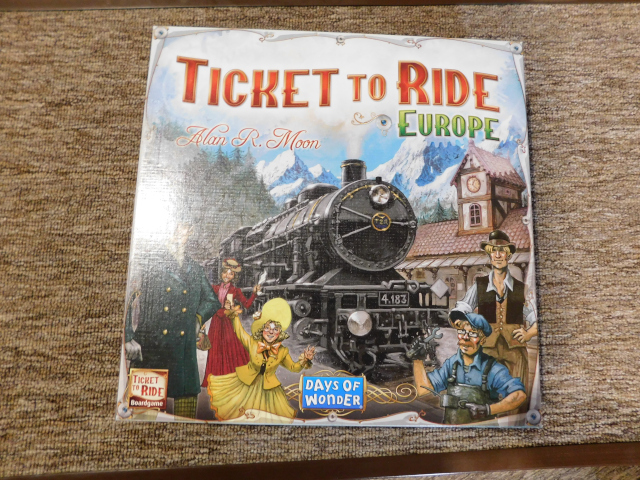
Photo of the game box of Ticket to Ride.

            In a world in which nearly every imaginary activity has been gamified and even “gaming” became a necessary new noun, I’m going to dare to write about old-fashioned board games. Yes, those games that come in cardboard boxes and are laid out on the table for the family to play, using dice and cards and little plastic people. What an anachronistic activity! Oddly enough, though, board games are still popular, if one can judge by the seasonal pop-up kiosks in shopping malls selling paper calendars (another anachronism!) and board games, both old and new. Apparently, the artifice of moving pieces on a board still holds some appeal.  

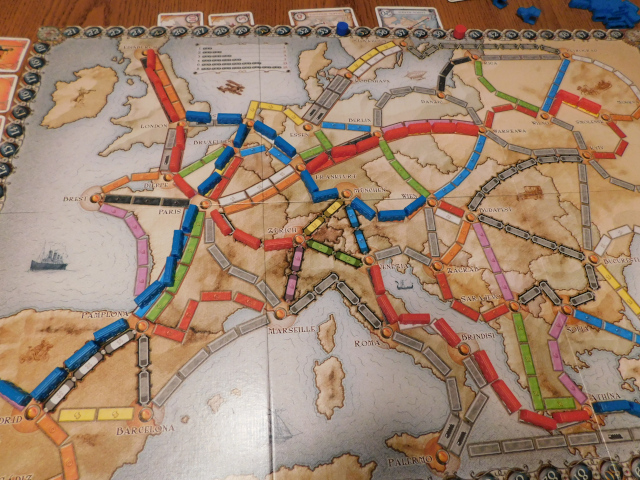
Photo of the board of Ticket to Ride with a game in progress.

            It was by happenstance that my husband and I discovered we had not fully understood either the rules or principles of Ticket to Ride, a discovery that changed my feelings about the game to a degree that I found disturbing. I’d never really paid attention to why I liked some games and disliked others. Now I needed to figure out what had really changed in my attitude to Ticket to Ride and if that mattered in any way. It wasn’t just an objection to a seeming rule change; given how freely we had adjusted the rules of Brazilian Rummy to make it more playable for just two people, I clearly did not feel that rules were immutable.

            When attitudes and behaviors seem inexplicable or downright weird, it usually pays to look back as far as necessary to work out what’s going on. In this case, that meant saying “hello” once again to my childhood self, that shy little country girl with minimal social skills.

 In my family of origin, games were played only on Sundays when work was not allowed. Often those game-playing sessions were enhanced with home-grown, freshly roasted sunflower seeds or still warm popcorn. These are some of my happiest memories of farm life, albeit not without shadows.

I was the youngest in the family, by a margin of 6 years, so games that required strategy or skill were impossible for me to win, unless someone let me win, which, I realized fairly early, was an insult of its own. So unless some element of randomness was built into the game, I wasn’t particularly interested.

 Strategy vs. chance: surely the makers of games have always grasped that much depends on the balance between those two. There were those in my family who definitely preferred checkers and chess, especially the latter. Both players begin with identical playing fields and number of pieces to march toward victory. The board is a battlefield that is level in all senses, and all possible moves are clearly delineated and equally available. There are no dice and no cards. Checkers and chess are games of intelligence only. There is some built-in aggression (the third key factor in games), since pieces are mowed down along the way. However, each assault on the opponent’s troops carries definite risk to one’s own. There is little tactical benefit in “killing” for the sake of “killing.”

            My father, I recall, never played Snakes and Ladders, which is entirely chance: the roll of the dice determines everything. (The moralistic notes on the board that connected ladders with good behavior and snakes with naughtiness were completely negated by the way the game was actually played. One can’t help but think of the way that good behavior has become suicidal in politics these days and naughtiness simply extends influence and power).

He also had little patience with Sorry (which I really liked) because while there were some limited choices, so much was determined by the luck of the draw that there was little pride in winning. Possibly my father had had more than enough randomness in life (he had come to Canada as a refugee) that he did not willingly tolerate chanciness. Not that he was averse to risk, per se; he just wanted as much control over the degree of risk as possible.

 Monopoly was another game that we often played; it did include some randomness—players roll the dice for every move. Mostly, though, it depended on economic strategy. It was capitalism in miniature. And I do not recall ever winning a game. Monopoly’s one virtue was that it didn’t lend itself to open aggression among players; winning didn’t depend on deliberately sabotaging someone else’s opportunity to make money, except by capitalism’s inherent principle of taking advantage of an opponent’s fiscal distress.   

 Interestingly, I recall laughter accompanying Monopoly, at least in the early stages of the game before the bankruptcies began. There was laughter with Sorry and Pit and Crokinole and other vintage games. There was no laughter at the chess games. Intellectual ability was on the line, and intellectual prowess was highly valued.

            So, back to Ticket to Ride.

We had not figured out that the game was designed, not only to require strategy (every turn involves some choices), but also to reward sabotage of other players. Suddenly, the game felt less benign. My husband and I had enjoyed the game so much, I think, because it required us to think carefully and to work with whatever cards we were dealt (that element of chance), but left the inevitable interferences with one another’s trains also to chance: skill plus chance in a ratio that minimized the importance of winning or losing. There was little personal pride at stake: it was the process that was fun.

 We have watched our children and our grandchildren play board games – and we played with them, of course. As any elementary school teacher could have told us, not every child can handle the competitiveness fostered by games that depend on aggression as part of the winning strategy. One game, rarely played by our children and played only once by grandchildren, was actually named Aggravation. The entire point of the game was to be mean to your opponents.  Granted, there was a substantial element of chance in the game, but not enough to neutralize its corrosive effect.

  It has been fascinating to observe a new trend in board games: cooperative play. The competitive element has been eliminated and players are all on the same team, facing the challenge posed by the game itself, each contributing some skill to the communal effort. I have not played such games enough to speculate on what has happened to the role of chance in these new games. No doubt much research on precisely that element has already gone into their design.

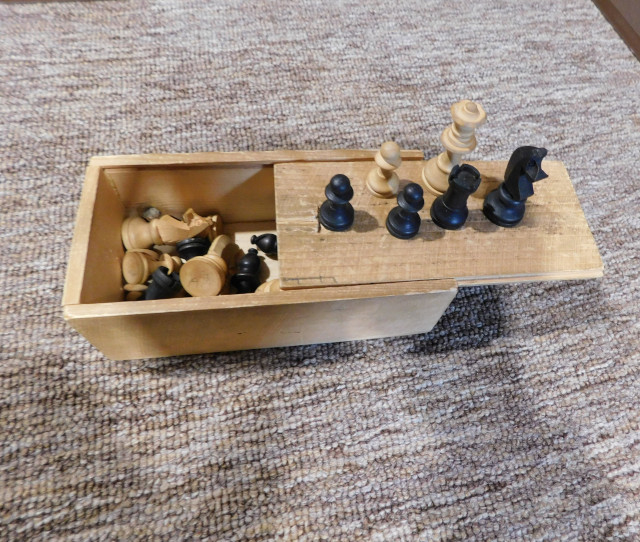
            For now, my brief visit to the past has not only helped me to make peace with Ticket to Ride—as long as we can “adjust” rules to suit us, there’s no problem—but has also ended my sentimental attachment to the now very old board games that still sit on our library shelves. The time has come, I think, to dispose of some ancient paper money and some deteriorating game boards. I hope that I can find some recipient for the antique wooden chess pieces, since it seems a shame to consign those to the garbage.

Photo of a small wooden box containing wooden chess pieces.

            What I should consign to whatever dustbin holds mental behavior patterns is my competitive desire to win at games, however chancy they might be. I hereby admit that I have never been immune to the allure of beating the odds. After all, my pride is at stake.

Two Deaths That Matter

“In truth, all deaths matter. What I say is simply that these two matter to me.”

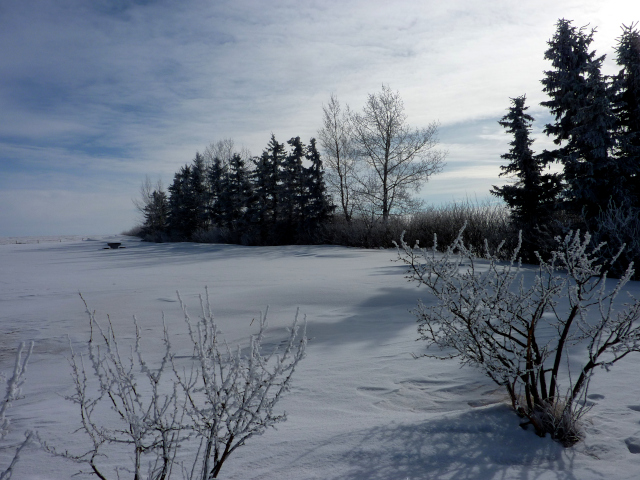
Winter scene with a partly cloudy sky. Dark evergreens throw black shadows onto the snow. It is a country scene with no sign of human habitation except for a barely discernible wooden picnic table.

            That two men died on February 16, 2024, is not, in itself, a noteworthy fact. Thousands upon thousands of men and women and children die each day on our planet earth. All those deaths are important to those around them who continue to live, and all of those lives, now ended, deserve to have their stories told. I speak of only two.

            The name of the first, Alexei Navalny, is well-known in many countries besides his native country, Russia. He was still young, only 47. Had he been free to work toward his vision, he could have accomplished much. Even so, he has galvanized supporters who continue to expose corruption and call for fairer government. His fearless return to Russia after his recovery from the poisoning attempt in 2020 has inspired admiration everywhere his story is known.   

            Navalny lived with passion and courage. He loved his country and he loved his people more. So with all the skills he had—and they were many—he condemned Putin’s oppression of his people and his selfish exploitation of his country. Regardless of the efforts to keep him from speaking out, he refused to be silenced and that cost him his life. Whatever the immediate cause of death (in the Siberian prison where he was held), which we may never know with certainty, there is no doubt at all that President Vladimir Putin of Russia wanted him dead.   

            I am not Russian and have not even heard Navalny speak in person, let alone known him in any meaningful sense of the word. Yet I grieve his death, and pray that it will not have been in vain.

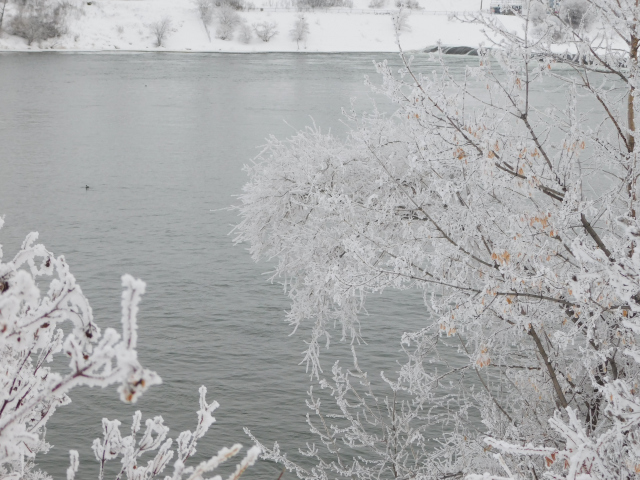
Winter photo of river with frost-covered shrubs on the bank.

            The name of the second man who died on February 16, Rev. Vern Ratzlaff, is definitely less well-known. He was also much older, having already had a long and full life. His last years were spent in a care home, dependent on staff for daily needs and on friends and family for what social life he could still manage, but those are minor details.

What matters is that in his own way, he lived with a passion for truth and justice as intense as any and loved his people, his congregations, with a compassionate heart. He had a brilliant mind and was a competent religious scholar and excellent teacher. He could have been a successful academic, yet he chose otherwise. The God he worshiped had called him to preach and to live out justice and peace and love. And so he did.

            For us, he is the tall bearded man, slightly stooped, with a gentle smile, who offered us friendship and a place in his church community. In his presence, we felt encouraged, trusted, safe. He had an ability to learn from others, with an astonishing openness to spiritual perspectives that differed from his. Although raised in a conservative-minded denomination with devout adherence to a clearly outlined Christian doctrine, Vern had learned a wider ecumenical vision that he fostered in the churches that he ministered to. His friendships were wide-ranging; he was welcomed with respect in other churches, and in synagogue, temple, and mosque.  

            He had a quirky sense of humor, an ability to laugh at himself, with a boyish sense of fun. Not all introverts appreciate so-called practical jokes, but Vern could delight in the absurd and the silly. At the same time, he had an inner stillness that let others breathe and be. He loved music and sang in choirs until that was no longer possible. He and his wife were generous and hospitable, welcoming others to their home and table; guest speakers in his church were invariably invited out for lunch.

He was not perfect – no human is. There were shadows in his history, interludes that a hagiographer would gloss over. However, Vern himself would not want a hagiographer: he knew for certain that God was gracious and forgiving. He would, no doubt, ask his grieving friends to go on living according to scriptural words that he loved and taught: this is what is required of you, “to act justly and to love mercy, and to walk humbly with your God” (Micah 6:8).

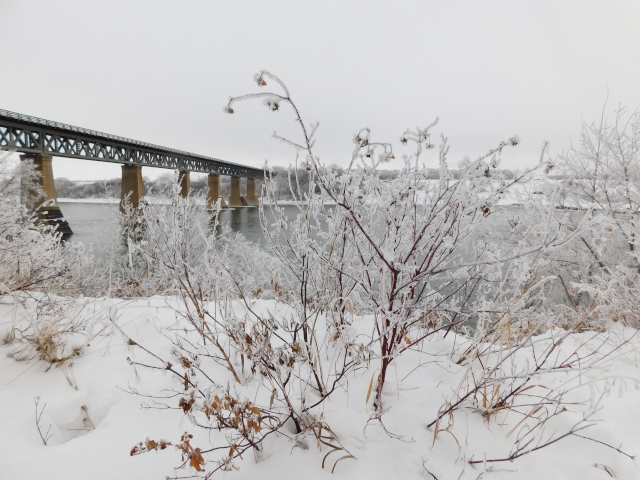
Winter photo of a river bank and a steel bridge. Shrubs are covered with hoarfrost.

Be Still, My Heart

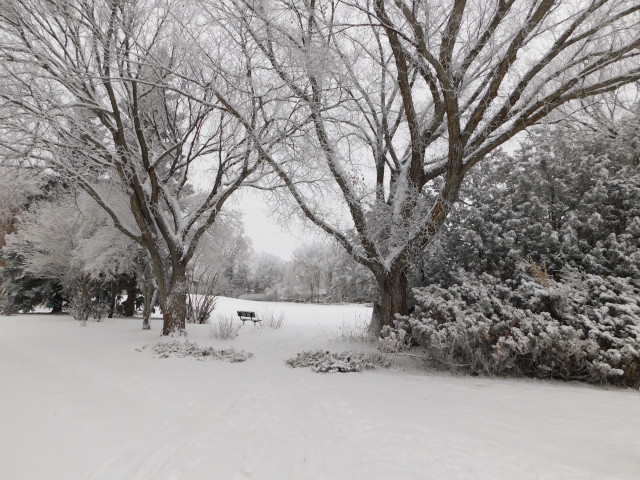
Winter photograph of a park with a solitary, empty bench in the lower third of the photo. On either side are huge elm trees, winter bare but lightly coated with hoar frost. Also on either side, closer to the edges of the photo are lower shrubs, also covered in hoar frost. The photo seems taken in black and white but it wasn't.

Come to me, all you who are weary and burdened, and I will give you rest.”

Matthew 11:28

            The itinerant teacher who spoke that invitation and offered rest was wearing dusty sandals when he spoke those words, not snowy boots. There were no mittens on his gesturing hands, either. The landscape around the Sea of Galilee was nothing at all like this small park a mere two blocks from our home.

            Why this photo should call up that long-ago promise of rest, I’m not sure. Indeed, I can’t even explain why I recently chose this 5-year-old photo as my computer background, after stumbling upon it by chance. Ever since, it has haunted me, drawn me in. It wants to become the subject of some grand reflection, no doubt, but its complete and inscrutable silence has left me without words.

            I offer it simply as an invitation to look and meditate. Let your heart be still for awhile.

For a time / I rest in the grace of the world, and am free.

Wendell Berry

Bread and Jam on New Year’s Day

            On January 1, 1996, I saw my mother for the last time. We had brought her to our home to share a meal with our children and two of my siblings who were visiting from another city. The meal was simple but featured a favourite traditional Mennonite dish – porzelkji (a deep-fried fritter with raisins, typically dipped in sugar). My mother had always served porzelkji on New Year’s Day. Two days later, I got a call from the nursing home where she lived; she had died suddenly.  

            That was 26 years ago. The complex mixture of emotions of that time have long since dissipated and been replaced by gentle nostalgia and acceptance. We had had a difficult relationship, my mother and I. While I had been the favoured last child, one last gift of motherhood for someone who measured her worth through motherhood, I had also been the most rebellious teen-ager and that precisely in the years of her menopausal misery. I was also the only child who settled down in the same city where my parents lived after selling the family farm. Inevitably, I became, in her last decades, both a necessary support and a convenient target of anger when fear and/or illness haunted her.

            Even before she died, I had begun to understand how much she had been shaped by two major traumas: the Russian Revolution when she was a child, and the Great Depression when she was a young adult. Both taught her more than she would have chosen to know about insecurity and scarcity. She never forgot those lessons.  

Photo of breakfast: a bowl of fresh fruit, yogurt and granola; a slice of toast spread with jam, a mug of coffee, and a small jar of homemade jam.

            All that came to mind this morning as I spread my homemade jam on a slice of toast (homemade bread) for breakfast. I chose it from the two or three jars of jams/jellies that are typically available in our fridge. Imagine that—I open more than one jar at a time! Every morning I can choose what I wish to put on my toast.

            My mother, however, had always insisted that no new jar of jam was ever, ever opened before the last one was completely used up. That was not a problem for me when we were still a family of six; even my mother’s large jars of jam were usually soon consumed. By the time I was the only child remaining at home, that was no longer the case. I was heartily sick of whatever flavour was currently open before we were permitted to have something else.

            That principle of using up the old before ever touching the new applied to bread as well (and clothing, but that’s another story), something I hadn’t particularly thought about until we were visiting at the home of one of our children where bread is also home-baked. A fresh loaf, warm from the oven, was sliced for supper even though a partial loaf from the previous baking still sat on the kitchen counter. This was a home where new delights could be fully appreciated without scruple. How wonderful was that!

Photo of four loaves of bread cooling on racks on the kitchen counter, with one loaf already on a cutting board and one slice cut.

            Had I truly been raised in an atmosphere where efficiency and cold, responsible use of everything to its utmost had ruled out so many possibilities of innocent joy? It seems so. I want to make it clear that I appreciate my parents’ compulsion to be thrifty: they had both had intimate acquaintance with poverty, even starvation. I do not have the right to decry their practical ability to use the last bit of everything, even to hoard newness as long as possible. In the face of today’s reckless consumerism amidst an over-stressed environment, their values offer an important counter-narrative.  

            On the other hand, I want to argue that thrift and utility do not have to rule out generosity or delight. Put the freshly cooked jam, with its glorious color and wonderful odor, into smaller jars (and keep reusing those jars!). Enjoy the freshly baked bread while it’s still warm, knowing that a freezer can take care of whatever older bread remains, or turn the stale bread into croutons and avoid the packaging that comes with buying croutons (my mother would have been truly appalled at the notion of paying good money to get chunks of dried bread!). Simple pleasures are to be treasured and readily shared.

            I still have much to learn about a wider generosity that makes sure that everyone has access to bread and jam—fresh bread and good jam (preferably made from plenty of real fruit and not sugared to death). At the beginning of 2024, I grieve over the increased need for food banks and the continued waste of much food, both in the production and in the sales thereof. We can surely do better than that, although in fairness, I should note that many organizations are working to reduce waste and improve access. What I also hope for is that necessary charity includes dignity, and above all, delight. Let there be joy for everyone.

It would be a long time before I knew that grace is found more in delight than in duty.

Patrick Henry