Now I Lay Me Down to Sleep

Photo of a bed, with books piled on the headboard.

Now I lay me down to sleep,

    I pray the Lord my soul to keep.

If I should die before I wake,

   I pray the Lord my soul to take.

                        Anonymous

            Back in December of 2024, in “A Gift for Christmas,” I wrote about my intention to begin a gratitude journal in 2025; I wanted to counter the daily news with something worthwhile and encouraging. Call it self-care, if you wish. So far, almost every day I have written down something for which I am grateful. The practice has made me pay attention all through the day, seeing things that I otherwise might not have noticed.

 From the beginning, I wasn’t looking for astonishing events that would change my life: no equivalents of lottery wins (for the record, I never buy tickets), no miraculous cures (although I believe that they do sometimes happen), no fabulous expensive vacations. I wanted to recognize astonishment in the midst of the ordinary.  

Some days that was easy: the smell of bread fresh from the oven; the taste of a simple meal lovingly prepared with healthy ingredients; the addition of a yoga pose to my regular routine that I had not been able to do for almost two years; an hour with a friend in a favourite local coffee shop; the texture of a scrap of satin found in the bottom of my sewing cupboard; the completion of a necessary yet unpleasant task; the unexpected joy of planting a garden with friends; the happy face of a purple pansy smiling into our kitchen window.

Photo to pots full of pansies, taken out of a kitchen window.

            There were also days when I stared mutinously at my little journal by the bedside. The sheer volume of grim news in the world and the persistence of emotional fatigue from sources I care not to name here opened the door to discouragement with despair close behind. Those forerunners of depression were all too familiar to me. Be grateful? Screw it, I thought, and stared longingly at my pillow, wanting only to seek oblivion.

 And then the obvious declared itself: the comfort and security of a good bed itself was a magnificent reason for unending gratitude. I had a good mattress, a warm duvet, and clean sheets, not to mention a new pillow. Surely it was not trivial to be grateful for that, not in light of the misery in the Middle East and Ukraine, and many other places on our earth (including our own city) where houseless people walk the streets looking for a place to lie down that might be warm enough and safe enough for them to stay alive until morning.  

I, on the other hand, can say the old prayer—“Now I lay me down to sleep . . . ”—with the reasonable assurance that I will indeed wake up again. In my neighbourhood, bombs do not go off, nor is it at all likely that gunfire will echo through the house. I’m also reasonably healthy. We’re far from forests or grasslands at risk of burning, and the South Saskatchewan River, should it flood, will not damage much of the city.

In the whole of my life I have spent exactly two nights trying to sleep in a car. Both occasions were the result of rain plus a tent malfunction. In other words, we were on vacation, a privilege in itself. And while our decision to spend our vacations camping was at first made because of a modest budget, it remained our choice long after other options became possible. In fact, we dismissed those other options in favour of getting a better tent and better sleeping bags! We had become lifelong campers.

Photo of a tent, a kitchen shelter, and a car in a campground near Jasper, Alberta.

            “Now I lay me down to sleep,” is, I now realize, a statement of privilege. It is a blessed state of mind to be able to recite it confidently, knowing that I do have a place to “lay me down.” A very comfortable place. That the child’s prayer also includes a reminder of mortality simply intensifies my gratitude.    

What shall I do with my gratitude? Can I turn it into some concrete actions for the sake of the people of my city who have no beds and no houses to put them in if they owned any beds?

 At the least, I could donate money or blankets or . . . . .  but my mind has shifted from beds to gratitude itself. Why should being thankful provoke any change whatsoever? Because gratitude is a tacit acknowledgement that I needed something and it was given to me by someone else or by some confluence of circumstances. Genuine gratitude is felt by those who know that they cannot control everything in their lives, who know that they need other people, and who know that they have done nothing to deserve all the goodness that has been given them.

 Gratitude is characteristic of a worldview that is not transactional, that does not see the Other as someone to be manipulated or used or destroyed. Being human is not a zero-sum game. Being human requires vulnerability and cooperation. That is the culture that grows thankfulness and thankfulness grows wholeness and joy.

 I should add to the “Now I lay me down to sleep” prayer. Something along the lines of “Thank you for my bed and my pillow and my life. / Thank you for all those others / wittingly and unwittingly / who have made me who I am.”

The Weight of a Name

close-up photo of mountain rocks and tiny alpine flowers, mostly moss campion.

            The language of stones is silence. Flowers likewise keep their own counsel. There are exceptions: dried flowers rustle in the wind; live flowers attract choruses of bees happy in their pursuit of nectar. Stones can raise a mighty ruckus if gravity moves them. No one who has watched a rock avalanche in the Rockies (as we have) can forget the almighty roar of stones tumbling down hundreds of feet in search of a level surface on which to take up a new habitation.

 These days I’m lonely for both stones and flowers, the landscape where I live being covered in feet of snow—which is also silent, unless hurled forward by wind, in which case it is the wind we hear, not the snow, or unless the temperature is low enough that snow squeaks beneath our boots.  

            Public discourse, by definition never silent (exceptions there also, of course, for sign language and body language), has taken on an edge in the last years that makes me long for hours spent outdoors, in silence, never mind the weather (and as I write, the wind chill on the other side of the window is – 47 C). So much could be said about how the public square functions these days. To be briefly facetious here, it’s not really a public square anymore at all but private glowing rectangles on which the shouting happens. I am not qualified—as if that matters much these days—to weigh in on momentous policy decisions; I will leave that to those with a higher pay grade and preferably some expertise.

 All I want to draw attention to is one seemingly insignificant, yet dismayingly common, tactic of signifying disapproval of an opponent: the twisting of names. That phrasing is actually too kind a label for the practice of using names as weapons. The intent is not actually to signify disapproval but to humiliate and destroy. What is actually signalled is the self-claimed superiority of the one who renames.

Nicknames, we used to call those miserable refusals to use a child’s given name. Who has not heard the horrible epithets created by playground bullies? Fatso, Lard Guts, Skinny, Rat Face, Four Eyes, Stinky. The insults are legion, almost always focused on what the hapless victim cannot change – race, appearance, disabilities. Memories of verbal bullying are hard to erase, as I can testify. 

 Nicknames can also be affectionate, within families, among close friends, between lovers. Pet names we call those tender labels. Which seems revealing on its own. There’s just a hint of ownership implied by “pet.” The act of naming is an act of power, a dynamic that becomes evident when the wearer of the nickname chooses to resist it. For a child who is growing up and wishes to leave the “pet name” behind, the continued usage of the name begins to feel like an insult. The line between affection and aggression can be thin.

            Human beings seem always to have known that naming is somewhat akin to magic. The Book of Genesis includes as part of the creation accounts the story of Adam naming all the animals, having been asked by God to do so. It seems a clear indication of greater intelligence in humans and thus also the responsibility of caretaking, a relationship that can be abused. Parents name their children, sensing at some level that they are conferring on this new little human an individuality, a personhood. That is most often a gracious naming, which in some cultures is also a powerful recognition of ancestors, a continuation of family traditions, even an accolade for some valuable characteristic.

 Colonialism was less gracious: over and over again, conquerors have renamed landscape features in an act of appropriation, declaring their ownership. Sometimes the original people, now without power, have also been renamed, sometimes to spare the conquerors the trouble of learning names in an unfamiliar language, sometimes as a deliberate effort to obliterate old traditions and familial ties. Brian Friel, an Irish playwright, in Translations, depicts the English practice of renaming and mapping Irish land as an act of dominance.  One of the characters eventually asks the obvious question: if all the place names are changed into another language, will the villagers still know where they are? Indeed, will they know who they are? Names matter.

 Given that long human history of naming as a weapon of power, we should probably not be surprised that the current political scene has been corrupted by childish nicknames. Whatever one may say about President Donald Trump (and I have little desire to begin a larger conversation), he has had frightening success in demeaning opponents through his bullying tactic of creating mean nicknames. I will spare my readers the pain of having to read a long list of such nicknames. If you follow the news at all, you will already know them. None of those names should live on, whether they were hurled at worthy men and women or at former “friends” of Trump’s as complicit in criminality as he is. I am particularly troubled by the seeming increase of a similar use of demeaning names in Canadian political conversations.

            From hereon, my voting decisions will be strongly influenced by political candidates’ use of names, and slogans, as a weapon. Never having held membership in any political party, I have made my choices primarily on the basis of individual candidates’ qualifications for office, with some consideration given to their party leaders. The character of the individual who will represent me in parliament matters as much as the policies advocated. If someone is willing to use demeaning labels against an opponent, I will interpret that as a serious character blemish, a disqualifying one. That is a failure to show respect to another human being.

 It is not a coincidence that the world’s main religions all call for respect to all human beings, and include some version of the Golden Rule, which asks us simply to offer all others the same dignity that we would wish to receive ourselves. One measure of that equalizing respect is to call each individual by his/her chosen name, or earned title. While such a courtesy would not, all by itself, undo extreme and unkind partisanship, it would be a step toward greater civility and hopefully also a movement toward more reasoned discussion of policy rather than a competition of personal attacks against opponents.

            I return to the stones and flowers that enrich my world. Their silence and their beauty soothe my spirit.

Could we perhaps improve the governance of our various countries by making it an inflexible rule that all would-be leaders spend 4 weeks in some lonely, isolated place outdoors?

Photo taken in Alberta Badlands, in Dinosaur Provincial Park.

A desert would do, so would a backwoods spot in the mountains, even a northern forested island. No aides allowed, no party officials, no team of caterers, no cell phones or laptops, no more than one book, preferably a blank journal, no trappings of power. Just one Indigenous elder who knows the land well whose periodic visits would make sure that actual starvation or major illness didn’t occur. At the very least, such a measure would open up space for undisturbed contemplation of the responsibilities of the desired governmental position and would remind our would-be dictators that they are, in the larger scheme of things, actually quite small and dependent.

Prolonged silence and solitude has a way of leading us inward. There is no name for that.

Hand-made and Heart-felt: my companion coffee mug

            The gift was given so long ago that I cannot name the day or the occasion. I do remember the giver and something about the maker. I was in my early 20s. The giver was my brother, and the maker was a friend of his, an older woman. She was a kindly potter who understood many things—that I learned later through hearsay, for I remember meeting her only once, in her studio. Perhaps, though, I have only imagined that meeting.

photo of the mug, a small plate with a muffin, a magazine, a linen napkin, and reading glasses.

            The mug was not notable for its beauty, for it was squat and brownish. In those days, had it been left to my choice, I’d have picked something more elegant, like a Blue Mountain pottery piece, then much in vogue and now found only in thrift shops and on collectors’ shelves. What I did notice at once was how the mug felt in my hands. It belonged there – completely. Something about the shape suited my hands, fit the pattern of my holding. I soon discovered that its shape also kept the coffee hot longer, something that mattered to me then already. My coffee addiction developed early.

 In the first years we had together, my mug and I spent many hours in university classrooms. I remember plunking the empty mug in the bottom of my capacious book bag which I schlepped to campus day after day. The mug came with me because I had been inducted, in my second undergraduate year, into the pleasure of long seminar classes. My first one (on Shakespeare) always began with the professor’s ritual of plugging in an electric kettle to begin the process of making coffee, then asking a few “questions to boil water by.” (Yes, it was instant coffee, brand now forgotten – I was addicted to coffee but not yet choosy about what kind.)  Once the coffee had been made, we settled down to work on the serious questions for the day.

 No doubt, the mug was used often in later years, post-university, when babies came to complete our family and transform us from carefree twenty-somethings into responsible thirty-somethings, preoccupied with the weight of parenting and church involvement and bills and house-owning. I have no clear visual memories of the mug during those years, although I am certain that I would have used it regularly. It had been a comfortable (and comforting) companion from the beginning of its days with me. That would not have changed regardless of how busy and distracted I might have been.

 Then came the days of teaching, with an interlude of further graduate studies, and then teaching again – until eventual retirement. My first “offices” on campus were miniscule and temporary. Embedded in my memory are long days of solitude in a tiny carrel in the library, cherished because it had a door and a lock. That meant that I could leave books there, of course, but more importantly, my typewriter (remember those??) and my coffee mug. To this day, sentences flow more easily when my favourite mug sits at hand.

            After I gained a more permanent office in the gracious spaces of St. Thomas More College, where I taught for 19 years, my warm brown mug lived in my office.

photo of my office in STM College. The mug is visible on the desk, and in the background are many books on shelves and a computer monitor.

It came with me to the various classrooms I taught in. Often the coffee was barely lukewarm by the end of the class, and little of it had actually been consumed. What mattered was that I had it in my hand or nearby on the desk. I was convinced that I was then more relaxed and that my students participated more readily in the kinds of discussion on good literature that gave me the “teaching highs” I valued so much.  Perhaps even now, more than 12 years since my retirement, former students remember me with coffee mug in hand. I rather hope so.

These days, that mug, now over 50 years old, lives only in our home. I guard it carefully when we have houseguests, lest it find itself in strange hands. Silly, isn’t it? Surely a mug knows nothing of whose hands fit around its inviting shape. And a washed mug is always ready for the next use by whoever picks it up. But we have a relationship, I insist. It’s so close a tie that even my liking for a particular travel mug that I have now used for some 15 years doesn’t rival it.  

  Its particular virtues? I think the circumstances of its making, in a small pottery studio in a garage of a suburban home in Edmonton, are important. The potter was a gentle woman, an artist, aware of the aches of living, aware of the frequent unfairnesses that hide in the best of places. She did her work with love, that’s certain. Each mug, each piece of pottery was made for its unique self. In the words of poet Gerard Manley Hopkins, my mug had its unique, living character, had its “inscape” from the beginning, and all the various stages of life that it has shared with me have only deepened that “inscape.”  

 Some day, one of our children will have to decide what becomes of that mug. Having survived so many years already, still uncracked and unchipped, despite an occasional fall to the floor, it is unlikely that it will ever be broken, certainly not by me.  

As I ponder its long life—and it is now so imbued with coffee flavors that it cannot be used for tea or hot chocolate or water—I recognize that it has given me one other pleasure: a lifelong appreciation for good pottery. When we travel, we are apt to find small galleries and craft markets (both indoors and outdoors) where we peruse the handmade items, and think about the love with which the items have been made. We have a small collection of handmade pottery mugs now, so that we can share our pleasure with family and guests.

            This Christmas I will once again dunk my homemade peppernuts into my coffee, served always in the perfect mug.  It was made in love, given in love, received gratefully with love.

Photo of the same kitchen table, with the mug now more prominent. Beside is a small bowl full of peppernut cookies,, a napkin, and teapot.
That is a teapot, yes, indeed. It happens to be more photogenic than any coffee pot that I own. Believe me, there is no tea in the beloved mug.

Grounded

“It turns out that groundedness requires actual ground.” (Jenny Odell)

            The words startled me. “Being grounded” is such a common phrase, often used vaguely with feel-good associations, although it still means generally good sense and balance. Odell’s abrupt return to literalness jolted that worn out metaphor straight back to its original earthiness, which then prompted me to consider what kind of ground I personally required for being “grounded.”

Two kinds of ground, I concluded: one was dirt itself, dirt on my hands, on my knees, underneath my fingernails, as I tended the plants I loved. That dirtiness I shall return to sometime in another posting. The other ground is less immediate – quite distant, in fact. It depends on sight rather than touch. I need to see a long, long way, toward the far horizon, where the earth gently touches sky. Then my very self is reduced to smallness even as I stand anchored on the ground beneath my feet.  

View of the ocean in Victoria, BC. Overcast sky with late afternoon colors.

The connection to the first kind of grounding—dirt—I have long understood as vital to my well-being. I am a gardener and gardening is not optional. The second kind of grounding—a move into mystery through infinite expansion of view—I have also always loved but not understood as being, simultaneously, a solidness of footing, as much emotional as physical. The first is a function of doing, which lures the soul into forgetfulness through the simple and absorbing tasks of touching. The second is a function of being, in which the self disappears into pure perception.

 There are landscapes that feel like home, and landscapes that are foreign. Born and raised on the prairies, I am not naturally akin to the ocean. I own cross-country skis and hiking boots, not the accoutrements of living next to water (canoes, boats, sails, life jackets, anchors). While I have canoed, a little, and ridden in the occasional boat and on a ferry, I remain a tourist by the sea, not a native. Walking on a beach feels exotic. It’s an adventure, not a home-coming.

Yet the distant horizon slows my breath and steadies me. It is beautiful – that insubstantial meeting of air and water. I cannot gauge distance. Who I am matters nothing; I am infinitely small. Except that I remain the still point of perspective. My feet stand on ground, sand, rock. The foundation is there, and from that foundation all human endeavour is exposed as temporal, conditional, while both rock and sand – and water – are forever.

Mostly sky with brown prairie hills.

            Fortunately for me, the actual ground required for emotional and spiritual grounding does not have to be at the edge of a body of water. Prairie landscapes, in which I am at home, also offer magnificent distance, a forever postponed horizon. Accompanied so often by equally endless wind that blows trivial concerns out of mind and heart, the untouched prairie offers a different kind of solidity that pays no heed to individual ego. I am small here as well, and perhaps even more vulnerable. There’s no place to hide. But then also no need to hide. Blessedly, my various identities and loyalties matter little against an overwhelming awareness of Otherness.

More than ever, I know that I belong to Earth. I am human, I am fallible. Though I stand alone in the moment, I know that I am not alone. My smallness is not demeaning; it is humbling and comforting all at the same time. 

Harney Peak in South Dakota. Many smaller mountains in the distance, in a bluish haze.

            There is a third landscape through which expanded horizons foster inner balance. It does require a definite physical commitment and an immediate experience of several kinds of literal ground along the way. Truth be told, this is the one that speaks most intimately to my heart. To stand at the top of a mountain pass, from which the eye can see across miles and miles of rock and soil, is to know oneself insignificant yet joyfully exultant in that diminishment. The very air one breathes is thin, and the line between the earthly and the heavenly no longer discernible.

            [Can pettiness and cruelty and selfishness stand against so much beauty? I wonder, could we require all politicians seeking office to spend two weeks living on actual ground and surviving on limited rations? Two weeks is probably not nearly enough but it could be a beginning. And I’m not sure if those two weeks should be spent in complete solitude or accompanied by an appropriate guide. Perhaps two weeks of each? Repeated regularly throughout the term of office?]

 Lest you be tempted to think that the view of the ocean from the penthouse suite would do just as well and require little effort or that the view of the mountains can be achieved from an airplane window or an abominable skywalk thrusting itself where it has no business to be, let me clarify: the ground beneath your feet is not optional.

Trail on Mt. Revelstoke in BC. The slope is rocky and a lone figure stands on the trail silhouetted against the sky, with more mountains in the distance.

 The power of the seascape is strengthened by the pebbles your fingers caress after your bum has wriggled into a comfy place on the sand. The vast prairie sky demands also the prickly grass underfoot and the whirring grasshoppers that fling themselves against your legs. Any soul-ish benefit the vista of the mountains might offer happens only after your boots first found balance on many rocks and tree roots. Let there be no glass and brick between you and the scents of the scene. If you would be grounded, the majesty of far-seeing cannot be turned into a saleable “view.”

Another photo of the beach in Victoria, BC. This time more of the beach is visible with plenty of driftwood.

            Groundedness requires actual ground – always.

Throw Something Away

My to-do lists and I have a complicated relationship. Sometimes for weeks on end, I write nothing down and simply choose tasks and activities according to impulse or urgency.  Then a sudden attack of ambition—or guilt—drives me to write down job after job in a frantic effort to make my days profitable and braggable, even if only to myself.

Photo of a couple of lists.

It’s not only hands-on tasks that are thus named and conquered. I have used to-do lists to bolster mental health and encourage good habits. For months during the pandemic, I began each day by writing down a reminder to be grateful for something, to talk to at least one person besides my husband, and to clean up something no matter how small or inconsequential. It was my bid for continuing sanity in the midst of a world that I didn’t recognize.  

            Now—yes, I am once again friends with to-do lists—I have chosen a new daily mantra: throw something away. This is not a new zeal for tidiness and/or efficiency. It is a growing awareness that our days in our beloved bungalow with its expansive yard designed for gardening and playing are probably numbered. Our bodies are aging, as everybody’s does. At some point, the maintenance of house and yard is going to become more work than we can manage safely and pleasurably.

Photo of our home and front yard.

Hence, my desire to steal a march on what might well become a frenzy of selling, giving away, and throwing away. I want to be able to take time for small sentimental objects, treasured jewelry, memory-laden clothing not likely ever to be worn again. I also need to confront the habit of saving all manner of things and strings in case they should be of use (inherited and absorbed from my parents whose adulthood was shaped by Depression-era necessity). I would rather not let it edge into the pathological.

Photo of several ID cards, some jewelry, a couple of tiny keys, a brooch or two.
Just how many outdated and irrelevant ID cards does one need to keep?

My perspective here has most assuredly been influenced by several close encounters with hoarding disasters. I happened to be the sibling who managed the greatest portion of the disbursal and disposal of my parents’ worldly goods. (I shall say nothing here of what it means to manage the emotional goods that parents also leave for their children.) Repeatedly, I was aghast at what they had chosen to keep through three separate moves: cans of paint for buildings on the farm now owned by someone else; appliances designed for subsistence farming, not urban kitchens; food past its expiry date; sewing notions for garments not worn in decades; carpet samples from a previous house; left-over wood from finished and unfinished projects; empty prescription bottles; excerpts of ancient letters; addresses for long-deceased relatives; birthday cards received 50 years ago; a few old diaries; immigration documents. Alright, I could understand why a few of those items remained. How could one throw away the precious piece of paper that signalled freedom in a new country?  

I could find no similar understanding for two neighbours who turned out to be hoarders of monumental proportions, making my parents look like minimalists. Watching the garbage collect in backyards, plants and shrubs grow unchecked into monstrous tangles, packages and parcels enter the front door in a never-ending march (until the front door was no longer accessible because of the stacks of unopened boxes, both inside the house and on the front steps)—oh, it was a sight to chill the soul. How could they have let mere stuff so dictate their lives? Indeed, allow that stuff to dictate the manner of their dying?

Such memories haunt me. They have propelled me, every now and then, into cleaning binges. However, I can also appreciate the irony of where I now stand on stuff, so to speak. While I can easily discard some incidentals, the longer we live, the more the things around us are likely to have accrued sentimental value. Some of the paintings and photographs that grace our walls have been given us by grandchildren. Their artistic projects now bring smiles each time we see them. Some items we have gifted one another or have chosen together to commemorate a special occasion. It’s all that added value, that rich sum of all the living we’ve done, that makes parting with those items harder now.

Our decisions about throwing stuff away are complicated as well by our awareness that what we’re actually doing is deciding how we wish to be remembered when we’re gone. The fragments of identity that we have shored up to remind ourselves who we are may not be necessary for us anymore, but will they matter to our children, who are likely still negotiating who they are and will become in relation to their past, which is inextricably connected to our past? I cannot forget that I gained self-awareness and more compassion as I learned more about my parents’ experiences. What bits of my “stuff”—the old letters, the photos, the sewing patterns, the published articles, the journal notes—are going to be important for children or grandchildren?

I have no way of knowing that, of course. And perhaps, what should happen in this binge of throwing away stuff is also a throwing away of my anxious need to control more than is reasonable. After all, I would have fiercely resisted any last attempt by my parents to determine what I did and what I could know. Surely I can let go of any fantasy that I can shape what our descendants will do with their own histories. It has been labor enough for me to make friends with my own story.    

We should probably all pause to confront our past from time to time, because it changes its meaning as our circumstances alter.

Karen Armstrong

Be Still, My Heart

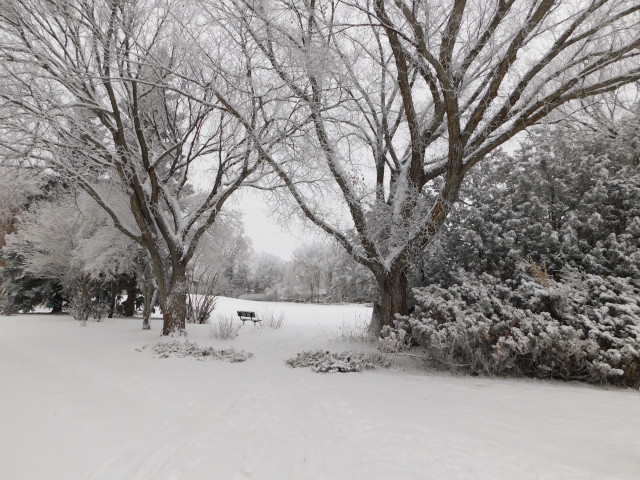
Winter photograph of a park with a solitary, empty bench in the lower third of the photo. On either side are huge elm trees, winter bare but lightly coated with hoar frost. Also on either side, closer to the edges of the photo are lower shrubs, also covered in hoar frost. The photo seems taken in black and white but it wasn't.

Come to me, all you who are weary and burdened, and I will give you rest.”

Matthew 11:28

            The itinerant teacher who spoke that invitation and offered rest was wearing dusty sandals when he spoke those words, not snowy boots. There were no mittens on his gesturing hands, either. The landscape around the Sea of Galilee was nothing at all like this small park a mere two blocks from our home.

            Why this photo should call up that long-ago promise of rest, I’m not sure. Indeed, I can’t even explain why I recently chose this 5-year-old photo as my computer background, after stumbling upon it by chance. Ever since, it has haunted me, drawn me in. It wants to become the subject of some grand reflection, no doubt, but its complete and inscrutable silence has left me without words.

            I offer it simply as an invitation to look and meditate. Let your heart be still for awhile.

For a time / I rest in the grace of the world, and am free.

Wendell Berry

Evening Light

Mystery is the place where we can finger the ragged edges of what we know and begin to make peace with what we will not know. (Stephen Jenkinson)

#1

            In my part of the world, days are getting shorter. Sunset begins sooner each day, signalling not only the end of another day but the end of a season. If I wish to continue my cherished evening walks, I shall have to walk in the dark. The summer’s mellow evening light has now shifted to late afternoon, slanting in at a different angle, lower on the horizon.  

Letting go of sunlight each evening is a ritual practice for letting go of much else in life. Whether it happens abruptly as the sun drops behind a mountain, or in a lingering blaze of warm colors (as is common on the prairies where the sky goes on forever), sunset blends awe with melancholy. This one day is almost over and cannot be retrieved, reminding us that our lives too will end. Yet the beauty of the sun’s disappearance is so varied, so evanescent, and so necessary—how could the earth and all its inhabitants continue to live without daily darkness and rest?—that we are cleansed by astonishment.  

The very word life shouts out promise, potential, opportunity, breath, vibrancy. Life has drive and will and force. It continues its changes forever. That which does not change, that does not obey the principle of death and resurrection into a new form, will die most certainly and finally, declaring its essence to be not-life.

The more a thing tends to be permanent, the more lifeless it tends to be.

(Alan Watts)

Sunset has to do with time and change. Celebration and loss, all at once. So we cling to the loveliness, even as we rejoice at the prospect of rest. We gaze at the dance of color and watch the earth around us take off its robes of light, giving way to starlight and moonlight. Who would have it otherwise?

#2

            These days, I’m asking myself how to let go and what might need to be let go. A friend is losing independence, giving up the tasks of caring for herself (when will that be my lot?). Another friendship seems lost entirely as we walk different paths now (shall I stop trying to maintain what was?). The pandemic has taken away both political innocence and a certain social ease (can I find hope again in realistic possibilities?).

 Some once-loved books have ceased to matter; they will be “remaindered” (to use a publisher’s phrase) and turned into something else that can be made with recycled paper. I’m not sure that the memories I will also have to relinquish can be recycled as usefully. There are no cemeteries for books, and photographs of my library end up looking like artifacts of interior decorating. 

Certain shelves of said library remind me that what seemed wise to me once upon a time is now folly, much as teens might look back on their favorite crib toys with a sheepish smile. Not all beliefs continue to sustain, necessary as they may once have been. Circumstances have changed. I have changed. I am now embarrassed to admit that I once had a copy of Total Woman and read it mostly without irony, although I might have felt twinges of critical thinking over the worst of its excesses. As the sun sets on some days, the ending is entirely welcome.

#3

There is a reason that photographers, amateur and professional, have probably all indulged in sunset phases. Melancholy and awe are addictive, yet essential to our humanness. We know very well the flutters of possibility within a new love, and the throbbing ache of a lost love. Regret and satisfaction. Is that reading too much into the result of light passing through more of the atmosphere and hence being scattered by additional particles?

My struggle for words is at an end. Let sunset photos finish this reflection. Each one was taken in a different place and hence calls up different memories, different feelings. I leave them untitled except for numbers, and I invite you, my readers, to let me know which one(s) call to your heart.  

#4
#5
#6
#7
#8
#9
#10

What We Can Choose – Part Two

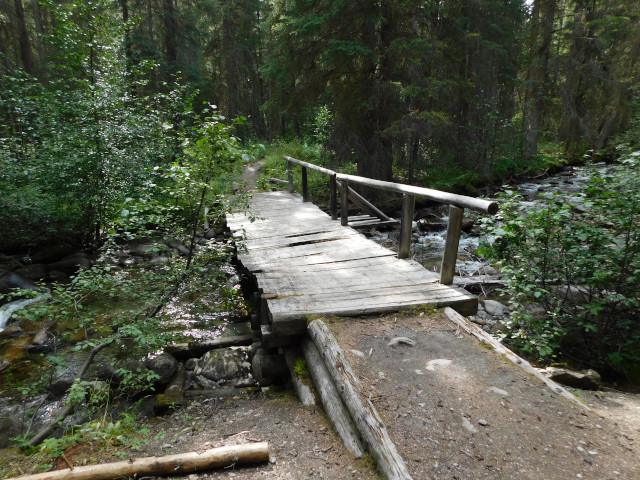
Photo of a trail leading to a rickety wooden bridge over a creek in the forest.

            This reflection will not be obvious. It considers not the what, but the how and the why and the what happens next. Those are often not obvious at all, partly because our culture has cast the language of choice in the individual mode. I am convinced that that can be misleading. There is no such thing as an entirely “personal” choice.

Shelves of packages of candies, taken in  a London Drugs store.

Let’s start with the trivial: which candy I choose to spend my dimes on (oops, not dimes—dollars!) can hardly matter in the grand scheme of human endeavour. The world seems indifferent to such a choice, even to whether I choose candy at all or potato chips (much more likely – I dislike candy). Yet as soon as we back away from a single bag of candy, the scene changes.

Store owners stock only those candies that sell; the more often I and others opt for lemon drops, the more likely it is that stores will stock them. That then determines what factories produce, and if making lemon drops has deleterious effects on the health of factory workers, then my utterly trivial choice matters. The more candy I eat, the more likely it is that the sugar overdose will affect my health, beginning with my teeth. My health, as it happens, is important to more people than just me.

I could also talk about what I choose to do with the now empty wrapper. Does it end up in the ditch at the roadside? or on the sidewalk beside a park? Out of what was that wrapper made? What was its overall cost?  

Even in the most trivial choices, I am in the midst of a whole web of connections with other human beings.

Shelves of different breakfast cereals, also taken in London Drugs.

Consider another seemingly simple choice: what shall I have for breakfast? Someday, archaeologists will draw conclusions about our culture based on packaging debris that survives beneath the rubble of centuries. Be it Frosted Flakes, or granola, or bacon and eggs, or smoothies with startling ingredients, every selection affects which business grows and which does not, which animals and plants are grown and which are not, which divisions of our health care institutions are overworked and which are not, which tracts of land are cared for adequately and which are not (see Michael Pollen’s The Omnivore’s Dilemma).

 The how and why of all our small choices together reveal our tastes, our values, even the causes for which we’ll be prepared to march in the streets. All of those choices have been created in the crucible of our multiple contexts, some of which have been given (perhaps most) and some of which we have chosen, each choice determining to some degree what follows.

Some choices are made without thought, the variables having been sorted out long ago: I need no conscious decision to walk by the candy store without pausing; I will, however, linger by the camping supply store and linger even longer by the book store window.

 Other choices are far more difficult. Why did I leave one church and eventually settle on a different one? Indeed, why have I chosen to continue to identify myself as Christian? (The initial identification as such was hardly a genuine choice, not where I grew up.) To answer those questions would require long stories, which call for a different venue than this blog.

The point I want to make here is that the choice was not personal except in the sense that I was the one who had to make it. In the end, my choice to leave a church I’d been part of for decades was the result of the influence of people (and some books) who invited me into different perspectives and other people who made it increasingly difficult to remain. No doubt my choice likewise affected others. Just how many or how much, I don’t know beyond the fact that some friendships ended.  

 Since we cannot know all the intricate ways in which our smallest choices might affect so many other people, the least we can do is to remain aware that our choices are both personal and not personal. That is, we do have to choose, many, many times a day even; I am the person whose foot pushes down on the brake or the accelerator—no one else does that for me. At the same time, every choice I make is not only the result of all the overlapping circumstances of my life but will then also affect later choices of mine and of others. Every effect becomes itself a cause.

 In our current climate of anxiety over the pandemic and dire political and climatic circumstances, perhaps two principles could and should be kept in mind. One is that sooner or later our choices (even the trivial ones) will enter the territory of values; they will become moral choices. As C.S. Lewis once insisted, all of our decisions, both trivial and momentous, will make us more of a certain kind of person, and who we become matters a great deal.

“I’ve been considering the phrase ‘all my relations for some time now. . . . It points to the truth that we are all related, that we are all connected, that we all belong to each other. . . . ALL my relations. That means every person, just as it means every rock, mineral, blade of grass, and creature. We live because everything else does.”

Richard Wagamese

 The other principle is connected to the previous one: the well-being of others should come first. That is such a huge statement that it has already filled libraries with books as philosophers and theologians and thinkers of all kinds have struggled to work out the relationship between our instinctive—and necessary—care for ourselves and our equally necessary care for others.

If we look out only for Number One, the society around us is likely to become, or least seem, more hostile. When unchecked selfishness is pursued in high office, the entire country becomes a less liveable place. Jesus once said, “Do unto others as you would have others do unto you” and also “those who would save their own souls must first give them away.” Other religions base their rules of conduct on the same principle, albeit worded in slightly different ways.

 If religious reasoning is not your preference, then scientific analysis will lead you to a similar conclusion. It turns out that human infants do not thrive without love (nor, for that matter, do adults), and societies in which altruistic behaviour is encouraged offer better and more satisfying living conditions.

Robert Frost’s famous poem “Two ways diverged in a yellow wood” concludes with “I took the one less travelled by / and that has made all the difference.” Generations of school children absorbed the lesson that we should be brave individuals and choose to be non-conformists. I would argue that had the narrator chosen the more travelled road, it would still have made all the difference. Choices do that.

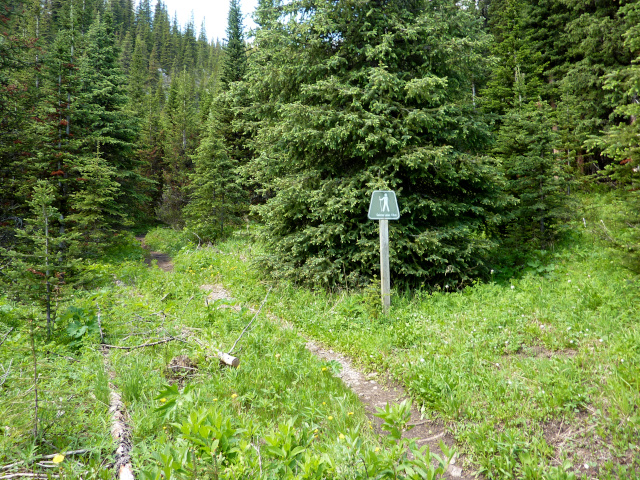
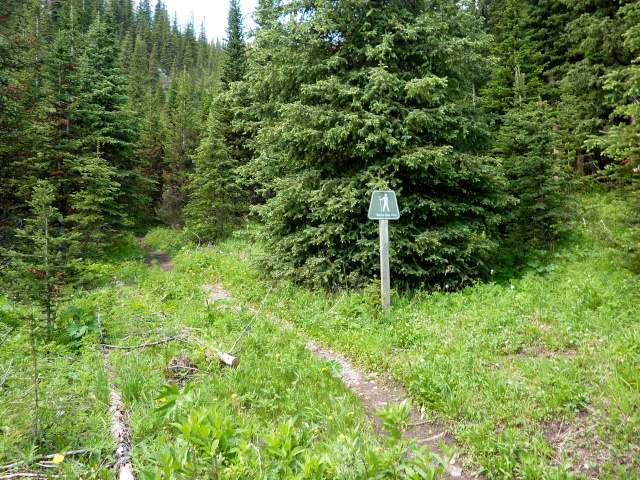
A mountain trail, but it's narrow and half over-grown. Only a small sign beside it reassures the hiker that this is an actual trail through the forest.

Oh, I kept the first for another day!

Yet knowing how way leads on to way,

I doubted if I should ever come back.

Robert Frost

The Wisdom of the Trail

Near the beginning of the trail to the alpine meadows near Mt. Edith Cavell. Photo taken in late summer 2021.

            I fell into hiking in the mountains almost by accident, but even at the beginning, it had the pull of destiny about it—that feeling that comes rarely and then with a wash of loveliness: I was born to do this.

It happened in Jasper National Park in 1968, when a convergence of necessities and opportunities gave me a summer of work in the tourist town of Jasper, Alberta. My friend and I had no car, just occasionally borrowed bicycles. Days off became hiking days because we wanted to get out of town, and there was little else to do. I succumbed immediately to the lure of the trail.  

Along one of the many trails on the Pyramid Shelf, near Jasper, AB. Photo taken in late summer 2021.

  Camping began three years later when my husband and I borrowed tents and other equipment to escape to the Rockies where we spent our days hiking trails, sometimes bagging a walk-up peak. Mountain climbers we were not and would never be, lacking both money and nerve. All that was needed for hiking, though, was a map and good boots – and the desire to explore.

 Decades later, my husband and I are still camping, still hiking. We hiked with our young sons as soon as we could persuade them to cooperate on the trails (frequent snacks helped!), and now we’re still hiking with them and with our grandchildren as well. I cannot imagine anything more soul-restoring.

 This summer, after a year lost to the pandemic, we were finally back in the Rockies, back to Jasper, where it had all begun. Thanks to the pandemic, we were hiking without our family, but we were hiking. We’re slower hikers now than we once were, more tolerant of our limits, more grateful than ever for every heart-stopping view we achieve.

Dorothy Lake, in Jasper National Park, photo taken in late summer 2021.

  Over the years, our hiking has become more meditative, even creative. In years past, I used to draft entire university course outlines in my mind as we walked in companionable silence. This year, as each scene revived memories of previous hikes, previous adventures, I began thinking of just how much all those beautiful mountain trails have taught us about living thoughtfully and well.   

            It was Mt. Rundle in Banff that first made life applications explicit.  

Mt. Rundle, towering above the golf course. Walk-up ascents can be done on the more gradual slope not visible here. Photo by Darian Froese.

My husband and I attempted that daunting, supposedly “walk-up,” ascent back in 1973, when our first real hiking boots were still stiff and untried. My older brother, who was with us for a few days and who had done the ascent before, led the way.

Less than an hour from the peak, I lost courage. I could not take another step on that sheer slope of rock. Never mind how often my brother reassured me that my boots would not slide, I couldn’t do it. I resolutely sat myself down on the rock, and informed my husband and brother that I would wait for them. They finished the climb, reveled in the astonishing view, took their pictures, and then returned jubilant. After which, I discovered that going down a mountain is even more unnerving than going up! 

As we hiked more often in subsequent years and achieved some high passes in the mountains (adjacent photo is Nigel Pass in Jasper National Park, 2004), I often recalled that “failure” and promised myself that I would get back to Mt. Rundle eventually.

 Twenty-two years later, in 1995, when I was facing the last hurdle of my PhD, we returned to Banff, with our two younger sons, now in their teens. I had insisted on that destination that summer because I had made a private bargain with myself: “if I can get to the top of Mt. Rundle, I can finish my dissertation.” I made it, but not easily. The last hour and more was a struggle over loose shale, on which I slid back down with nearly every step up. Mt. Rundle, by pushing me almost to despair, taught me that I could choose to keep putting one foot in front of the other. I also learned the value of not hiking alone; the presence and patience of our sons mattered more than they’ll ever know.

At the top, I hardly knew what was more astonishing—the sight of the entire Bow Valley spread out far below me, or the fact that I was really and truly there.  

  The following day, I bought a huge poster of Mt. Rundle. For the next year, that poster graced the wall of my tiny study room in the U of S library where I finished writing my dissertation. When I wanted to hurl books at the wall or just give up and go home, I would look at the summit of Mt. Rundle and whisper, “I can do this.”

A photo of Mt. Rundle (by Darian Froese) taken many years later (2009) when my husband and I were content to view the mountain from the relatively easy viewpoint on Mt. Castle, near the falls. It is now more astonishing to me than ever that we were ever on the peak of Mt. Rundle.

            There have been many other gifts of wisdom that the many hiking trails in the Rocky Mountains have given me. I could, I suppose, write the hiking equivalent of All I Really Need to Know I Learned in Kindergarten.

The worth of the trail itself, for example, never mind what its destination might be. Mt. Rundle was a fantastic goal, but the truth is, there was much to pay attention to throughout the eight or nine hours of the climb and descent. Yes, pay attention—to all of it: the enclosing silence of the forest, not truly silent but rich with the breath of trees, the songs of birds, the scolding of the squirrels, perhaps even the echo of a far-off rock fall; the delicate beauty of lichen, ferns, flowers, insects; the scent of the mountain air; the peacefulness of shifting clouds and the absence of urgency of any kind.

The walking of many trails has taught me much about letting myself be the traveler first of all. The journey itself is the point. Arrival is a bonus. Sometimes spectacularly so.

Taken in 1998, somewhere on a ridge near the peak of Mt. Indefatigable in Kananaskis, Alberta.

Which is another way of saying that hiking has changed my perspective in important ways. I am less driven now as a hiker, less anxious to achieve goals, although the prospect of a trail that keeps going up still gives me an adrenalin rush. In our many seasons of hiking I have also learned how to adjust my literal focus.

There is, I’ve found, a time to take in the long view and let myself be inspired by the challenge, and a time to gaze only at the next few feet. Back on our first attempt at Mt. Rundle, I gained considerable altitude simply following my brother’s advice to look only at the back of his boots just ahead of me. To look at the enormous distance between me and the peak was a bad idea. In hiking as in life, it helps to know oneself well enough to gauge when one needs to stare at the ground and when one should look up to the hills.  

  The exaltation of arrival—at the high ridge, at the glacier-fed lake—comes in three stages for me: first a long-held breath of awe, then happy exclamations—LOOK! We’re here! We made it!—and finally an inner silence, the self-forgetfulness of just being. If the timing of the hike is right, this is the place to combine transcendence with the ordinary ritual (and it feels like a ritual!) of having lunch. It’s the miracle of being alive writ large.   

Besides, a lengthy lunchtime postpones that most wrenching moment of the hike, when the hiker has to pick up the pack again and turn his or her back on the glory to begin the return journey. It’s not only that the descent from the high place is going to be hell on vulnerable knees; it’s the knowledge that this moment is rare, precious. Our instinct is to hold on to it.  

But it’s not possible to stay there. There are other mountains, there are other journeys, other places in which one must put one foot in front of the other. No matter how stunning the view, sooner or later the good-bye must be spoken (I prefer the German Aufwiedersehen – “until we see each other again”).  

Oh, there will be stories to tell afterward. Notice that 26 years and 48 years later, I’m retelling the stories of those two ascents of Mt. Rundle yet again. I no longer have the Mt. Rundle poster; after years of hanging on the walls of my different offices, it was eventually passed on to Value Village. It was time for me to let it go.

The beauty of a mountain is talked about most from a distance . . . .

When the Time Is Right

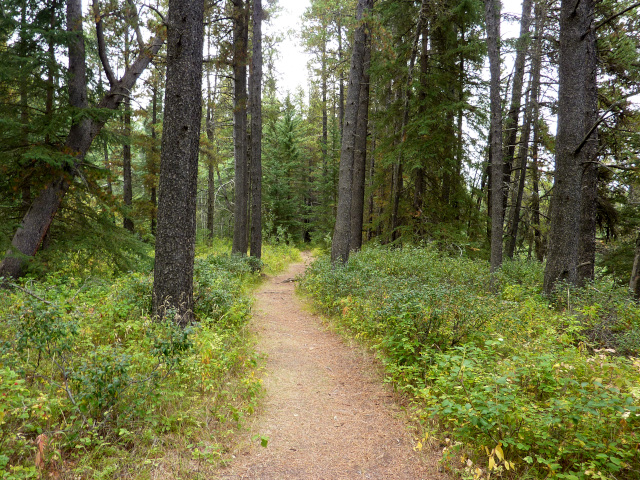
A dirt path through heavily forested area.
“The path has infinite patience” (Aboriginal saying)

            The most well-known statement about the fitness of time is from the biblical Book of Koheleth, better known as Ecclesiastes. The author, who prides himself on his realism and willingly admits the futility of most human effort, yet sees a pattern in human events that might argue for an over-arching Providence after all: “there is a time to be born and a time to die, a time to laugh and a time to mourn,” and so on. One by one, he lists the extremes of human emotion and experience and declares that there is a right time for every single one.

I have no wish to quarrel with his summary. My focus is on lesser matters, although I could indeed riff on Koheleth in a dozen ways: There is a time to accept the particular miseries of this job and there is a time to begin looking for a different one; there is a time to take risks and a time to be cautious; there is a time to say no to an obstreperous toddler and a time to forestall needless anxiety by promptly meeting immediate needs. There is a time to vote Liberal and a time to vote Conservative—oh, dear, I was not going to summon up political debate!

There is a time for everything, and a season for every activity under heaven:

Ecclesiastes 3:1

 Several occasions and important dates in the last months have led me to look back on past decisions and consider whether I had indeed followed the advice of a good friend who once assured me that I would know when the time was right for a big decision if I paid attention. I would sense, deep within myself, when, for example, I should resign from some committee whose work had once given me pleasure and purpose, or when it was time to let go of possessions that had once been oh, so important.

 Actually, I’ve been inclined to think matters are more complicated than that. I can recall decisions that seemed shaped more by circumstances and urgent need than reflection, and careful planning wasn’t possible. There had been no time to ask myself if the time was right. Sometimes inclination urged me on, yet I faced only closed doors.

 That’s not where I am now. The path remains open – there’s no blocking gate. Yet within me, the conviction grows that it is time to say farewell to a part of my identity. As of the end of this year, 2021, I shall not be an editor any more, except of my own work (if one can call repeated revisions editing). It has been a pleasure to be of assistance, to take someone else’s writing and make it as smooth and persuasive as possible without altering either the intent or the voice of the writer. It has been a wonderful challenge to learn to “hear” the writer’s voice and then make it stronger, clearer. The frequent tussles with language, when the exactly right word proved elusive, were exhilarating, at least when the battle was over.

Editing is background work. Sometimes an editor is given public credit, sometimes not. In the academic world, where I have functioned, the one who polishes the conference paper, corrects grammatical errors, and makes the list of references conform to a journal’s specifications, is rarely mentioned. That’s as it should be. I have only tweaked the details of someone else’s work—that someone should get all the credit for doing the hard work of research, sorting through ideas, and writing (and re-writing at my behest).

How is it that something that was once a pleasure, indeed still gives satisfaction, can become something that needs to be given up? I’m not sure. It seems to me that the motivation could be a range of circumstances from the changing nature of that something (a dance club that loses its sense of community through personality clashes, for example) to some change in me, the decider.

That the passage of time has something to do with it is beyond doubt. Each succeeding birthday has sharpened my awareness that time is not infinite. I do not have all the time in the world. Just as a summer of illness taught me that life is too short for me to read all the books I might imagine I wanted to read, or even to finish every book that I’ve begun, so the passing of ordinary time carries the lesson that not everything needs to be done, and certainly not everything needs to be done by me!

There are no wrong turnings. Only paths we had not known we were meant to walk.

Guy Gavriel Kay

While retirement from teaching was not an issue over which I was granted as much choice as I might have wished for, I did learn over the subsequent months that it is indeed better to step out of the working life while one is performing well than to keep going until one has become incompetent and everyone else is waiting impatiently for the end of the ordeal.

My memories of my last teaching year give me much pleasure. It had been a very good year. Besides, I was now freed from the tyranny of ever-changing technology which I would have found harder and harder to learn. Already the gap between the way I thought and the ways my students thought was growing dangerously. It was time to learn how to be a grandparent instead of a teacher; grandparents are generally granted more tolerance and forgiveness.

 As I recall the rightness of that major shift in my life, I am more comfortable now about planning to give away my style manuals and grammar books. I shall delete files, I think, without wincing, but I’m not so sure about turning my business cards into grocery lists. Perhaps I’ll keep one or two as souvenirs? Still, it is time.   

Everything that has a beginning has an ending. Make your peace with that and all will be well.

The Buddha
Another path, this time narrower and almost overgrown, into dense evergreen forest. There is a small sign indicating the beginning of  a mountain hiking trail.