Bread and Jam on New Year’s Day

            On January 1, 1996, I saw my mother for the last time. We had brought her to our home to share a meal with our children and two of my siblings who were visiting from another city. The meal was simple but featured a favourite traditional Mennonite dish – porzelkji (a deep-fried fritter with raisins, typically dipped in sugar). My mother had always served porzelkji on New Year’s Day. Two days later, I got a call from the nursing home where she lived; she had died suddenly.  

            That was 26 years ago. The complex mixture of emotions of that time have long since dissipated and been replaced by gentle nostalgia and acceptance. We had had a difficult relationship, my mother and I. While I had been the favoured last child, one last gift of motherhood for someone who measured her worth through motherhood, I had also been the most rebellious teen-ager and that precisely in the years of her menopausal misery. I was also the only child who settled down in the same city where my parents lived after selling the family farm. Inevitably, I became, in her last decades, both a necessary support and a convenient target of anger when fear and/or illness haunted her.

            Even before she died, I had begun to understand how much she had been shaped by two major traumas: the Russian Revolution when she was a child, and the Great Depression when she was a young adult. Both taught her more than she would have chosen to know about insecurity and scarcity. She never forgot those lessons.  
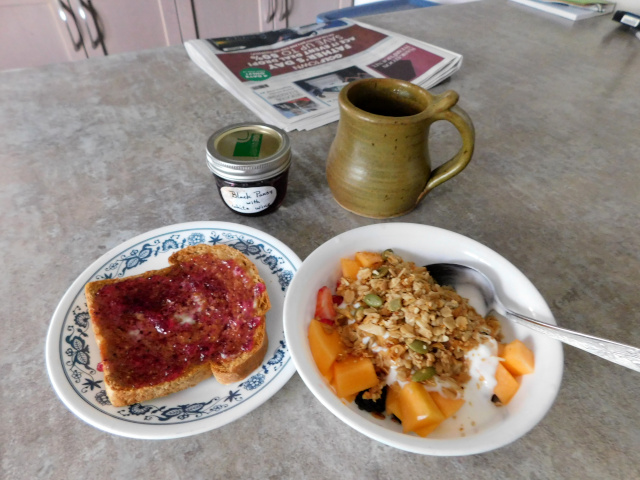
Photo of breakfast: a bowl of fresh fruit, yogurt and granola; a slice of toast spread with jam, a mug of coffee, and a small jar of homemade jam.

            All that came to mind this morning as I spread my homemade jam on a slice of toast (homemade bread) for breakfast. I chose it from the two or three jars of jams/jellies that are typically available in our fridge. Imagine that—I open more than one jar at a time! Every morning I can choose what I wish to put on my toast.

            My mother, however, had always insisted that no new jar of jam was ever, ever opened before the last one was completely used up. That was not a problem for me when we were still a family of six; even my mother’s large jars of jam were usually soon consumed. By the time I was the only child remaining at home, that was no longer the case. I was heartily sick of whatever flavour was currently open before we were permitted to have something else.

            That principle of using up the old before ever touching the new applied to bread as well (and clothing, but that’s another story), something I hadn’t particularly thought about until we were visiting at the home of one of our children where bread is also home-baked. A fresh loaf, warm from the oven, was sliced for supper even though a partial loaf from the previous baking still sat on the kitchen counter. This was a home where new delights could be fully appreciated without scruple. How wonderful was that!
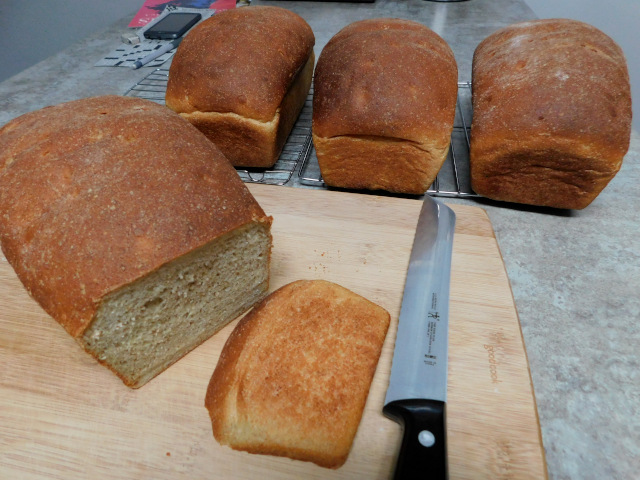
Photo of four loaves of bread cooling on racks on the kitchen counter, with one loaf already on a cutting board and one slice cut.

            Had I truly been raised in an atmosphere where efficiency and cold, responsible use of everything to its utmost had ruled out so many possibilities of innocent joy? It seems so. I want to make it clear that I appreciate my parents’ compulsion to be thrifty: they had both had intimate acquaintance with poverty, even starvation. I do not have the right to decry their practical ability to use the last bit of everything, even to hoard newness as long as possible. In the face of today’s reckless consumerism amidst an over-stressed environment, their values offer an important counter-narrative.  

            On the other hand, I want to argue that thrift and utility do not have to rule out generosity or delight. Put the freshly cooked jam, with its glorious color and wonderful odor, into smaller jars (and keep reusing those jars!). Enjoy the freshly baked bread while it’s still warm, knowing that a freezer can take care of whatever older bread remains, or turn the stale bread into croutons and avoid the packaging that comes with buying croutons (my mother would have been truly appalled at the notion of paying good money to get chunks of dried bread!). Simple pleasures are to be treasured and readily shared.


            I still have much to learn about a wider generosity that makes sure that everyone has access to bread and jam—fresh bread and good jam (preferably made from plenty of real fruit and not sugared to death). At the beginning of 2024, I grieve over the increased need for food banks and the continued waste of much food, both in the production and in the sales thereof. We can surely do better than that, although in fairness, I should note that many organizations are working to reduce waste and improve access. What I also hope for is that necessary charity includes dignity, and above all, delight. Let there be joy for everyone.

It would be a long time before I knew that grace is found more in delight than in duty.

Patrick Henry

A Christmas Wish List for My Readers

Writing a blog, which I’ve done for almost four years now, is a lonely affair. I’m not complaining, since writing is almost always a lonely pursuit. Every now and then, though, I do think more particularly about my readers and try to imagine where you might live, or what we might talk about if we could have coffee together someplace interesting–in your country or mine.

Writing about Christmas is an additional challenge because of all the designated holidays that I am familiar with, this one has been written about and sung about and indulged in and celebrated more than any other. Surely everything that can be said about Christmas, concerning whichever grand narrative you choose to focus on, has been said – many times over. A wish list, on the other, can be new every year.

Unfortunately, these days the world seems locked into so many conflicts and stupid flirtations with apocalyptic scenarios that the very act of creating a wish list seems frivolous. One could, of course, go big and like one of my grandchildren, add to the list “the moon.” Why not? Why not ask for the utterly unlikely, such as world peace?

Instead, I will retreat as I often do to the small things, for they matter more than we think: it is out of little actions that our habits of mind are formed, and it is out of our habits of mind that we make the big decisions and the crucial speeches that can change the world. Well, our own small spheres at least.

So, the list:

At least once, in the days before and after Christmas, I wish for you the time to watch an entire sunrise, preferably in a place without street lights and power lines. In my part of the world, the days are very short now, and the sun rises after breakfast, as it were. Take a cup of coffee or cocoa with you and watch the subtle first hints of color transform themselves into a blaze of glory. It is always a miracle, especially when the nights have been long and dark.

I wish for you two uninterrupted hours or more in which to curl up in a comfy chair or wide window seat where you can let yourself become utterly absorbed in a good novel. Preferably a classic or a young adult book that will bring you into a world that has a stable moral centre and in which a happy ending can be anticipated.

I wish for you many warm hugs and I-love-you’s. There might be gifts involved as well, but they aren’t that necessary, are they?

I hope that in your home, your office, your favorite hang-out, there are flowering plants. In my world, that’s most likely to be poinsettias, but maybe you’ll be lucky enough to be near a spectacular amaryllis in full bloom. Or maybe where you live, there are gorgeous flowering shrubs outdoors. Let there be someplace where you can smell the earth and savor the complexity of petals with their heavenly tints.

And this last wish might seem perverse or more like an admonition than a wish: I hope that there is at least one opportunity for a phone call or an in-person meeting in which you can say, “I’m sorry,” and be heard and still feel safe. We are none of us faultless. Without a doubt, there are individuals who need to hear an apology that will open up possibilities for better understanding. Christmas inevitably contains some tough stuff; it’s the fall-out, I suspect, from over-wrought expectations of all sorts. I wish for you one interval of time, however brief, in which hope can arise and love increase.

Merry Christmas and a Happy New Year!

Start Growing Jade

            Start growing jade when you’re young. Jade grows slowly.

I have two baby jades that volunteered to grow on their own, each from a leaf that had fallen from a mature plant. Now, some 3 years later, the initial leaves are still green, albeit increasingly wrinkled, and the baby plants are still tiny, having achieved a full inch at last. I doubt that I will live long enough to see those babies graduate to bigger pots. 

photo of tiny jade plant.

            Why do I even bother to keep them? For whom am I nurturing these little lovelies? Will the earth still be habitable when they have grown to a more stately height?

As well you might ask why human babies are so adored in nursing homes. One never grows too old to feel the tug of cuteness or to smile automatically at baby giggles. Who hasn’t been awed by the slender bones of a wee kitten – never mind whether one will ever be present to be soothed by the purring of the grown cat?  

I have asked myself if that’s what hope looks like: simply loving an inch-high jade plant. Or deciding to buy and plant a slow-growing Japanese maple tree in a yard that, given the usual odds, you won’t be able to take care of for longer than a few more years. One response to global-sized despair is to think small.

 The past weeks have been a season of despondency for me (yes, in the middle of spring with its happy colors). I am not unfamiliar with the grey shades of depression, although I can usually name precipitating circumstances. This time there is no one nameable circumstance that I can address and so find my way up from the bottom of the well. The malaise is general, diffused, phantom-like, perhaps a common characteristic of our Zeitgeist. These are perilous times.

 No, not perilous so much as just plain mean-spirited, quarrelsome, relentlessly factional, as if humanity has forgotten how to work together to solve perilous problems, simply retreating instead behind tribalism’s walls. I cannot find the energy to respond in any useful, public way.

Except to meditate on my jade plants and bid them grow as it is in their nature to grow. To rephrase Emily Dickinson’s “Hope is the Thing with Feathers,” hope is the thing with leaves, and then branches and therefore also sturdy stems, even trunks. There will be a grown-up jade someday. It will say, “I basked in the sun and sipped a little water, now and then. That is all.”  And it is enough.

 We who have language and compassion can also share the water and the sun and food. And give away a baby jade.

It’s all a matter of paying attention, being awake in the present moment, and not expecting a huge payoff. The magic in this world seems to work in whispers and small kindnesses.

Charles de Lint

We Need a New Word

Words are slippery.

They mean what they mean, yes, but they mean always within a context, and contexts change.

            As a child of the Protestant Reformation, a descendant of Mennonites (a radical branch of that Protestant Reformation), and a wordsmith, I’ve been thinking a lot lately about our political language. What on earth happened to protest since the 1500s? Why could I be proud of my religious heritage, yet so much on edge and unhappy now?

The verb “protest” has become more noun than verb. One doesn’t pro-tést these days – one joins a pró-test, and that changes more than just pronunciation and grammatical function.

 So: protest as a verb. It differs from object and from disagree. To disagree means, according to Oxford Dictionary, to “hold a different opinion.” In other words, you and I don’t think the same way about some idea or some thing or some action: cement is a better surface for an urban driveway than asphalt. There are good reasons on either side of that disagreement (cost, labor, endurance) but moral implications are absent.   

To object means, again according to Oxford, to express or feel opposition or disapproval or reluctance. That’s stronger than to disagree because emotion is involved. Whatever happens in the discussion, the one who is objecting feels hurt or offended or even appalled. That would be the distinction that my editing self would make. When my late father used to introduce me to his acquaintances as the “baby of the family,” never mind that I was already an adult with children of my own, I objected strenuously. It felt belittling to me, although I’m willing to concede now that he meant it as affection. We disagreed on the meaning of “baby” and I objected to his application of it.  

But to protest is to bring in not only emotion but moral judgment. Here I’m reaching back in time to try to recover the meaning of the word before it became a noun that means an official demonstration against government or some other powerful institution or leader. That’s the primary meaning now. Even in that noun form, perhaps especially in that form, the word carries the weight of moral judgment. A protest (noun) occurs because enough people judge some action morally wrong. It’s deemed unjust, unfair.

 If we’re talking about unfairness or injustice, it follows that the protester is in a position of less power than the person or institution against which the protest has been made. The protestor may be a direct recipient of the unjust action or maybe not. Many protests have been launched on behalf of those who had no voice or influence. The common thread is the moral judgment. This or that action is just wrong; it violates a law or some accepted standard of behaviour.

 There is something else about the verb “protest” that we seem, as a nation, to have forgotten entirely: it is intended to persuade. The very fact that the objection raised is morally justified assumes that the one who protests and the one against whom the protest is made share (or should share) a common ethical standard. The concept of injustice makes no sense without an accepted definition of justice.  Martin Luther, who inadvertently began the Protestant Reformation, appealed to the standard of the Bible and the tenets of Christianity when he protested against several actions of Roman Catholic clergy. His initial intention was first open discussion, then persuasion, based on a common faith.  

(Generally speaking, it is, of course, possible that the objection has been made in bad faith and is not morally justified; equally possible is that those whose behaviour has been objectionable do not have any ethical standards to which one can appeal. Neither case invalidates the protest’s initial purpose of persuasion. I insist that the ideal not be forgotten.) 

            By this point, given the current political climate, all sorts of righteous stances are doubtless being claimed by my readers, not to mention fervent disagreements with my definition of “protest.”

 So I will retreat temporarily into a simple illustration taken from my teaching years. A student was unhappy with an assigned grade; she felt certain that I had marked her paper unfairly because I was prejudiced against her. That is a moral problem. While some subjectivity is always a factor in marking essays, outright unfairness is unacceptable, not only to students but also to university administrators and department heads.   

As long as my student expressed her opinion courteously and presented evidence for her accusation, she was completely within her rights and could hope to be persuasive. My role was either to offer a reasonable explanation of the grade or to acknowledge her point and re-evaluate the paper (and/or ask a colleague to evaluate it). Either way, we should have been able to end the discussion with our dignity intact. Indeed, it could have been the beginning of an improved relationship.  

 However, if she had insulted me as a person and added threats of character assassination or even worse, she would have crossed a line between protest and blackmail—“you do this or I will ruin you.”  That is not yet physical violence, but it is violence. Her protest would have given up the moral high ground and become intimidation, thus turning the interaction into a power struggle, which leaves no one’s dignity intact, and makes an improved relationship very difficult, indeed. 

 When Martin Luther King, Jr., and Gandhi before him, insisted that any and all protests should remain non-violent, in language and in action, they were aiming at persuasion, which seeks to make clear what the relevant moral principles are and appeals to both a common humanity and a common acceptance of those moral principles. This is not to say that protests against long-standing evils such as slavery are easy. By no means. Many, perhaps most, slave-owners saw the protest marches as intolerable uppity behaviour by those whom God had made to be their slaves. As long as the marchers refused to turn their protest into rebellion, they kept the moral high ground and underlined the principle of a common humanity, something the slave owners had consistently denied. 

            I indicated earlier that I was a descendant of Mennonites, first known as Anabaptists, who refused to bear arms and developed a strong code of pacifism. Other groups like the Quakers have also chosen non-violence. That does not rule out protest. To speak up against unfairness and injustice, even oppression, is a moral obligation, especially if the speaking up is not for oneself but for those who cannot speak up.

But the way of peace refuses violence in all its forms, and seeks reconciliation. That is the ideal. I cannot speak for Quakers but I know that Mennonites have not always avoided violence, either on the national stage or in their own families. The teaching remains, though, challenging us to seek actively to make peace.

 I confess that I am congenitally disposed to avoid even legitimate protest. I will write letters to my elected representatives (not very often), but I do not march or carry signs. My preference is to “guard each man’s dignity and save each man’s pride,” to quote from a 1970’s Christian worship song.  Other cultures value the “saving of face” which is simply a different metaphor for the kind of agreement that allows for gracious exits from the conflict.

            Is that always possible? I don’t know. Some situations do present themselves as inherently impossible, yet I have read many inspiring stories of people who have suffered much rather than use violence and have ultimately brought about lasting change. Stephan A. Schwartz argues that social changes attempted through revolution and violence generally do not last as long as those social changes created through non-violent means. He lists several examples, including universal education, abolition of slavery in countries such as Britain, universal health care. Remember the old saying, “a man convinced against his will is of the same opinion still”?

As Stephen Berg wrote in “Deer in the Mist,” “insisting on angels drives angels away.” Or as I heard in a sermon many decades ago, the way of spiritual grace is always a matter of “gift,” not “grasp.”

Everything real, happens first,
out of sight, in the far away furnaces of courage
which are fueled, not by passion, but love.
(Stephen Berg)

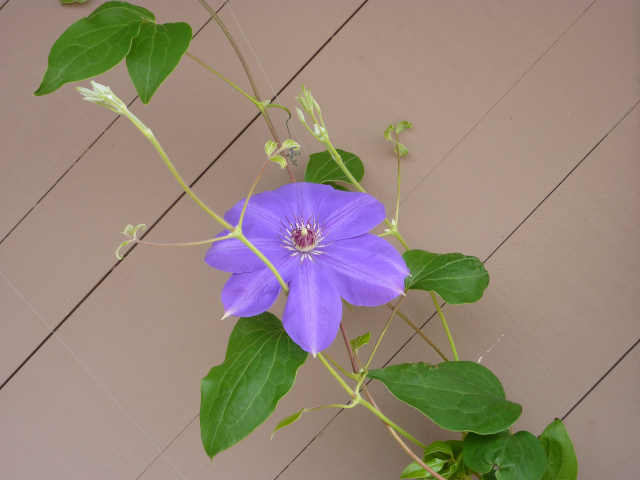
Photo of a single clematis vine climbing up a wall with seemingly nothing to cling to. There is one lovely mauve flower.

Thinking About Report Cards

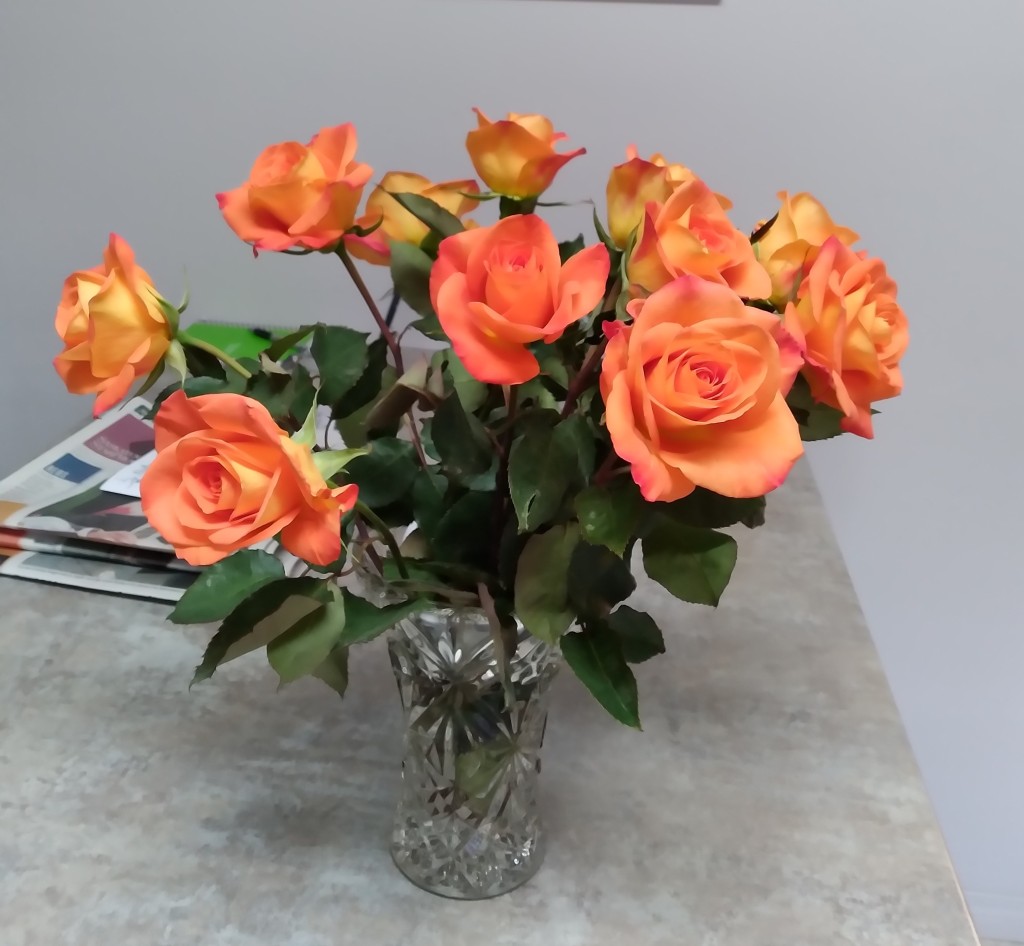
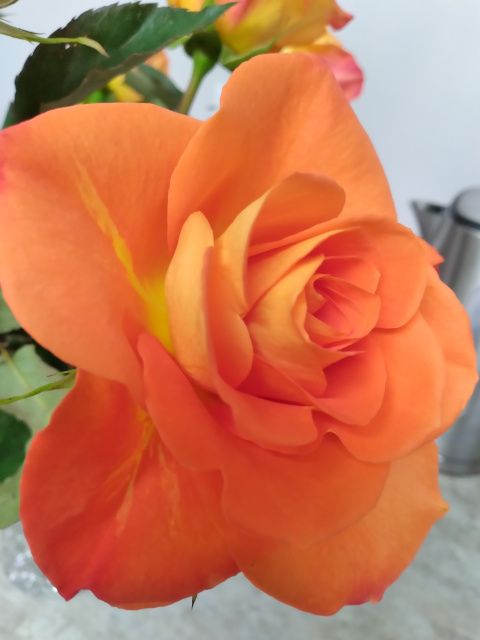
photo of a vase of a dozen coral roses

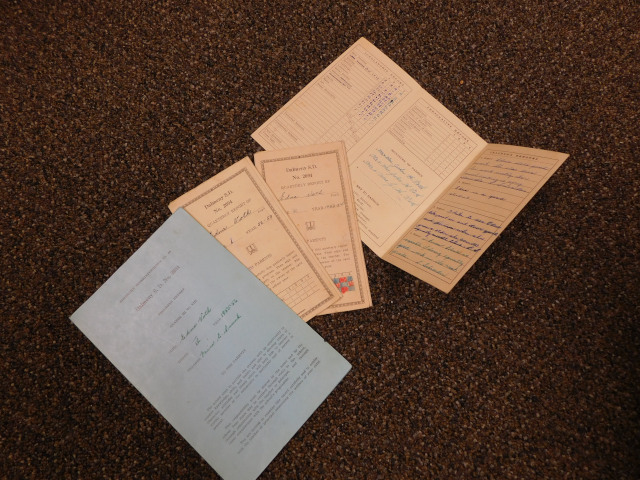
A prowl through a file cabinet drawer, long untouched, revealed a collection of report cards with my name on them (Grades 1 – 12). Oh, my. There were some blunt comments from teachers about my hopeless handwriting—that mattered in those days—and inconsistent work habits, and one anomalous observation on the Grade 3 report card that perhaps as I grew older I would take part more in outdoor sports.

photo of my report cards from Grades 1 - 4.

Remember those report cards, and the trauma of taking them home? Those were the days when children could fail their grade and be asked to repeat it. I was never seriously concerned about that possibility, yet still anxious about what I might have to take home to be signed. Would the report card be good enough that I wouldn’t get any reprimands? My siblings and I were expected to do well in our studies and to conform to strict standards of behaviour. And where there is a clear expectation, there is also the possibility of failing to meet it.  

Which raises two questions, I suppose, with wide application: how clear and reasonable is the expectation? how fair and appropriate is the evaluation?  That bygone teacher who bemoaned my lack of participation in softball had known nothing about the daily hours I spent outdoors walking, exploring, doing farm chores, playing with animals, helping in the garden, even reading in secret places in the nearby bushes. She could not have known that for me solitude in the natural world felt infinitely safer than the ball diamond.   

And I began thinking about the edginess in our societies these days.  I use the plural form of “society” because ever-present social media have created separate cultural groups whose component parts span continents, and because the pandemic has encouraged the creation of very small sub-societies along with huge online silos of rigidly held opinions. No longer do the report cards, in whatever form they take, come only once a year.  

 We live now with evaluations all the time: some are formal, such as work performance reviews, grades on particular projects, peer reviews of publishable articles, demotions or promotions, professional degrees, trade certifications; some are informal, such as the disappointment or delight on someone’s face, a welcome invitation to a social occasion or utter silence from former friends, thousands of likes or brutal online bullying, a stunning bouquet delivered at the door or a package of dog poop left on the porch, acceptance or rejection. There is not much point in railing about the unfairness of evaluation itself—who can ever really grasp everything about someone else’s circumstances or motives?—because we simply cannot manage without evaluations, both great and small.  To be realistic here, I should admit that we have always been living with evaluations; they are nothing new.

 Do we not get quotes for prospective building projects or home renovations? Each business that submits a quote will be evaluated. Do we not develop friendships with former strangers on the basis of our judgment of their trustworthiness and compatibility? Do we not evaluate the politicians who present themselves for office and call for our votes? It’s important that we take time to decide whether trust is justified or not. Will we listen to the cold call we just got on the phone, or slam the receiver on yet another bogus message about credit cards? (It is really too bad that cell phones have no slam option). Will we respond warmly to the chatty clerk or resist what feels like too much sales pressure?

There are degrees of judgmentalism, of course. Some of us are suspicious, automatically assuming that others’ motives must be nefarious at worst, self-interested at best; some of us are more open, assuming that others are well-meaning until we are clearly proved wrong. I am using the personal plural “we” and “us” rather freely here to underline the fact that none of us is entirely one kind of person or the other. Our motives are not consistent; our behaviour is not consistent; our tolerance of risk varies; our ability to learn and change is always there.

 Herein lies the importance of report cards. They do not function only to regulate who is allowed to proceed and who is not qualified for some task (and I know of no society that does not have some such structure for organizing itself). For now, think instead of the personal value for the recipient of the report card, whether it be an actual document with an official seal on it or not.  

  The phrase that comes to my mind is Canadian novelist Adele Wiseman’s description of Abraham, the key character in The Sacrifice. He has visualized himself as a very important man in his small Jewish community; he may be just the local butcher but he’s also a keen student of Torah, a master story-teller, a man of wisdom who “knows” that God has a special role for him. He is, after all, Abraham (and Wiseman gives him no surname). But there comes a moment in a terrible family conflict when the angry words of his daughter-in-law become a “mirror flipped up in his face and he himself stood revealed as he was to another, a stranger. . . (The Sacrifice 316, emphasis mine).  

  That is the function of evaluations. How can we know ourselves without the reactions of others? Child psychologists speak of the importance of parents mirroring the infant’s efforts to communicate. The return smile and the verbal echoes tell the little one that she/he matters. Ditto for the clapping games and the singing and the hugging. The babe is busy discovering a self through parental affection—a process that remains mysterious, despite all the books and much documented experience.  

 This discovering of a self, shaping a self? I understand far too little to hold forth on it with any wisdom. What I do know is that, necessary as unflattering report cards are now and then, equally necessary, in far greater measure, is affirmation of the various selves that we live out in our daily lives—affirmation that is needed in both the giving and the receiving.  

 In these days of way too much judgment and far too many anonymous “report cards” circulating online like some virus worse than COVID, perhaps the best thing we can do is to flip up a gentler mirror that reflects respect: “I see you, and you are a human being of great worth.”

I wish I could show you

when you are lonely

or in darkness

the astonishing light

of your own being.

            (Hafiz)

Photo of a single coral rose.

What We Can Choose – an exercise in the obvious


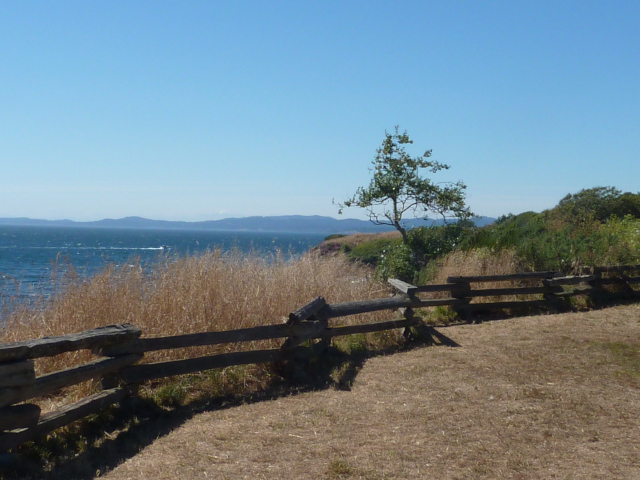
Landscape with ocean and mountains very much in the background. In the foreground is a high bluff with dry grasses, one lone small crooked tree and a wooden fence that angles from the bottom left-hand corner to the middle of the right hand. The photo is a combination of wide vistas and a fence that draws a clear boundary between dried-up lawn and wild grasses.

To begin at the beginning—and I said this would be obvious—we did not choose to be born. Or to be born as a human being. However you view the world that you know, whatever framework of meaning you might use to contemplate your momentous birth, you were most definitely not the one who decided that you would be a human and not a tadpole or a poodle or a grizzly bear.

It follows that you also did not decide what hormones would be dominant in the microscopic wiggly something that was your first shape. So one of the first pieces of your identity, which usually determines the kind of name you get, was not your choice. Okay, changing names is an option; even changing gender is now possible. What is not possible to change is what you came into the world with in the first place.

 Ditto for your parents and your surroundings. You did not choose the year of your birth or the location. You did not choose the economic situation of your mother (or her relationship to your father), the color of your skin, your genetic make-up, your biological relatives, your first language, the culture in which you practiced that language, your first notions of spirituality. None of those momentous determiners out of which come so much of what makes you who you are were chosen by you. Not one.  

 So we cannot logically claim credit for any of those momentous determiners of our identity. Nor can we blame ourselves or anyone else, for what was not ever chosen, by us or them.  

 Am I belabouring the obvious here? Yes, I am. Because too many discussions—in our public squares, in our courts, in our governments, in our living rooms—ignore the obvious. Should a child born in a refugee camp or in city slums be despised for being poor? No. She did not choose poverty. Should the child with millions in her bank account before she can count to ten be respected for that very fact? No. She did not choose it or earn it. Should the dark-skinned individual be blamed for her skin? Or be made into a curiosity because of her kinky hair? No, absolutely not.  

 Let me be specific and personal. I do not deserve praise or blame for being a woman or being light-skinned or even for being born into a family and culture that valued hard work and education. Whatever advantages were granted to me simply because of where and when I was born were indeed mine to use or not to use, but I need to remember two facts. One is that not everyone comes into the world with similar choices available; two is that I actually had considerably less choice in many ways than I once imagined. I could not, for example, as a teenager in a small Mennonite town, have chosen to become Muslim—that was not within the range of possibility for me until I was in my thirties or forties probably, once I had actually met Muslims and learned something about Islam.

 We tend to treat religion and sometimes politics as well as if those stances can be freely chosen from a wide spectrum of offerings. Not so. It would, for example, have been actually impossible for someone living in Shakespeare’s time to become an atheist. The very concept had not yet taken shape. One could be Catholic or Protestant—that choice had become available, probably within Shakespeare’s living memory. Mostly, though, one was what one had been born to.  

 To imagine that it is readily possible to choose from many religions is a modern idea not often sufficiently qualified by the fact that our initial worldview, through which we view all subsequent options, is given to us before we are old enough to choose anything. I would argue that “choosing” our political views is equally contingent upon the culture in which we have first learned to think politically and the political surroundings to which we have been subsequently exposed. Surely that fact should temper any impulses we might have to label the “other” party as the enemy or to see ourselves as supremely righteous and clever for belonging to “our” party. Not that changing a political stance is impossible, nor that converting to another faith is impossible. Clearly not. As Viktor Frankl wrote, “Between stimulus and response there is a space. In that space is our power to choose our response.” Nevertheless, an acknowledgement of contingencies that shape habitual responses could help to defuse tense conversations.

Between stimulus and response there is a space. In that space is our power to choose our response.

Victor Frankl

 Popular metaphors regarding the philosophically fraught business of choosing include the well-used image of “playing the hand that we were dealt.” When playing poker or bridge or even solitaire, our ability to choose is severely limited, not only by the cards that are actually in our hand for each round of play but also by the rules of the game. Moreover, how we play our cards will depend on who else is sitting around the table (are they highly competitive, poor losers, cheaters, family members, strangers?) and what the stakes might be (are we playing for peanuts, or laughs, or hundred dollar bills?).

 Theoretical speculation and playful metaphors aside, may I ask as politely as I can, what is going on in the current intensity of political and racial language, all amid an insistence on “freedom of choice”? As if everyone has available all manner of choices.  

Let me try to illustrate: it is highly unlikely that I will choose my response to a police officer on my front step from an infinite list of options because the very fact that I have a front step on which the officer can stand already rules out quite a few possibilities, such as an immediate fear of eviction. The additional fact that it is highly likely the officer will have the same color of skin as I do rules out more possibilities. I will still probably feel real fear, but it will be fear that someone I love has been hurt in an accident, not fear that I’m about to be arrested for something I may or may not have done. In other words, I enter a particular event out of my own context, shaped by various givens, and by the experiences I have lived through before that moment, only some of which I could have chosen.   

  I belong to the Boomer generation; that means that my economic opportunities will have been different than those of my parents and different again from those of my children, and of my grandchildren. My parents were immigrants, so it’s no surprise that I learned the virtues of hard work and education. Then again, my parents were Mennonite and I was a girl, which means that the value of hard work applied but the value of education would have been tempered by certain assumptions about women’s place in the world. Could I have, as a teen, decided I was going to be Christian missionary? Yes, definitely. That option was endorsed by pretty well everyone I knew. Could I have decided to become a politician and hope to become premier of the province? Not in my wildest dreams. Could such options have opened up for me later in my adult years? Possibly, but with great difficulty.

 Buried beneath the obvious limits set by culture and religion and language and economic opportunity is the shaping of the individual personality which unfolds in a mysterious symbiotic process of givens and choices, each of which exercises influence on future choices and even on the terms in which memories are recalled. Psychologists have studied these variables since psychology became a recognized science. Long before that, though, parents have agonized over causes and effects ever since Adam and Eve somehow ended up with a devout and biddable shepherd and a jealous gardener turned murderer.

In other words, we do all have choices to make, important choices, which we make within a range of possibilities, choices for which we are responsible. I’m not arguing for complete determinism, just pointing out the inevitable limits of free will – limits that should curb our judgmental impulses and intemperate rhetoric.

Photo of forest on Vancouver Island but the trees are low except for one scrubby evergreen bent by prevailing winds to a 45 degree angle. In lower right hand corner is a path.

The good news, as I see it, is that if we choose to, we can expand our range of possibilities. While it’s true that we were all gifted with the worldview through which we first tried to make sense of who we were, we can choose to widen that worldview, just by letting ourselves hear other stories. I can dismiss as nonsense your belief that houses should be always immaculate, for instance, or I can ask to hear your story about how that belief came to be yours. In the process of telling and listening, both of us could adjust our perspectives.

  I admit that our capacity to absorb new information is limited. It is not possible to know everything and to hear everyone’s story with sympathetic mind. The first action is limited by the sheer abundance of stuff to know, and the second is limited by one’s emotional and imaginative capacity, which has not been developed equally in all children. Nevertheless, each story I listen to with as open a mind as I can manage will exercise my imaginative faculties and enlarge my perspective.

 Then perhaps I can learn to defer judgment or animosity until I have heard more of the story. That’s a choice that becomes ever more available as I practice it.     

To be continued.  . . . .      

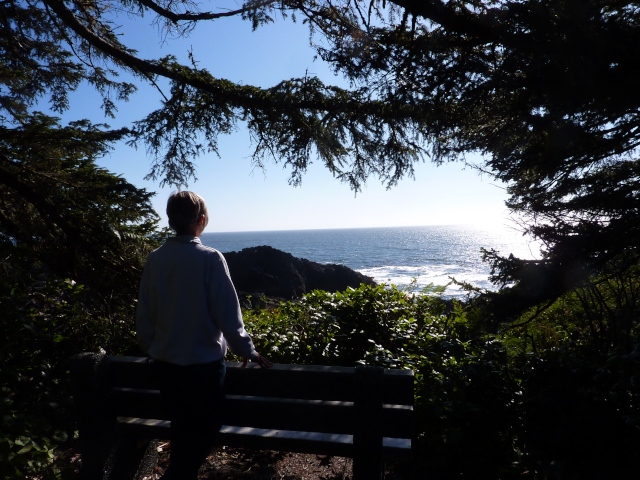
Later afternoon sun on the ocean in the background. Foreground is the author staring through the trees at the ocean, leaning against a bench.

When the Time Is Right

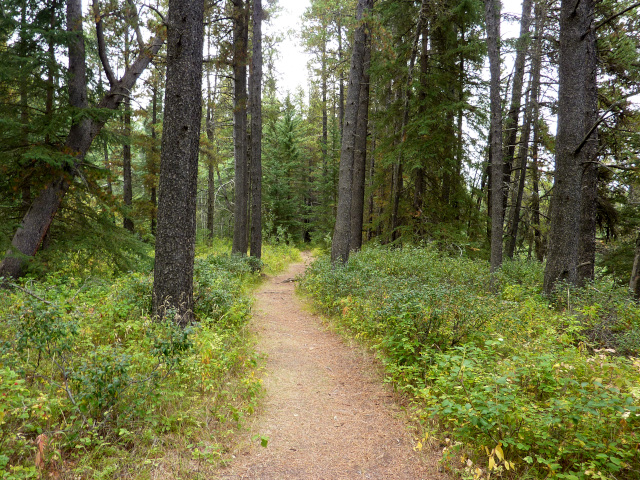
A dirt path through heavily forested area.
“The path has infinite patience” (Aboriginal saying)

            The most well-known statement about the fitness of time is from the biblical Book of Koheleth, better known as Ecclesiastes. The author, who prides himself on his realism and willingly admits the futility of most human effort, yet sees a pattern in human events that might argue for an over-arching Providence after all: “there is a time to be born and a time to die, a time to laugh and a time to mourn,” and so on. One by one, he lists the extremes of human emotion and experience and declares that there is a right time for every single one.

I have no wish to quarrel with his summary. My focus is on lesser matters, although I could indeed riff on Koheleth in a dozen ways: There is a time to accept the particular miseries of this job and there is a time to begin looking for a different one; there is a time to take risks and a time to be cautious; there is a time to say no to an obstreperous toddler and a time to forestall needless anxiety by promptly meeting immediate needs. There is a time to vote Liberal and a time to vote Conservative—oh, dear, I was not going to summon up political debate!

There is a time for everything, and a season for every activity under heaven:

Ecclesiastes 3:1

 Several occasions and important dates in the last months have led me to look back on past decisions and consider whether I had indeed followed the advice of a good friend who once assured me that I would know when the time was right for a big decision if I paid attention. I would sense, deep within myself, when, for example, I should resign from some committee whose work had once given me pleasure and purpose, or when it was time to let go of possessions that had once been oh, so important.

 Actually, I’ve been inclined to think matters are more complicated than that. I can recall decisions that seemed shaped more by circumstances and urgent need than reflection, and careful planning wasn’t possible. There had been no time to ask myself if the time was right. Sometimes inclination urged me on, yet I faced only closed doors.

 That’s not where I am now. The path remains open – there’s no blocking gate. Yet within me, the conviction grows that it is time to say farewell to a part of my identity. As of the end of this year, 2021, I shall not be an editor any more, except of my own work (if one can call repeated revisions editing). It has been a pleasure to be of assistance, to take someone else’s writing and make it as smooth and persuasive as possible without altering either the intent or the voice of the writer. It has been a wonderful challenge to learn to “hear” the writer’s voice and then make it stronger, clearer. The frequent tussles with language, when the exactly right word proved elusive, were exhilarating, at least when the battle was over.

Editing is background work. Sometimes an editor is given public credit, sometimes not. In the academic world, where I have functioned, the one who polishes the conference paper, corrects grammatical errors, and makes the list of references conform to a journal’s specifications, is rarely mentioned. That’s as it should be. I have only tweaked the details of someone else’s work—that someone should get all the credit for doing the hard work of research, sorting through ideas, and writing (and re-writing at my behest).

How is it that something that was once a pleasure, indeed still gives satisfaction, can become something that needs to be given up? I’m not sure. It seems to me that the motivation could be a range of circumstances from the changing nature of that something (a dance club that loses its sense of community through personality clashes, for example) to some change in me, the decider.

That the passage of time has something to do with it is beyond doubt. Each succeeding birthday has sharpened my awareness that time is not infinite. I do not have all the time in the world. Just as a summer of illness taught me that life is too short for me to read all the books I might imagine I wanted to read, or even to finish every book that I’ve begun, so the passing of ordinary time carries the lesson that not everything needs to be done, and certainly not everything needs to be done by me!

There are no wrong turnings. Only paths we had not known we were meant to walk.

Guy Gavriel Kay

While retirement from teaching was not an issue over which I was granted as much choice as I might have wished for, I did learn over the subsequent months that it is indeed better to step out of the working life while one is performing well than to keep going until one has become incompetent and everyone else is waiting impatiently for the end of the ordeal.

My memories of my last teaching year give me much pleasure. It had been a very good year. Besides, I was now freed from the tyranny of ever-changing technology which I would have found harder and harder to learn. Already the gap between the way I thought and the ways my students thought was growing dangerously. It was time to learn how to be a grandparent instead of a teacher; grandparents are generally granted more tolerance and forgiveness.

 As I recall the rightness of that major shift in my life, I am more comfortable now about planning to give away my style manuals and grammar books. I shall delete files, I think, without wincing, but I’m not so sure about turning my business cards into grocery lists. Perhaps I’ll keep one or two as souvenirs? Still, it is time.   

Everything that has a beginning has an ending. Make your peace with that and all will be well.

The Buddha
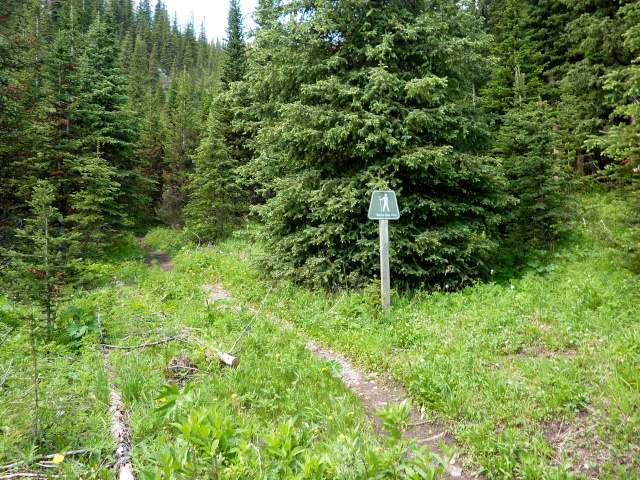
Another path, this time narrower and almost overgrown, into dense evergreen forest. There is a small sign indicating the beginning of  a mountain hiking trail.

Updating the Public Calendar

            Every now and then, when the times are right, previously unthinkable ideas suddenly gain a sympathetic hearing. We are, just now, in a time of re-evaluating public monuments and asking hard questions about who gets a monument and why. If it was monuments I wanted to write about this time, I would definitely begin with Percy Byssche Shelley’s“Ozymandias,” a poignant reminder that nothing remains forever, not even monuments.

I’m not sure that there is an equally apt poem for helping us ask who should get a calendar day or when we might remove a special day or whether we could demote a public holiday into just a named day only. We should consider that more often, I think.

A Mother’s Day card given to me

In early May, in the week before Mother’s Day, I heard an elementary teacher interviewed on CBC Radio say firmly that Mother’s Day shouldn’t even be mentioned in the school, although she had no objection to families acknowledging the day in whatever way was suitable for them. She herself refused to ask her students to make special cards or crafts for their mothers because it was too emotionally complicated. Perhaps the time has come for some rethinking.   

So what is Mother’s Day like for you? I’ve heard such a variety of stories here, and could tell a few of my own, if I chose (which I won’t). For some children, it’s a special, beautiful day with flowers for Mommy and a child-cooked meal, liberally seasoned with love. For some children, it’s an awkward day filled with anxiety about what mood Mommy might be in. Or it could be a bitter day because there is no Mommy there to honor.

 For some mothers, it’s a tender day, time to smile with pleasure over the simple offerings made by childish hands. Perhaps the children are grown now with young ones of their own and the gathering of the clan on Mother’s Day is full of comfortable satisfaction of seeing traditions continued, new adventures begun, and affectionate, happy teasing passed down from uncles to nephews and nieces.

For other mothers, the day is wracked with regret, with submerged grief, perhaps overshadowed with inter-generational violence. What do you suppose Mother’s Day might mean for Indigenous mothers whose children were taken away? who never saw their children again? The fulsome compliments printed on the inside of many Mother’s Day cards can be agonizingly remote.

And I have not yet mentioned the women who are not mothers who wish they could be. It’s a complicated day, indeed.

            May I suggest that it is time to readjust our calendars and allow Mother’s Day (and Father’s Day, too—all of the above observations apply) to become a matter of private choice?

Back in the early 1900s, when Mother’s Day was inaugurated officially, women were still generally assumed to have been created to become mothers. Never mind voting, never mind holding office, never mind taking up respected and well-paid careers—women were designed solely to have and raise babies. They were limited to service and work that earned little—either money or respect. Mother’s Day, with its call for gratitude, served an important purpose in its recognition of the role and work of women, even as it unfortunately raised expectations for mothers without opening up other avenues of being. Surely we have now moved beyond that stereotype, and have also recognized that families come in different forms and that nurturing is done by many others besides mothers. That observation is not, by any means, meant to diminish the importance of having and raising babies.

Herewith, I offer three suggestions for making Mother’s Day unnecessary:

One, foster a culture of gratitude through small daily rituals. Teach your children from the time they learn to talk to say a clear “thank you for breakfast” (and lunch and dinner) to whoever made the meal. Teach that ritual through modeling. If Papa baked the bread, say thanks. If Big Sister made the salad, say thanks. If Baby set the table, say thanks. Say “thanks for doing the laundry,” even though that individual always does the laundry. Say “thanks for cleaning the bathroom – it looks lovely.” Express appreciation for simple tasks throughout the household, however that household is composed. Say thanks to your roommate for tidying her room, and do it without sarcasm or judgment. Keep it simple but be grateful.

While we’re at it, let’s practice those rituals of gratitude at the work place and in our neighbourhoods. Say thanks to the longsuffering individual who finally cleaned the staff room. Say thanks, often, to the night-time cleaning staff, to the boss, to the front-line receptionist. Say thank you to the grocery store cashier, the delivery person, the mail carrier. Let pandemic awareness of the services of other people continue long past the pandemic.

Two, extend the gratitude from specific tasks to states of being. Try the occasional “I like seeing you cuddled up with the dog; it makes me feel comfy”; “when I see you lost in a book, I’m pleased for you”; “your giggle is so happy it’s contagious – did you know that?” For some of us, that might take a tremendous effort of will and some practice. Given that when I was a child, I saw (and felt) far more of criticism than gratitude, it’s been a long hard course of learning for me that’s still not finished.  

Three, make birthdays a big deal. Birthdays are individual days; they’re marked just on your calendar not on public calendars. Find ways of bringing joy and recognizing the unique personhood of the people who are close to you. Birthdays are not about how well someone fills a particular role (that’s what has always made me uncomfortable about Mother’s Day—those outsize expectations always left me feeling guilty). Birthdays are about the gift of being that that person has brought into the world. Celebrate that! 

To put it simply, I wish we could recognize the worth and dignity of each human being, never mind special days. Practicing rituals of gratitude in our household and in our work places and in our public spaces might well undercut societal evils such as the racism that is only too obvious in recent news headlines. For sure, there is a desperate need also for structural reform, but for now, I’m thinking of the small deeds, the simple words that can spread an impact for good.  

May I now say, “thank you for reading this”?   

A handmade thank you card from a friend. Inside was a personal note of gratitude.

In the Ending is the Beginning

“In my beginning is my end. . . . / In my end is my beginning.”  

T. S. Eliot
Photo of an old rotting tree stump with a bright green baby fireweed plant in front of it, growing in between the roots of the stump.

            There is more than one way to tell a story—although when it comes down to it, they do all have a beginning, a middle, and an end. In our everyday story-telling, we instinctively begin at the beginning of whatever event is at the heart of the story and then talk our way to the end. So the beginning, middle, and end correspond directly to the actual chronology of it all, although even the most inexperienced raconteur seems to know that drama and suspense can be intensified by judicious pauses, or brief digressions to supply context.   

Reality itself rarely unfolds that simplistically; it does not hesitate at the right moment, or offer some wise reflection along the way. Right in the middle of an experience, our memories intrude to remind us that we’ve felt this way before, and our instinctive behavior patterns kick in to make the ongoing development something of a reprise. In other words, keeping to strict chronological time is probably impossible, both in life and in story.

 Not surprising then, that story-tellers sometimes begin in medias res – “in the middle of things.” In movie parlance, any given scene can be fleshed out with a backstory. And any beginning is an arbitrarily selected point, because one could always take one step backward and offer yet more context and more causal explanations. Just so, endings can always be added to because any loose thread can become another beginning. Even the tidiest epilogue has within it the seeds of another story or two. Writers of serially published fiction in print or on screen (e.g. Charles Dickens, J.K. Rowlings, Julian Fellowes) know very well how eagerly readers apply pressure for a happy ending or beg for yet another installment

 While the earliest novels were usually chronologically organized, it didn’t take long for novelists to experiment with where to begin the story and how to tell it: perhaps in the middle of things, asking the reader to persevere through bewilderment until flashbacks offered clarity; perhaps almost at the end and then working backwards, as it were; perhaps in two entirely different time sequences and then moving two plots forward alternately until they finally converge. And so on. Omniscient narrators, who could explain all motives and see into every character’s mind, gave way to assorted first-person narrators, some trustworthy, some not, thus asking readers to make moral judgments with no more assistance than is offered in real life.

 Yet the end is always the end. That is, the story concludes where the story-teller chooses—it may or may not offer the reconciliation and satisfaction we had hoped for. Still, it ends. In the words of medieval romance stories, “there is namore to say.” Whatever the desired effect, the author has shaped the story toward that final end at which point the reader closes the book and begins to reflect on how it all happened and what it might mean.  

A few paintbrush flowers growing out of the rotted remains of a fallen tree.

            For most of my life, I took for granted not only that stories had beginnings and middles and ends, but also that readers should submit to the choices authors had made about what went into the beginning, the middle, and the end. I opened all storybooks, chapter books, and novels at page 1 and read my way through to page 120 or 789, however long the story arc stretched. I would not have dreamed of reading the ending first. Indeed, if a friend had already read the book, I ended the conversation promptly at the first hint of what the ending would be. No spoilers, please!

 Yet I had begun rereading stories almost as soon as I learned to read, thanks to frequent scarcity of books. If I’d already read everything that happened to be in the house just then, I reread books rather than not read, some of them many times. I learned very early, that while the pleasure of the second reading was quite different from the pleasure of the first, both were delightful. To use Booth’s image from The Company We Keep, I happily spent time with my favorite book friends, even though, or maybe because, I already knew how their lives would turn out. That knowledge actually increased the bond between us. In the absence of suspense, I could savor each moment along the way, instead of skimming frantically to find out what happened next.

 Had I been more theologically inclined at that stage, I might have recognized that I was trying on God’s omniscient perspective. Was there not something godlike about smiling yet again at Austen’s Elizabeth Bennett (Pride and Prejudice) in her initial dislike of Darcy and her utter misreading of his character? Or about my tenderness toward Alcott’s Beth (Little Women) going to visit the destitute, knowing full well that Beth would eventually die because of that visit? Or the frisson of dread near the end of Downton Abbey’s Season 3, watching Matthew in his joyous expectations of the future, all ignorant that his future was almost over? To know the end from the very beginning increases our awareness of our own mortality, and might well increase also our discomfort with not knowing how our end will arrive or when.

Bright yellow arnica flowers flourish under the dry branches of a dead, fallen tree. A few rocks rest beside the brightest flowers.

            In the memoir The End of Life Book Club, author Will Schwalbe reflects on his experience of sharing books with his mother during her last year of life. As they negotiate the hopes and fears of terminal cancer, spending hours together during her chemotherapy appointments, they choose books alternately and discuss their reactions. An unusual book club, indeed, with only two members and a known, inevitable ending to its duration.

In one conversation, Schwalbe admits that he “found the book terrifying,” Forgetting his mother’s habit of reading the end of books first, he adds, “And I was very surprised by the ending. Were you?” “Of course not—I’d read it first,” she replies, “I don’t think I could have stood the suspense if I hadn’t known what was going to happen. I’d have been way too worried.”  

 When I first read that, many years ago, I was appalled. How could you spoil book after book like that? I did not know then that I would eventually join her and become a “spoiler” of endings.

It first happened about a quarter of the way through a memoir I was reading for the world’s best book club (see previous post – “The Measure of a Story”). I felt so wounded by family dysfunction, so appalled by repeated, self-instigated personal disasters, and so offended by life-style choices that seemed morally blind to me, that I skipped to the last chapter in order to bring the pain to a quick end. Then, once I knew that the author had achieved a form of survival that I could admire, I had just enough interest left to read the second-last chapter, and then the third-last chapter, and on. It was an odd reading, for sure, a reversal of the usual order of things. Could one have called that a God’s eye view of a human life? Forward and backward and forward again? Time so elastic as to be irrelevant?

 Since then, I have defied the authorial order of things more and more frequently. Maybe it’s the uncertainty of living through the pandemic, maybe, too, my awareness of my own mortality that have made it almost impossible for me to endure too much suspense. Before I can allow myself to become involved I need to be reassured that the ending will not be arbitrary or unbearably bleak, but has evolved appropriately out of the beginning. I want more by way of hope than just a chin-up acceptance that life is horrible but some people can still be courageous.  

That must be why, in this year of the pandemic, I’ve become addicted to murder mysteries, that is, those written by authors who use the genre conventions to explore moral dilemmas and social issues rather than exploit violence for dubious ends. In P.D. James’s novels, for instance, I know that the lead character, Inspector Adam Dalgleish, will survive because he has to be there in the next novel. I have also learned to trust James’s moral sense; there will be examination of motives and a nuanced exploration of evil and of goodness. That is enough to make the intervals of suspense bearable. The world will come out right at the end, but not with a superficial “rightness” that ignores reality or the free will of the characters.

            The ending has always been in the beginning; it is not random, nor is it pointless. These days that’s more important than it has ever been.

In the uncertainty of pandemic days, when numbers go up and numbers go down, restrictions are tightened, then loosened, then tightened again, I have found comfort, not only in predictable yet nuanced fiction, but also in the ways of the earth. Out of the ending of some organic matter arises the beginning of other organic matter. Life and death will not let themselves be sorted into separate meanings. It is not only in story that beginnings and endings entangle themselves but in our lives as well. Hence the photos that intersperse this text. Out of every ending arise new beginnings; together they are beautiful.

Everything that has a beginning has an ending. Make your peace with that and all will be well.

(the Buddha)
A few delicate orange wood lilies, blooming in a mass of green grass and shrubbery and next to the dry roots of a fallen tree.

Remembering the Winter of the Heart – a Reprise

Rabbit in an early unseasonably early storm. It’s about as prepared for winter as we were in November 2020.

Just over two years ago, the second posting on this blog was called “Remembering the Winter of the Heart.” In the wake of a full year of COVID-19, my mind has been drawn to re-visiting the season of emotional winter. In February of 2018, I was grateful that life consisted of summer and winter, both literally and emotionally. The balance, I declared then, was necessary and fruitful.

 Since then we have, as an entire society, explored dimensions of solitude that have always been familiar to contemplatives but not to the rest of us. Our homes have become our fortified castles, not just brief resting places between multiple commitments elsewhere. We have collectively bought more jigsaw puzzles and books than airline tickets and hotel reservations.

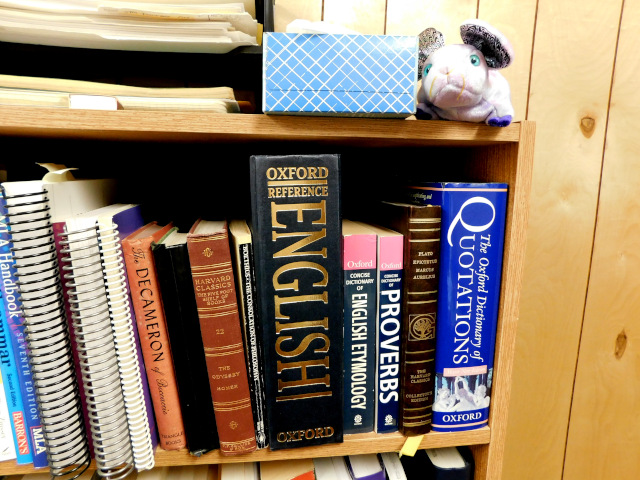
Photo of book shelves in my library, which also contain numerous jigsaw puzzles.

Enough people discovered the joys of baking bread that yeast became scarce. Enough people re-discovered – or discovered – the joys of gardening that last spring there was a shortage of seeds (let’s hope that suppliers are ready for this spring).

Photo of our garden in mid-summer with everything green and bushy, doing very well indeed.

Liquor consumption has increased. Sociologists will be busy for many years studying the results of this massive global experiment in drastically changing cultural behaviour.

Now that spring is on its way (there will still be winter storms where I live, but we know the snow won’t last), and the roll-out of vaccines promises an end to the siege of COVID-19, I want to speak my thanks for the deepening of thought and the deliberate fostering of loving connections that occurred in this great collective Winter of the Heart. The additional solitude, and the waves of insecurity, have underlined our vulnerability and offered us space and time to turn depleted energy into important self-reflection.

 We have had time to learn to see subtler shades of white and grey. When the lure of screen-delivered distractions palled, our eyes rested on bland white and saw it as miraculously varied.

photo of huge snow drifts with shades of white and grey and the hint of a barbed wire fence across the top.
Hoar-frost covered trees and shrubs around a small clearing where the white snow is patterned with shadows of the branches.


Hoar-frost covered weeds, bending with the weight of the frost, against a background of snow with shadows turned blue by the angle of light.

We have had time to let boredom metamorphose into bone-deep relaxation. Restfulness acquired expansiveness. Urgency lost its hold and immediacy its power to corral all senses.

Admittedly, that state of not-quite-hibernation was not the prerogative of everyone.

I hereby acknowledge that I write out of the privilege of the retired and adequately funded. For many, this year of the pandemic has meant extra work, multiplied tensions, fear of unending poverty, the weight of loss upon loss, or even loneliness so all pervasive and crushing that being at rest felt more like being comatose. Contemplation itself lost all meaning. I want to hold these grim experiences in balance with my personal effort to be grateful and to be, despite everything, at home in this intensified winter of the heart.

We have had, after all, time enough to nurture compassion. In fact, all our creativity has been required to continue to stay connected to the ones we love and to reach out to those whose pain has, for whatever reasons, become part of our own consciousness as well. While sometimes anger seemed the only feasible response to the statistics and to the blindly furious missives flooding social media, there has been time enough in this winter of inside and outside the heart to let go of all that anger and see instead the fear lurking behind the eyes.

Whatever their attendant annoyances (fogged up glasses, unseen smiles, unheard syllables), masks should have taught us to look people in the eye. And to listen more closely, not only to the actually spoken word but also to the intense desire to know and to be known.  “Who are you, really? What’s going on in your wintry heart?”

This season of the winter of the heart has also taught more of us to walk, not to get anywhere in a hurry or to compete with someone else in how many steps can be taken, but to walk for the sake of walking. To walk in order to feel and see that the world around us is beautiful and various. To breathe the air that rejuvenates and is safe.

To envy the swarm of company that the cedar waxwings enjoy.

To hear the chickadees call out “chick-a-dee-dee-dee,” or “hey, sweetheart!” Even when eyes are so blinded by tears that the path is felt rather than seen, the simple language of birds is wonderfully reassuring to “their lonely betters” who have promises to keep (W.H. Auden), and who simply can’t keep them now.

The promise of winter, however, is that spring always follows. There will be a real summer in our landscapes and in our hearts, even if, for some of us, there is an unfathomable “feast of losses” to live through. Even if – perhaps because – the feasts of losses are also collective. Sorrow and beauty come to us all, just as winter and summer come to us all.

Oh, Wind, if winter comes, can Spring be far behind?

Percy Byssche Shelley