The Wisdom of the Trail

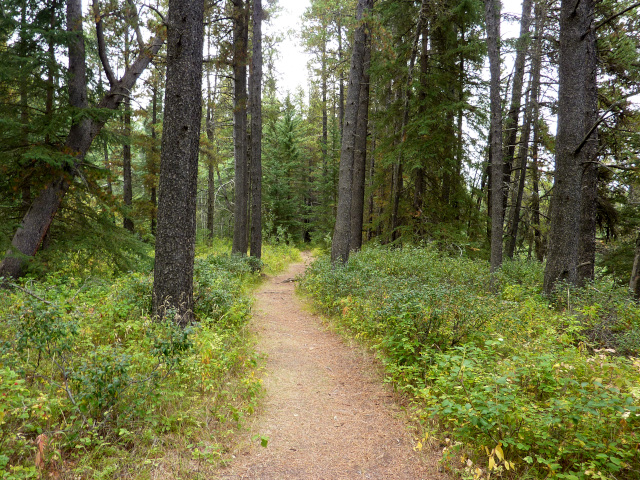
Near the beginning of the trail to the alpine meadows near Mt. Edith Cavell. Photo taken in late summer 2021.

            I fell into hiking in the mountains almost by accident, but even at the beginning, it had the pull of destiny about it—that feeling that comes rarely and then with a wash of loveliness: I was born to do this.

It happened in Jasper National Park in 1968, when a convergence of necessities and opportunities gave me a summer of work in the tourist town of Jasper, Alberta. My friend and I had no car, just occasionally borrowed bicycles. Days off became hiking days because we wanted to get out of town, and there was little else to do. I succumbed immediately to the lure of the trail.  

Along one of the many trails on the Pyramid Shelf, near Jasper, AB. Photo taken in late summer 2021.

  Camping began three years later when my husband and I borrowed tents and other equipment to escape to the Rockies where we spent our days hiking trails, sometimes bagging a walk-up peak. Mountain climbers we were not and would never be, lacking both money and nerve. All that was needed for hiking, though, was a map and good boots – and the desire to explore.

 Decades later, my husband and I are still camping, still hiking. We hiked with our young sons as soon as we could persuade them to cooperate on the trails (frequent snacks helped!), and now we’re still hiking with them and with our grandchildren as well. I cannot imagine anything more soul-restoring.

 This summer, after a year lost to the pandemic, we were finally back in the Rockies, back to Jasper, where it had all begun. Thanks to the pandemic, we were hiking without our family, but we were hiking. We’re slower hikers now than we once were, more tolerant of our limits, more grateful than ever for every heart-stopping view we achieve.

Dorothy Lake, in Jasper National Park, photo taken in late summer 2021.

  Over the years, our hiking has become more meditative, even creative. In years past, I used to draft entire university course outlines in my mind as we walked in companionable silence. This year, as each scene revived memories of previous hikes, previous adventures, I began thinking of just how much all those beautiful mountain trails have taught us about living thoughtfully and well.   

            It was Mt. Rundle in Banff that first made life applications explicit.  

Mt. Rundle, towering above the golf course. Walk-up ascents can be done on the more gradual slope not visible here. Photo by Darian Froese.

My husband and I attempted that daunting, supposedly “walk-up,” ascent back in 1973, when our first real hiking boots were still stiff and untried. My older brother, who was with us for a few days and who had done the ascent before, led the way.

Less than an hour from the peak, I lost courage. I could not take another step on that sheer slope of rock. Never mind how often my brother reassured me that my boots would not slide, I couldn’t do it. I resolutely sat myself down on the rock, and informed my husband and brother that I would wait for them. They finished the climb, reveled in the astonishing view, took their pictures, and then returned jubilant. After which, I discovered that going down a mountain is even more unnerving than going up! 

As we hiked more often in subsequent years and achieved some high passes in the mountains (adjacent photo is Nigel Pass in Jasper National Park, 2004), I often recalled that “failure” and promised myself that I would get back to Mt. Rundle eventually.

 Twenty-two years later, in 1995, when I was facing the last hurdle of my PhD, we returned to Banff, with our two younger sons, now in their teens. I had insisted on that destination that summer because I had made a private bargain with myself: “if I can get to the top of Mt. Rundle, I can finish my dissertation.” I made it, but not easily. The last hour and more was a struggle over loose shale, on which I slid back down with nearly every step up. Mt. Rundle, by pushing me almost to despair, taught me that I could choose to keep putting one foot in front of the other. I also learned the value of not hiking alone; the presence and patience of our sons mattered more than they’ll ever know.

At the top, I hardly knew what was more astonishing—the sight of the entire Bow Valley spread out far below me, or the fact that I was really and truly there.  

  The following day, I bought a huge poster of Mt. Rundle. For the next year, that poster graced the wall of my tiny study room in the U of S library where I finished writing my dissertation. When I wanted to hurl books at the wall or just give up and go home, I would look at the summit of Mt. Rundle and whisper, “I can do this.”

A photo of Mt. Rundle (by Darian Froese) taken many years later (2009) when my husband and I were content to view the mountain from the relatively easy viewpoint on Mt. Castle, near the falls. It is now more astonishing to me than ever that we were ever on the peak of Mt. Rundle.

            There have been many other gifts of wisdom that the many hiking trails in the Rocky Mountains have given me. I could, I suppose, write the hiking equivalent of All I Really Need to Know I Learned in Kindergarten.

The worth of the trail itself, for example, never mind what its destination might be. Mt. Rundle was a fantastic goal, but the truth is, there was much to pay attention to throughout the eight or nine hours of the climb and descent. Yes, pay attention—to all of it: the enclosing silence of the forest, not truly silent but rich with the breath of trees, the songs of birds, the scolding of the squirrels, perhaps even the echo of a far-off rock fall; the delicate beauty of lichen, ferns, flowers, insects; the scent of the mountain air; the peacefulness of shifting clouds and the absence of urgency of any kind.

The walking of many trails has taught me much about letting myself be the traveler first of all. The journey itself is the point. Arrival is a bonus. Sometimes spectacularly so.

Taken in 1998, somewhere on a ridge near the peak of Mt. Indefatigable in Kananaskis, Alberta.

Which is another way of saying that hiking has changed my perspective in important ways. I am less driven now as a hiker, less anxious to achieve goals, although the prospect of a trail that keeps going up still gives me an adrenalin rush. In our many seasons of hiking I have also learned how to adjust my literal focus.

There is, I’ve found, a time to take in the long view and let myself be inspired by the challenge, and a time to gaze only at the next few feet. Back on our first attempt at Mt. Rundle, I gained considerable altitude simply following my brother’s advice to look only at the back of his boots just ahead of me. To look at the enormous distance between me and the peak was a bad idea. In hiking as in life, it helps to know oneself well enough to gauge when one needs to stare at the ground and when one should look up to the hills.  

  The exaltation of arrival—at the high ridge, at the glacier-fed lake—comes in three stages for me: first a long-held breath of awe, then happy exclamations—LOOK! We’re here! We made it!—and finally an inner silence, the self-forgetfulness of just being. If the timing of the hike is right, this is the place to combine transcendence with the ordinary ritual (and it feels like a ritual!) of having lunch. It’s the miracle of being alive writ large.   

Besides, a lengthy lunchtime postpones that most wrenching moment of the hike, when the hiker has to pick up the pack again and turn his or her back on the glory to begin the return journey. It’s not only that the descent from the high place is going to be hell on vulnerable knees; it’s the knowledge that this moment is rare, precious. Our instinct is to hold on to it.  

But it’s not possible to stay there. There are other mountains, there are other journeys, other places in which one must put one foot in front of the other. No matter how stunning the view, sooner or later the good-bye must be spoken (I prefer the German Aufwiedersehen – “until we see each other again”).  

Oh, there will be stories to tell afterward. Notice that 26 years and 48 years later, I’m retelling the stories of those two ascents of Mt. Rundle yet again. I no longer have the Mt. Rundle poster; after years of hanging on the walls of my different offices, it was eventually passed on to Value Village. It was time for me to let it go.

The beauty of a mountain is talked about most from a distance . . . .

Generous Hospitality

Photo of a small deep blue-green lake in the mountains with a trail toward the lake in the foreground.
A place that welcomes me on the rare occasions when I can get there.

            Sometimes our aversions reveal more of us than our acknowledged preferences. I have always been appalled by the hoarding of things. To go shopping for the sake of shopping seems pointless and to gather material goods without end self-defeating. I saw the consequences of that kind of hoarding up close when a neighbourhood fire took one life and upended another – all because of a failure to dispose of anything. I was likewise horrified by the sight of no less than 12 huge disposal bins of stuff being hauled away from a different house in the neighbourhood whose sole owner and resident had been moved to a care home. I have heard several equally baffling stories of compulsive hoarding, yet I still cannot comprehend such a life-threatening accumulation of mere stuff.

 So it was something of a shock to glimpse a hoarding tendency in myself. One can, I now realize, cling to experiences and even household jobs with a stinginess that runs counter to genuine hospitality. The easing of pandemic restrictions in the past months, during which whatever resources I had within myself and around me had to be sufficient, has indirectly shifted my perspective on what it means to be generous rather than to hoard.

 A story from former teaching days will do as introduction. When I first stepped behind the podium in university classrooms, I vowed to teach only literature texts that I myself enjoyed. How could I communicate the importance of reading without sharing those novels, poems, essays, and dramas that I had learned to love? I kept my vow, mostly.

There came a time, though, when I no longer taught my special favorites. I had loved Jane Austen’s Pride and Prejudice, for example, and delighted in every rereading. That’s precisely why it was hard to be gracious about negative reactions from students, whether in class discussions or in assigned papers. I wanted to protect the novel, preserve it from the fumbling misunderstandings or dislikes of beginning readers. In other words, I wanted to hoard for myself my pleasure in Austen’s linguistic skill and memorable characters.  

There is a risk in offering to others what one loves, be it favourite books, special vacation spots (the opening photo remains unidentified on purpose), gardening tasks, cooking, craft skills, family heirlooms, special foods, treasured items. If the love, along with the story that explains the love, is not understood or is just brushed aside as unimportant, the specialness of the experience is somehow spoiled. The normal human desire to share what is beloved runs into the equally normal human desire to preserve in purity what is beloved. 

The normal human desire to share what is beloved contradicts the equally normal human desire to preserve in purity what is beloved.

Another example from my university student days: my sister and I attended the U of S at the same time, for a year or two. I was aiming for a degree in English literature; she was working on a degree in clinical psychology. Without a doubt, my very vocal antipathy for psychology provoked resentment if not outright hostility, even as I vigorously defended my favorite Shakespeare seminar class against her negative memories from a different Shakespeare class. Our relationship survived that difference; sisterly commitment can teach mutual tact.

 Odd how easy it is for me to understand lapses into ungenerous attitudes that occurred decades ago. Distance provides perspective and some wisdom. It has not been as easy to see in the moment when I have chosen to hoard my pleasure in something rather than to share it willingly.

 So let me sidle up to the painful analysis by stepping sideways into the sharing of material gifts. To purchase some ready-made item as a gift is comparatively risk-free, although feelings can be hurt there, too. You don’t like the book that I chose for you? Well, you can always give it away again or perhaps return it if I’ve included a gift receipt. Not a problem. If you don’t mind telling small lies, I might never discover that you were annoyed I could even imagine that you’d like such a book.

 However, if I’ve put hundreds of hours into crocheting a beautiful afghan meant as a bedspread, and you then toss it to the cat for a plaything – oh, that’s another matter entirely. If I’ve worked meticulously to prepare and then present some baking or flower arrangement or meal, yet the gift is seemingly not appropriately received, then I’ll feel as if my effort was valueless.

Photo of a bouquet of gladiola against a off-white wall.

            Already those examples shade into the category of experiences or labour turned into a material gift. Such gifts entail some giving of myself.  

So what about the sharing of myself that hospitality calls for? I have known since childhood that there is such a thing as ungenerous, ungracious hospitality. Obligation, whatever its source, can motivate us to be the host, make the appropriate gestures, and provide the necessaries, whether we are emotionally ready or not. Mercifully, the visit can still become a joyous occasion in spite of initial reluctance. But it is far better to open heart and home willingly, with eager anticipation. There is a reason that the surprise (and surprising) guest who brings miraculous gifts appears in so many folk tales and in sacred texts.  

Much as I admire the gift of being hospitable and have learned to take great delight in hosting guests, I admit that I still struggle sometimes to find a balance between the joy of hospitality—it’s been so long since we could offer dinners in our home or put the spare bedroom to good use—and an ongoing need for some solitude, not to mention too great a sensitivity about prized possessions or beloved tasks.

An example: I love gardening (my readers already know that) and even the usually onerous chores such as weeding are mine. Let me exaggerate here and insist that my flowers and I know one another: I think I know how much water they need and how gentle I should be when I pluck off dead flowers. What then shall I say when some child passing by on the front walk wants to “help”? Or asks if he can pick some flowers? – yeah, the ones I planned to save for seed next year.

  I began this blog writing about hoarding. Easy enough to decry the silliness of collecting empty plastic bottles or ancient newspapers. Not so easy to look in the mirror and admit that I sometimes let my perfectionism block real connections with guests as much as if I had piled up boxes of stuff across the front hall. But I wanted that entrée to look exactly that way, so I refused the help of someone who wanted to be part of the creative process, too, not just an eater of the final production.

photo of a plate with a carefully arranged fruit salad with ice cream and nuts, all on a base of lettuce leaves.

  A final story: my beloved mother-in-law was the embodiment of hospitality. She taught me much that I needed to learn about welcoming people into our home, into our life. There came a time when she could no longer offer hospitality, when it was our turn to host family gatherings. Thinking that it was about time she took some well-earned rest (and her hands had become shaky), I wanted to turn down her offers to help. The making and serving of meals was now my job. Fortunately, I was reminded, tactfully, that she still needed to be part of the kitchen crew with its happy chatter, wanted to see herself as a contributing member of the community. My refusal of help had been ungenerous.

I am grateful for the continual teaching I get from our children as they now raise their own children. Their free sharing of work and experiences with their little ones teach me now what I didn’t learn when I was a child: sharing is better than hoarding, and comfortable relationships matter more than final products.

When the Time Is Right

A dirt path through heavily forested area.
“The path has infinite patience” (Aboriginal saying)

            The most well-known statement about the fitness of time is from the biblical Book of Koheleth, better known as Ecclesiastes. The author, who prides himself on his realism and willingly admits the futility of most human effort, yet sees a pattern in human events that might argue for an over-arching Providence after all: “there is a time to be born and a time to die, a time to laugh and a time to mourn,” and so on. One by one, he lists the extremes of human emotion and experience and declares that there is a right time for every single one.

I have no wish to quarrel with his summary. My focus is on lesser matters, although I could indeed riff on Koheleth in a dozen ways: There is a time to accept the particular miseries of this job and there is a time to begin looking for a different one; there is a time to take risks and a time to be cautious; there is a time to say no to an obstreperous toddler and a time to forestall needless anxiety by promptly meeting immediate needs. There is a time to vote Liberal and a time to vote Conservative—oh, dear, I was not going to summon up political debate!

There is a time for everything, and a season for every activity under heaven:

Ecclesiastes 3:1

 Several occasions and important dates in the last months have led me to look back on past decisions and consider whether I had indeed followed the advice of a good friend who once assured me that I would know when the time was right for a big decision if I paid attention. I would sense, deep within myself, when, for example, I should resign from some committee whose work had once given me pleasure and purpose, or when it was time to let go of possessions that had once been oh, so important.

 Actually, I’ve been inclined to think matters are more complicated than that. I can recall decisions that seemed shaped more by circumstances and urgent need than reflection, and careful planning wasn’t possible. There had been no time to ask myself if the time was right. Sometimes inclination urged me on, yet I faced only closed doors.

 That’s not where I am now. The path remains open – there’s no blocking gate. Yet within me, the conviction grows that it is time to say farewell to a part of my identity. As of the end of this year, 2021, I shall not be an editor any more, except of my own work (if one can call repeated revisions editing). It has been a pleasure to be of assistance, to take someone else’s writing and make it as smooth and persuasive as possible without altering either the intent or the voice of the writer. It has been a wonderful challenge to learn to “hear” the writer’s voice and then make it stronger, clearer. The frequent tussles with language, when the exactly right word proved elusive, were exhilarating, at least when the battle was over.

Editing is background work. Sometimes an editor is given public credit, sometimes not. In the academic world, where I have functioned, the one who polishes the conference paper, corrects grammatical errors, and makes the list of references conform to a journal’s specifications, is rarely mentioned. That’s as it should be. I have only tweaked the details of someone else’s work—that someone should get all the credit for doing the hard work of research, sorting through ideas, and writing (and re-writing at my behest).

How is it that something that was once a pleasure, indeed still gives satisfaction, can become something that needs to be given up? I’m not sure. It seems to me that the motivation could be a range of circumstances from the changing nature of that something (a dance club that loses its sense of community through personality clashes, for example) to some change in me, the decider.

That the passage of time has something to do with it is beyond doubt. Each succeeding birthday has sharpened my awareness that time is not infinite. I do not have all the time in the world. Just as a summer of illness taught me that life is too short for me to read all the books I might imagine I wanted to read, or even to finish every book that I’ve begun, so the passing of ordinary time carries the lesson that not everything needs to be done, and certainly not everything needs to be done by me!

There are no wrong turnings. Only paths we had not known we were meant to walk.

Guy Gavriel Kay

While retirement from teaching was not an issue over which I was granted as much choice as I might have wished for, I did learn over the subsequent months that it is indeed better to step out of the working life while one is performing well than to keep going until one has become incompetent and everyone else is waiting impatiently for the end of the ordeal.

My memories of my last teaching year give me much pleasure. It had been a very good year. Besides, I was now freed from the tyranny of ever-changing technology which I would have found harder and harder to learn. Already the gap between the way I thought and the ways my students thought was growing dangerously. It was time to learn how to be a grandparent instead of a teacher; grandparents are generally granted more tolerance and forgiveness.

 As I recall the rightness of that major shift in my life, I am more comfortable now about planning to give away my style manuals and grammar books. I shall delete files, I think, without wincing, but I’m not so sure about turning my business cards into grocery lists. Perhaps I’ll keep one or two as souvenirs? Still, it is time.   

Everything that has a beginning has an ending. Make your peace with that and all will be well.

The Buddha
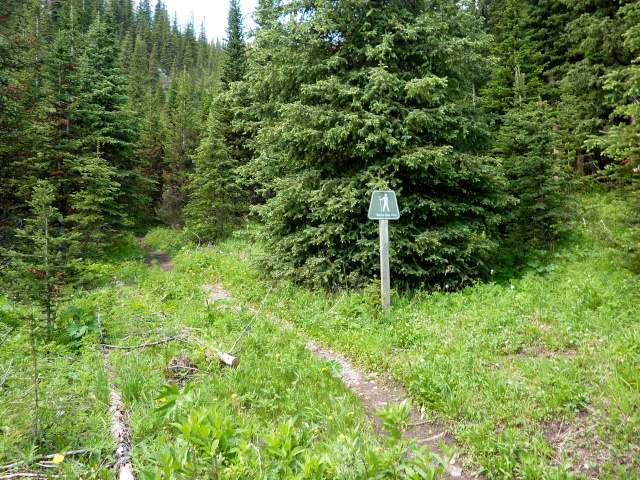
Another path, this time narrower and almost overgrown, into dense evergreen forest. There is a small sign indicating the beginning of  a mountain hiking trail.

Where the Wild Flowers Are

            One of the greatest hardships for me during the pandemic has been the loss of our annual camping trips, both with and without children and grandchildren. The worst trial was, of course, living entirely without family gatherings, since we have no family members living in our city. Apart from that, though, I sometimes felt that my soul would shrivel into something mean and meaningless if I did not soon manage to return to our favourite hiking trails in the Rockies.

To help me find patience to wait just a little longer, I have been scrolling through my photos of wild flowers. While I love the mountain vistas and dream of standing at high altitudes again, it has often been the wild flowers up in the alpine slopes, deep in the pine forests, and along rocky shores of rivers that send rejoicing through my veins. It remains a mystery to me that the Creator should have been so recklessly generous with the sheer numbers and varieties of beauty that live mostly beyond human gaze.

            May I share some of that beauty with you all? 

Wild flowers offer two kinds of pleasure – on masse and one by one. We have, in our various mountain hikes, stumbled on acres of wild flowers, and also discovered small clusters bravely growing on a rocky slope or camouflaged in deep forest grasses. Taking good photos of entire hillsides covered with flowers or valleys likewise filled with color is a challenge, I’ve found. Nothing I’ve taken has ever duplicated my first astonishment. The above photo of a nameless valley somewhere above Taylor Lake, the destination of a trail off the highway just north of Banff, offers me equal portions of happy memory and regret – perhaps I should have tried another angle.

We discovered the meadow by accident. Our plan was to hike up to Taylor Lake, perhaps cool our feet in the water, have some lunch, and then return the way we came. It was a last hike before we departed for home, and we were already tired even before we laced up our hiking boots that morning. It’s not a particularly onerous hike; it should have been a delightful, gentle closing scene on a soul-restoring holiday. However, arrival at the lake felt like entering a combat zone, with our tiny opponents vicious and thorough. There wasn’t enough insect repellent in both our packs to make lunch here possible.

So we kept walking, past the lake and on up a slope, not knowing where the path would take us, presumably up to some ridge for which we no longer had sufficient energy. Then the trail abruptly opened out onto this meadow with more flowers in one place than we had ever seen before except for one, much longer meadow on the trail to Helen Lake, also off the Banff-Jasper Highway. Mosquitoes were forgotten! Even lunch became secondary to exploring the gifts of this place.

But to get a good photo of the whole? A real challenge for this amateur photographer. But I keep trying.

Nobody sees a flower, really. It is so small it takes time. We haven’t time and to see takes time, like to have a friend takes time.

Georgia O’Keefe

In my own garden in Saskatoon, there are also blue forget-me-nots. They closely resemble their alpine cousins, which means that they seem insignificant, not particularly important among the larger, showier perennials with their dominant reds and yellows. Blue flowers often seem more delicate, almost hesitant to claim space whether in gardens or in the wild.

Alpine slopes are a demanding environment. With minimal soil covering the rock and the harsh cold winds that blow most of the time, flowers grow by anchoring themselves low to the ground, offering little surface to the wind and spreading their fine roots in a net wider than themselves.

I would like to learn that from the forget-me-nots and all their other alpine friends.

Blue-eyed mountain grass is another shy flower that I admired for years in my mountain flower book before ever finding it in the wild. One has to be paying attention to spot these 1 cm. beauties in the midst of the grass and shrubbery on sub-alpine slopes. The plant itself, its leaves mere thin-bladed grass, attracts no attention. Had it not been that on the trail up to Mt. Allan in Kananaskis Country, Alberta, there happened to be a considerable cluster of them, all in bloom, I might never have learned how to spot them.

I attempted to grow a prairie version of them in my garden, with no success. Upon thinking it over, I concluded that it is not necessary to own and control what one loves. Let those gorgeous blue-purple eyes with their startling yellow centres remain in the wild where they can reward those who pay attention.

One last flower from the blue section of any flower guide – blue harebells. These, too, are not overly dramatic, do not overwhelm through sheer color and size. However, they are not shy. Indeed, it seems as if they are everywhere, having developed versions of themselves that are content in almost any habitat. The mountain harebells are smaller, shorter, and the arctic version (appearing on the higher alpine slopes) are a mere 10 cm tall or less. The distinctive bell-shaped flower is consistent in all varieties.

Their adaptability is enviable; they change only as much as circumstances require without sacrificing anything of their essence. Seeing them is a little like meeting family: maybe one didn’t expect to see them here, or there, but instant recognition brings a smile.

Just as one should not judge a book by its cover or a human being by the color of their skin, so one should not judge a flower by its name. Whoever thought of naming these gorgeous purple flowers, with tiny gold studs on their stamens, scorpion weed? It seems to have come from resemblance between the coiled leaves and the curled tail of a scorpion. Having never seen a real scorpion, I cannot comment.

Their other, less common name – silky phacelia – has the poetic music the flower absolutely requires. Scorpion weed, indeed! This is a “weed” I’d be happy to welcome in my garden, except that my prairie garden offers neither the altitude nor the open dry rocky slopes that these dramatic beauties require.

I must have taken thousands of pictures of paintbrush already. They grow everywhere, it seems, from ditches along the highways to high alpine slopes. I have photographed them against water, against rocks and old tree stumps, with dandelions, bright yellow arnica, white labrador tea, even rein orchids. They’re such friendly flowers and so at home in whatever setting that they practically beg for yet another photo, like the overly chummy uncle at a party, happy to put his arm around anyone and pose for a picture.

Paintbrush flowers come in so many shades of red and orange and pink and yellow that I keep taking more photos. As if I needed another reason to love them, I learned that paintbrush flowers, with their loosely clustered and sturdy petals and abundant sweet nectar, probably evolved together with hummingbirds (Plants of the Rocky Mountains). Now that’s just perfect.

Nothing in my farming background taught me to love thistles. They were a weed, a noxious weed to be eradicated by whatever method was available, and damn the torpedos. Not until I’d been away from the farm for many years did I discover that thistles often have a beautiful scent, and they are exquisite on the avalanche slopes, as wonderfully made as any wild flower.

It is the special gift of a wild flower to demonstrate clearly that there is a place for every one of them, in its chosen place. Each has unique beauty, special ways of attracting bees and other insects, the right kind of root to establish itself where it belongs – in community with a host of friends. That I needed to be reminded of these days.

The earth laughs in flowers.

Ralph Waldo Emerson

In Memoriam

This is not the blog posting that I had planned to write. At some point, I will still offer that collage of wild mountain flowers and share my longing to go hiking again. Now is not the time.

All I can think of is recent news of discoveries of unmarked graves of Indigenous children. Human history is, unfortunately, replete with similar stories: mass graves of Jewish prisoners in European forests; mass graves of victims of the Black Death; stories of attempted genocide in various lands. None of which decreases, even by one small degree, the trauma and mourning following the recent discoveries of unmarked graves. And note that for Indigenous peoples, these are not “discoveries” but confirmation, finally, of stories that they had been telling in whispers for generations.

My attention has been caught by the distinction between “mass graves” and “unmarked graves.” It’s an important distinction. Mass graves indicate death on such a scale that individual burials—along with appropriate ceremony—are not possible. There are too many bodies. Those mass graves may have been dug with indifference, certainly with great haste, and likely no suitable rituals to recognize the humanity of those who were once alive; the mass graves could also have been dug in haste but still with deep regret at loss of human life and as much respect as was possible under the circumstances.

Unmarked graves are different. They raise other questions. For sure, they imply a continuing practice, not an emergency. Given that these graves were dug beside schools run by churches, one would hope that some prayers were said. The hope seems dubious. Had there been due respect, the graves would have been marked. Almost all families, in all cultural and religious communities, name in some way those who have gone on to another world. At some deep level, we need to speak the names of the dead and honor their presence.

To live in ceremony is the greatest and truest gift we can give to ourselves.

Richard Wagamese

As someone who is not part of this story, except to the extent that I live here, in Saskatchewan on Treaty 6 territory, I do not know how to respond. I am convinced that we are all called to bear witness, difficult as that is. In two previous posts “A Lamp in the Night” and “Can We Please Make Some Anniversaries Unnecessary?” I began some exploration of what bearing witness might entail. It means not looking away or justifying the pain (or minimizing it). It means listening, carefully, to the stories, making a safe space for the stories to be told. It could include bringing food, offering handkerchiefs (actually or figuratively) for tears, providing what is necessary so that the lost children can be recognized. Perhaps placing small pairs of shoes at makeshift memorials.

Ach, it is the pictures of small shoes on church steps that nearly break my heart. Several years ago, when my husband and I toured the United States Holocaust Memorial in Washington, DC., it was the display of hundreds and hundreds of discarded shoes from the dead that brought me to weeping. There is something even more wrenching about abandoned children’s shoes. What must it have meant for young Indigenous children to have had their handmade, beautiful moccasins taken away and being given European-style shoes that didn’t love their feet?   

Where and how this story will yet take us is unknown.  It is yet another bitter blow to absorb after the pandemic has already shown us so many other inequalities and weaknesses. At the same time, COVID-19 has also taught us something of the extent of human compassion and shown us so much generosity. Let the tenderness that has been cultivated among us now be extended especially to our Indigenous friends in their bitter time of grief.

I’ve been considering the phrase “all my relations” for some time now. It’s hugely important. It’s our saving grace in the end. It points to the truth that we are all related, that we are all connected, that we all belong to each other. The most important word is “all.” Not just those who look like me, dance like me, speak like me, pray like me or behave like me. ALL my relations. That means every person, just as it means every rock, mineral, blade of grass, and creature. We live because everything else does. If we were to choose collectively to live that teaching, the energy of our change of consciousness would heal each of us–and heal the planet.

Richard Wagamese

Updating the Public Calendar

            Every now and then, when the times are right, previously unthinkable ideas suddenly gain a sympathetic hearing. We are, just now, in a time of re-evaluating public monuments and asking hard questions about who gets a monument and why. If it was monuments I wanted to write about this time, I would definitely begin with Percy Byssche Shelley’s“Ozymandias,” a poignant reminder that nothing remains forever, not even monuments.

I’m not sure that there is an equally apt poem for helping us ask who should get a calendar day or when we might remove a special day or whether we could demote a public holiday into just a named day only. We should consider that more often, I think.

A Mother’s Day card given to me

In early May, in the week before Mother’s Day, I heard an elementary teacher interviewed on CBC Radio say firmly that Mother’s Day shouldn’t even be mentioned in the school, although she had no objection to families acknowledging the day in whatever way was suitable for them. She herself refused to ask her students to make special cards or crafts for their mothers because it was too emotionally complicated. Perhaps the time has come for some rethinking.   

So what is Mother’s Day like for you? I’ve heard such a variety of stories here, and could tell a few of my own, if I chose (which I won’t). For some children, it’s a special, beautiful day with flowers for Mommy and a child-cooked meal, liberally seasoned with love. For some children, it’s an awkward day filled with anxiety about what mood Mommy might be in. Or it could be a bitter day because there is no Mommy there to honor.

 For some mothers, it’s a tender day, time to smile with pleasure over the simple offerings made by childish hands. Perhaps the children are grown now with young ones of their own and the gathering of the clan on Mother’s Day is full of comfortable satisfaction of seeing traditions continued, new adventures begun, and affectionate, happy teasing passed down from uncles to nephews and nieces.

For other mothers, the day is wracked with regret, with submerged grief, perhaps overshadowed with inter-generational violence. What do you suppose Mother’s Day might mean for Indigenous mothers whose children were taken away? who never saw their children again? The fulsome compliments printed on the inside of many Mother’s Day cards can be agonizingly remote.

And I have not yet mentioned the women who are not mothers who wish they could be. It’s a complicated day, indeed.

            May I suggest that it is time to readjust our calendars and allow Mother’s Day (and Father’s Day, too—all of the above observations apply) to become a matter of private choice?

Back in the early 1900s, when Mother’s Day was inaugurated officially, women were still generally assumed to have been created to become mothers. Never mind voting, never mind holding office, never mind taking up respected and well-paid careers—women were designed solely to have and raise babies. They were limited to service and work that earned little—either money or respect. Mother’s Day, with its call for gratitude, served an important purpose in its recognition of the role and work of women, even as it unfortunately raised expectations for mothers without opening up other avenues of being. Surely we have now moved beyond that stereotype, and have also recognized that families come in different forms and that nurturing is done by many others besides mothers. That observation is not, by any means, meant to diminish the importance of having and raising babies.

Herewith, I offer three suggestions for making Mother’s Day unnecessary:

One, foster a culture of gratitude through small daily rituals. Teach your children from the time they learn to talk to say a clear “thank you for breakfast” (and lunch and dinner) to whoever made the meal. Teach that ritual through modeling. If Papa baked the bread, say thanks. If Big Sister made the salad, say thanks. If Baby set the table, say thanks. Say “thanks for doing the laundry,” even though that individual always does the laundry. Say “thanks for cleaning the bathroom – it looks lovely.” Express appreciation for simple tasks throughout the household, however that household is composed. Say thanks to your roommate for tidying her room, and do it without sarcasm or judgment. Keep it simple but be grateful.

While we’re at it, let’s practice those rituals of gratitude at the work place and in our neighbourhoods. Say thanks to the longsuffering individual who finally cleaned the staff room. Say thanks, often, to the night-time cleaning staff, to the boss, to the front-line receptionist. Say thank you to the grocery store cashier, the delivery person, the mail carrier. Let pandemic awareness of the services of other people continue long past the pandemic.

Two, extend the gratitude from specific tasks to states of being. Try the occasional “I like seeing you cuddled up with the dog; it makes me feel comfy”; “when I see you lost in a book, I’m pleased for you”; “your giggle is so happy it’s contagious – did you know that?” For some of us, that might take a tremendous effort of will and some practice. Given that when I was a child, I saw (and felt) far more of criticism than gratitude, it’s been a long hard course of learning for me that’s still not finished.  

Three, make birthdays a big deal. Birthdays are individual days; they’re marked just on your calendar not on public calendars. Find ways of bringing joy and recognizing the unique personhood of the people who are close to you. Birthdays are not about how well someone fills a particular role (that’s what has always made me uncomfortable about Mother’s Day—those outsize expectations always left me feeling guilty). Birthdays are about the gift of being that that person has brought into the world. Celebrate that! 

To put it simply, I wish we could recognize the worth and dignity of each human being, never mind special days. Practicing rituals of gratitude in our household and in our work places and in our public spaces might well undercut societal evils such as the racism that is only too obvious in recent news headlines. For sure, there is a desperate need also for structural reform, but for now, I’m thinking of the small deeds, the simple words that can spread an impact for good.  

May I now say, “thank you for reading this”?   

A handmade thank you card from a friend. Inside was a personal note of gratitude.

In the Ending is the Beginning

“In my beginning is my end. . . . / In my end is my beginning.”  

T. S. Eliot
Photo of an old rotting tree stump with a bright green baby fireweed plant in front of it, growing in between the roots of the stump.

            There is more than one way to tell a story—although when it comes down to it, they do all have a beginning, a middle, and an end. In our everyday story-telling, we instinctively begin at the beginning of whatever event is at the heart of the story and then talk our way to the end. So the beginning, middle, and end correspond directly to the actual chronology of it all, although even the most inexperienced raconteur seems to know that drama and suspense can be intensified by judicious pauses, or brief digressions to supply context.   

Reality itself rarely unfolds that simplistically; it does not hesitate at the right moment, or offer some wise reflection along the way. Right in the middle of an experience, our memories intrude to remind us that we’ve felt this way before, and our instinctive behavior patterns kick in to make the ongoing development something of a reprise. In other words, keeping to strict chronological time is probably impossible, both in life and in story.

 Not surprising then, that story-tellers sometimes begin in medias res – “in the middle of things.” In movie parlance, any given scene can be fleshed out with a backstory. And any beginning is an arbitrarily selected point, because one could always take one step backward and offer yet more context and more causal explanations. Just so, endings can always be added to because any loose thread can become another beginning. Even the tidiest epilogue has within it the seeds of another story or two. Writers of serially published fiction in print or on screen (e.g. Charles Dickens, J.K. Rowlings, Julian Fellowes) know very well how eagerly readers apply pressure for a happy ending or beg for yet another installment

 While the earliest novels were usually chronologically organized, it didn’t take long for novelists to experiment with where to begin the story and how to tell it: perhaps in the middle of things, asking the reader to persevere through bewilderment until flashbacks offered clarity; perhaps almost at the end and then working backwards, as it were; perhaps in two entirely different time sequences and then moving two plots forward alternately until they finally converge. And so on. Omniscient narrators, who could explain all motives and see into every character’s mind, gave way to assorted first-person narrators, some trustworthy, some not, thus asking readers to make moral judgments with no more assistance than is offered in real life.

 Yet the end is always the end. That is, the story concludes where the story-teller chooses—it may or may not offer the reconciliation and satisfaction we had hoped for. Still, it ends. In the words of medieval romance stories, “there is namore to say.” Whatever the desired effect, the author has shaped the story toward that final end at which point the reader closes the book and begins to reflect on how it all happened and what it might mean.  

A few paintbrush flowers growing out of the rotted remains of a fallen tree.

            For most of my life, I took for granted not only that stories had beginnings and middles and ends, but also that readers should submit to the choices authors had made about what went into the beginning, the middle, and the end. I opened all storybooks, chapter books, and novels at page 1 and read my way through to page 120 or 789, however long the story arc stretched. I would not have dreamed of reading the ending first. Indeed, if a friend had already read the book, I ended the conversation promptly at the first hint of what the ending would be. No spoilers, please!

 Yet I had begun rereading stories almost as soon as I learned to read, thanks to frequent scarcity of books. If I’d already read everything that happened to be in the house just then, I reread books rather than not read, some of them many times. I learned very early, that while the pleasure of the second reading was quite different from the pleasure of the first, both were delightful. To use Booth’s image from The Company We Keep, I happily spent time with my favorite book friends, even though, or maybe because, I already knew how their lives would turn out. That knowledge actually increased the bond between us. In the absence of suspense, I could savor each moment along the way, instead of skimming frantically to find out what happened next.

 Had I been more theologically inclined at that stage, I might have recognized that I was trying on God’s omniscient perspective. Was there not something godlike about smiling yet again at Austen’s Elizabeth Bennett (Pride and Prejudice) in her initial dislike of Darcy and her utter misreading of his character? Or about my tenderness toward Alcott’s Beth (Little Women) going to visit the destitute, knowing full well that Beth would eventually die because of that visit? Or the frisson of dread near the end of Downton Abbey’s Season 3, watching Matthew in his joyous expectations of the future, all ignorant that his future was almost over? To know the end from the very beginning increases our awareness of our own mortality, and might well increase also our discomfort with not knowing how our end will arrive or when.

Bright yellow arnica flowers flourish under the dry branches of a dead, fallen tree. A few rocks rest beside the brightest flowers.

            In the memoir The End of Life Book Club, author Will Schwalbe reflects on his experience of sharing books with his mother during her last year of life. As they negotiate the hopes and fears of terminal cancer, spending hours together during her chemotherapy appointments, they choose books alternately and discuss their reactions. An unusual book club, indeed, with only two members and a known, inevitable ending to its duration.

In one conversation, Schwalbe admits that he “found the book terrifying,” Forgetting his mother’s habit of reading the end of books first, he adds, “And I was very surprised by the ending. Were you?” “Of course not—I’d read it first,” she replies, “I don’t think I could have stood the suspense if I hadn’t known what was going to happen. I’d have been way too worried.”  

 When I first read that, many years ago, I was appalled. How could you spoil book after book like that? I did not know then that I would eventually join her and become a “spoiler” of endings.

It first happened about a quarter of the way through a memoir I was reading for the world’s best book club (see previous post – “The Measure of a Story”). I felt so wounded by family dysfunction, so appalled by repeated, self-instigated personal disasters, and so offended by life-style choices that seemed morally blind to me, that I skipped to the last chapter in order to bring the pain to a quick end. Then, once I knew that the author had achieved a form of survival that I could admire, I had just enough interest left to read the second-last chapter, and then the third-last chapter, and on. It was an odd reading, for sure, a reversal of the usual order of things. Could one have called that a God’s eye view of a human life? Forward and backward and forward again? Time so elastic as to be irrelevant?

 Since then, I have defied the authorial order of things more and more frequently. Maybe it’s the uncertainty of living through the pandemic, maybe, too, my awareness of my own mortality that have made it almost impossible for me to endure too much suspense. Before I can allow myself to become involved I need to be reassured that the ending will not be arbitrary or unbearably bleak, but has evolved appropriately out of the beginning. I want more by way of hope than just a chin-up acceptance that life is horrible but some people can still be courageous.  

That must be why, in this year of the pandemic, I’ve become addicted to murder mysteries, that is, those written by authors who use the genre conventions to explore moral dilemmas and social issues rather than exploit violence for dubious ends. In P.D. James’s novels, for instance, I know that the lead character, Inspector Adam Dalgleish, will survive because he has to be there in the next novel. I have also learned to trust James’s moral sense; there will be examination of motives and a nuanced exploration of evil and of goodness. That is enough to make the intervals of suspense bearable. The world will come out right at the end, but not with a superficial “rightness” that ignores reality or the free will of the characters.

            The ending has always been in the beginning; it is not random, nor is it pointless. These days that’s more important than it has ever been.

In the uncertainty of pandemic days, when numbers go up and numbers go down, restrictions are tightened, then loosened, then tightened again, I have found comfort, not only in predictable yet nuanced fiction, but also in the ways of the earth. Out of the ending of some organic matter arises the beginning of other organic matter. Life and death will not let themselves be sorted into separate meanings. It is not only in story that beginnings and endings entangle themselves but in our lives as well. Hence the photos that intersperse this text. Out of every ending arise new beginnings; together they are beautiful.

Everything that has a beginning has an ending. Make your peace with that and all will be well.

(the Buddha)
A few delicate orange wood lilies, blooming in a mass of green grass and shrubbery and next to the dry roots of a fallen tree.

Sweet Revenge – or How to Choose a Scapegoat

In April, there has to be a photo of spring – just because.

There are no photos that directly illustrate this posting. The events recalled herein took place back when very expensive film was used to take pictures of very important people at very important events. No one would have thought to focus the camera on a ceramic ornament in a plain farmhouse living-room. If a camera was brought out at a child’s party, it was to photograph the birthday child with the birthday cake. All else could be left to memory. Or imagination.

            Most children have chores to do that they hate—if not, they should have. Whether that be shoveling out the debris in their bedrooms or setting the table or putting their dishes in the dishwasher after a meal or cleaning up dog poop in the backyard, compulsory tasks prepare children for responsibilities of adulthood. Depending on how the regimen is implemented, such chores may be readily transformed into long-lasting habits, founded on consideration for others and reverence for good order—or they may become passionately hated inevitabilities.

 My parents meant well. While I might insist now that their slavish devotion to work could have been balanced with greater understanding of the merits of play, I am grateful for many of the habits they instilled in me. I tried to do something of the same for our own children, with what I hoped was more tolerance for play and some allowance for the development of childish free will. Only they are in a position to evaluate the success of the plan.

One of the duties I had as a child was to dust the living-room in our old farm house. With rags cut from worn-out clothes, I had to wipe the dust off every single picture edge, every rung of every wooden chair, and the least ¼-inch bit of surface on our venerable Heinzman upright piano. The top of the piano was a particular horror because, along with several framed photographs, it had ornaments (all gifts probably), each of which sat on a crocheted doily. Every ornament had to be moved, dusted to a point of immaculate polish, the piano surface underneath also polished, and then replaced precisely, in the center of the doily. Perhaps I exaggerate my mother’s perfectionism here, but I doubt it.

My detestation of the task focused especially on a large parrot of garish colors. I knew nothing of parrots, might well have been enchanted by a real parrot—this particular, ridiculously heavy bird became my scapegoat, bearing for me a confusing brew of emotions. I was often a lonely child, always bookish, addicted to escape into worlds that were glamorous and exciting, where conflicts were always resolved in favor of the young heroine. In those imaginary worlds, there were no ceramic parrots.

As a teen-ager, I hated the abominable thing even more, now for what I perceived as its ugliness, its absolute inelegancy. Was I developing a more sophisticated aesthetic? Or just displacing my unhappiness over my parents’ strictness regarding social activities onto an innocent, old-fashioned ornament? It’s hard to sort out because I don’t remember seeing any more sophisticated examples of artwork. Nor did I resist all of my mother’s cleanliness routines; several have become mine as well, regardless of how much I had once disliked them.

So it could have been just the act of dusting. To this day, it is the household chore that I postpone as long as possible.

            Decades later, I was now the disagreeable adult who insisted that her sons learn to do their chores, preferably without complaint. And at the same time, I was also the adult child who was now responsible for dispersing or disposing of my parents’ possessions after the death of my father and my mother’s move to a nursing home. The work of sorting clothing, of deciding the fate of furniture pieces, of looking through old cards, books, letters, photographs was all overlaid with the pain of loss and regret over unfinished stories. Such final processes are never easy. I tossed various small ornaments into a box, swearing never to place them on any surface in our house. And I packed up the ungainly, still miserably heavy parrot into a box of its own. Some decisions can be postponed indefinitely by the simple expedient of carting boxes into the basement.

Then came the planning of a birthday party. For which son, I no longer remember. Unlike today’s popular themed birthday parties held in gymnasiums, play places, swimming pools, etc., this party was an economical home affair with simple games and homemade food. In a moment of insane inspiration, I conceived a game of “toss and break.”

 Out came a whole box of ancient dishes, cracked and unmatched, unusable and so unsaleable. On our cement patio, which could later be swept clean, I set up one dish at a time, allowing exuberant and gleeful little boys to throw balls and break dishes. There was a guilty delight in watching the ensuing destruction. I brought out a few remaining ornaments as well. Marvelous smashes they made.

 The parrot, however, I saved for its own destiny. Later, when the young guests had gone home, probably with stories that horrified their parents, I brought out the parrot. I put it up on a pedestal of some sort, still dusty from its packing box, and fetched one of our sons’ bats.

 Ach, I can still recall the delicious pleasure with which I anticipated the parrot’s final “putting down.” Well, a dignified euthanasia it was not. One swing – and the most satisfying shattering of all. Years of dislike dissipated in one blow.  Our highly entertained sons then demanded a turn, and I let them swing at the larger pieces. Rest in pieces, old parrot. May your descendants be real birds; I shall not love even the memory of this artificial parrot into reality.

 That objects can gain symbolic worth and become lastingly loveable, I know well from experience. Any parent knows about the special blanket or the stuffed toy. All it takes is one loss of such a precious object to educate adults about its crucial importance. If they are honest, parents should also confess to having special things that hold too many memories to be discarded. Every time I try to scale back my library, my hands refuse to toss some old books that, though I haven’t read them in decades, have become almost sacred objects. It will fall to our sons, no doubt, to rip the covers apart and toss them into the recycle bin. So be it. I am content with that prospect.

 Call it a necessary process of transference, sacralisation—whatever term is appropriate here, even “scapegoat” (usually a reference to people)—for objects can learn to embody for us emotions that are too complex to be readily or safely expressed otherwise. It is the way of those objects that have been around long enough to have achieved some character, some essence of their own.

May peace be with all real parrots!

 Someday, if and when the COVID-19 pandemic is well and truly over, I would like to build a huge bonfire out of disposable masks collected on neighbourhood streets and parking lots. On any given day, one can fill bags upon bags of them, unfortunately. It will be a huge, beautiful fire, and I shall take care to stand downwind of the smoke.

For Easter 2021

Against a backdrop of white satin sits a single small votive candle holder with a lit candle and a small silver cross necklace.

To all my reader friends, Happy Easter!

It’s not the usual Easter, I know. Each household, however small or large, will mourn the traditions that will not be followed, the guests that will not arrive, the community celebrations that will not held—for the second time. Last year it was bearable, somehow. We could do our part for the health of the our community and of our country.

This year, for me, the loneliness feels acute. Our house should be filled with the happy noise of playing children; the kitchen should be crowded with busy adults, making food, cleaning up from meals, telling stories over mugs of hot coffee, answering eager questions from excited children. Somewhere there should be a bouquet of daffodils, in the midst of piles of scrap paper turned into art work. Not this year.

Similar white satin background, this time with a larger lit white candle beside the votive candle. The entire photo is blurred.

Instead, my heart is comforted by the miracle of an amaryllis bulb, now growing at last after an entire winter of determined dormancy. Several other amaryllis bulbs had kept their long dark leaves from summer (admittedly making no flowers) and did their part to beautify our household. Now, out of the dry dirt and debris of long-gone leaves has arisen the beginning of a flower stalk.

The amaryllis plant with the flower stalk just beginning. It's about 2 inches tall.
Photo taken March 13th.

            The growth was so startlingly that I began measuring the stalk every morning.

 For a few days I hoped that I would get a flower for Easter Sunday, at least some showing of color in the bud.  

Photo of the growing flower bud of the amaryllis against a shadowed background.
Photo taken Good Friday, April 2

Now it’s clear that I shall have to wait until after Easter. I am not complaining. Every stage of that growth is precious and beautiful, each morning a delight. The “dead” bulb has risen to new life.

 The symbols of Easter — the most important holiday in the year for Christians and a celebration of spring for others — all suggest newness and astonishing (maybe astonished) life. The shell of an egg, whether painted or no, contains (or did once contain) that which nourishes life. Had the egg been hatched, the chick would not resemble the egg in the slightest. That is a miracle. The happy unwrapping of foil or opening of decorative boxes reveals chocolates which sometimes contain delectable fillings within, yet another surprise; pretty baskets contain eggs of all sorts, including plastic ones that contain who knows what little treasure. The most powerful symbol of all, the empty tomb, speaks to the transformation of death into new life. Life cannot be contained; it will burst forth, it will begin anew.

Photo of an amaryllis with two red flowers open.
This old photo of a different amaryllis is a memory of beauty that informs my hope for this spring’s beauty.

 With that hope, I wish you all a Happy Easter! May you be mindful of the gifts that are given. May your heart be gladdened by beauty. May your hands hold tenderly some symbol of joy and love.

“The very first Easter taught us this: that life never ends and love never dies.”

Kate McGahan

Remembering the Winter of the Heart – a Reprise

Rabbit in an early unseasonably early storm. It’s about as prepared for winter as we were in November 2020.

Just over two years ago, the second posting on this blog was called “Remembering the Winter of the Heart.” In the wake of a full year of COVID-19, my mind has been drawn to re-visiting the season of emotional winter. In February of 2018, I was grateful that life consisted of summer and winter, both literally and emotionally. The balance, I declared then, was necessary and fruitful.

 Since then we have, as an entire society, explored dimensions of solitude that have always been familiar to contemplatives but not to the rest of us. Our homes have become our fortified castles, not just brief resting places between multiple commitments elsewhere. We have collectively bought more jigsaw puzzles and books than airline tickets and hotel reservations.

Photo of book shelves in my library, which also contain numerous jigsaw puzzles.

Enough people discovered the joys of baking bread that yeast became scarce. Enough people re-discovered – or discovered – the joys of gardening that last spring there was a shortage of seeds (let’s hope that suppliers are ready for this spring).

Photo of our garden in mid-summer with everything green and bushy, doing very well indeed.

Liquor consumption has increased. Sociologists will be busy for many years studying the results of this massive global experiment in drastically changing cultural behaviour.

Now that spring is on its way (there will still be winter storms where I live, but we know the snow won’t last), and the roll-out of vaccines promises an end to the siege of COVID-19, I want to speak my thanks for the deepening of thought and the deliberate fostering of loving connections that occurred in this great collective Winter of the Heart. The additional solitude, and the waves of insecurity, have underlined our vulnerability and offered us space and time to turn depleted energy into important self-reflection.

 We have had time to learn to see subtler shades of white and grey. When the lure of screen-delivered distractions palled, our eyes rested on bland white and saw it as miraculously varied.

photo of huge snow drifts with shades of white and grey and the hint of a barbed wire fence across the top.
Hoar-frost covered trees and shrubs around a small clearing where the white snow is patterned with shadows of the branches.


Hoar-frost covered weeds, bending with the weight of the frost, against a background of snow with shadows turned blue by the angle of light.

We have had time to let boredom metamorphose into bone-deep relaxation. Restfulness acquired expansiveness. Urgency lost its hold and immediacy its power to corral all senses.

Admittedly, that state of not-quite-hibernation was not the prerogative of everyone.

I hereby acknowledge that I write out of the privilege of the retired and adequately funded. For many, this year of the pandemic has meant extra work, multiplied tensions, fear of unending poverty, the weight of loss upon loss, or even loneliness so all pervasive and crushing that being at rest felt more like being comatose. Contemplation itself lost all meaning. I want to hold these grim experiences in balance with my personal effort to be grateful and to be, despite everything, at home in this intensified winter of the heart.

We have had, after all, time enough to nurture compassion. In fact, all our creativity has been required to continue to stay connected to the ones we love and to reach out to those whose pain has, for whatever reasons, become part of our own consciousness as well. While sometimes anger seemed the only feasible response to the statistics and to the blindly furious missives flooding social media, there has been time enough in this winter of inside and outside the heart to let go of all that anger and see instead the fear lurking behind the eyes.

Whatever their attendant annoyances (fogged up glasses, unseen smiles, unheard syllables), masks should have taught us to look people in the eye. And to listen more closely, not only to the actually spoken word but also to the intense desire to know and to be known.  “Who are you, really? What’s going on in your wintry heart?”

This season of the winter of the heart has also taught more of us to walk, not to get anywhere in a hurry or to compete with someone else in how many steps can be taken, but to walk for the sake of walking. To walk in order to feel and see that the world around us is beautiful and various. To breathe the air that rejuvenates and is safe.

To envy the swarm of company that the cedar waxwings enjoy.

To hear the chickadees call out “chick-a-dee-dee-dee,” or “hey, sweetheart!” Even when eyes are so blinded by tears that the path is felt rather than seen, the simple language of birds is wonderfully reassuring to “their lonely betters” who have promises to keep (W.H. Auden), and who simply can’t keep them now.

The promise of winter, however, is that spring always follows. There will be a real summer in our landscapes and in our hearts, even if, for some of us, there is an unfathomable “feast of losses” to live through. Even if – perhaps because – the feasts of losses are also collective. Sorrow and beauty come to us all, just as winter and summer come to us all.

Oh, Wind, if winter comes, can Spring be far behind?

Percy Byssche Shelley