A Gift for Christmas

Photo of cross-country skiing park with hoar frost on the trees and evergreens.

What gift shall I give my readers for Christmas this year? It hasn’t been an easy year, this 2024. Not for any one except the ultra rich perhaps, and then only if you calculate “ease” in terms of dollars or rubles or pesos or whatever currency you will. What with political tensions, economic uncertainties, and storms of all sorts with all sorts of consequences for those who got in the way, the year has been a challenge, indeed.

I do not want to offer a wordy post. The world has heard more than enough words already, not many of which offered hope or even kindness.

Photo of hoar frost on trees, with a little library in the foregrounds.

What I want to offer is the gift of beauty. The kind of beauty that is free, if we have eyes to see. The city of Saskatoon, where I live, has been granted at least two good snow storms even before the official first day of winter. The world here is overlaid with white. In the last two days, weather conditions were perfect for the forming of hoar frost. All is white now, even the thinnest blade of grass and forgotten mitten in the backyard.

Close-up photo of shrub with all branches covered in frost
Close-up of evergreen branches heavy with snow and frost.

If I may, I would also like to offer just a tiny bit of inspiration for the New Year. Resolutions have never been my schtick; I think good habits are formed slowly, with repetition and as a result of both careful thought and growing need, not at the behest of the calendar. However, this year I intend to begin a gratitude journal, a simple exercise of beginning the day (or the afternoon!) with a brief naming of something for which I am grateful. If it brings me all of a few minutes of gladness of heart, then that is already a gift.

May your Christmas be beautiful. Thank you to all my readers.

A tall elm tree with a huge canopy of branches, all white against a blue sky.

A Bookish Christmas

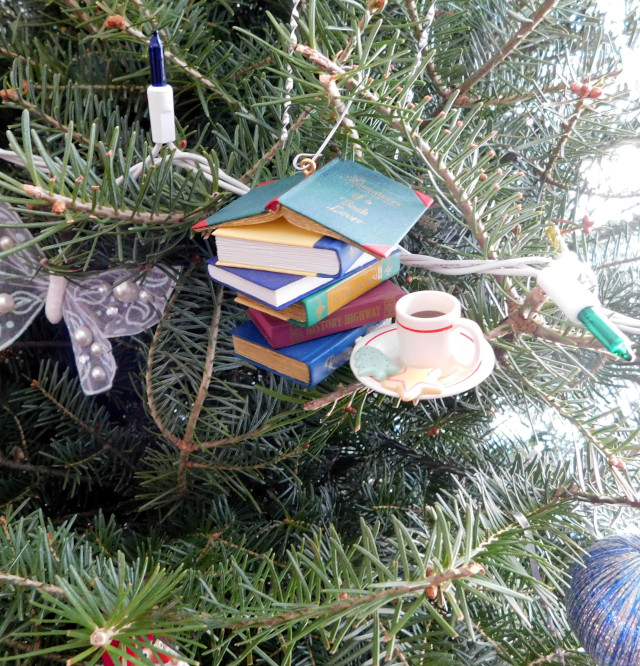
Photo of an ornament on a Christmas tree.

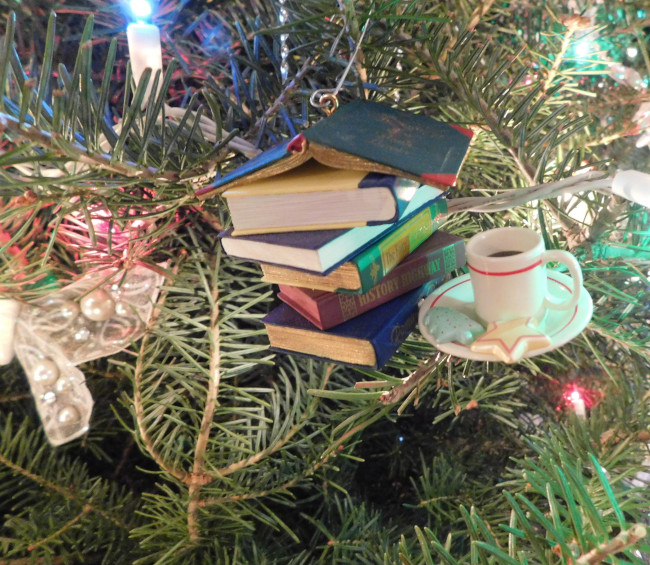
            My friend gave me an ornament for Christmas, years ago. It’s a tiny wooden stack of books with a teacup on the side. I thought it was perfect; as teachers of English literature, we both knew that Christmas and books go together.

Books are excellent gifts – they offer whole new worlds to dwell in, just when the season and the typical Canadian prairie weather make the very thought of a good book and a comfy reading spot irresistible. Add a hot beverage, preferably a hot rum toddy, and all’s well.

 The connection between Christmas and books was made for me in elementary school. I remember mostly school and church concerts, ending always with those familiar brown paper bags containing peanuts in the shell, candies, a chocolate or two, and an orange. I also remember one car-in-the-ditch-in-a-snowstorm episode; huge Christmas trees in our farmhouse living-room, decorated with homemade ornaments (strings of popcorn, gold-painted walnut shells), a very few presents under the tree, but always plenty of food, including all kinds of traditional cookies.

At school, each classroom had a Christmas box; we drew a name of a classmate and bought a present. That was more stressful than exciting because I worried about asking for money to buy something; money was not given out easily. Besides, I had absorbed my mother’s fear that whatever I bought wouldn’t be good enough.

  Yet there was one golden moment, probably in Grade 4 or 5. I received a book! Could that have been my first? It seems so. In the next few weeks, I must have reread Little Women by Louisa May Alcott several times. And I reread it in subsequent years, too, until the beautiful hard cover became quite shabby. And each time my tears welled up at the scenes of Beth’s death and Jo’s refusal of Laurie.

  I have received many books as gifts since then, always welcomed. There’s something magical about unwrapping a book – what will it be? what kind of world will I be able enter? Will this be a treasured book that I will reread and reread?

 In memory of that gift, I offer to all my readers, not actual books, but book suggestions. Maybe one of these books will invite you into a world that you needed to visit or wanted to visit or didn’t even know that you would be delighted in. I hope so.

            Herewith my eclectic offerings, chosen for various reasons, listed in no particular order, with brief comments:

Guy Gavriel Kay’s Tigana. Not quite the best fantasy ever written (that honor is still held by The Lord of the Rings), but very close. Gavriel Kay creates detailed, coherent worlds with memorable characters and causes worth fighting for. Make sure you begin this one when you will be uninterruptible because the world of Tigana is hard to leave.

Nora Gallagher’s Moonlight Sonata in the Mayo Clinic. The realm of undiagnosed serious illness is not one we willingly enter, yet this memoir drew me in, repeatedly, initially because her spiritual journey was shared so honestly. On my third or fourth reading, during my own illness, her key metaphor of living in the Land of Oz made complete sense. Perhaps not recommended to those who work in health care because their familiarity with that world can blunt the effect of Gallagher’s excellent prose.

Lawrence Hill’s Any Known Blood. I could recommend other novels by Hill, but this is the one I read most recently. His exploration of five generations of one family is both tender and searing; by the fifth Langston Cane, the pigmentation is more white than black, yet the racism is still felt bone deep. It is a troubling tale, yet the strength of the human spirit and existence of genuine goodness is always there.

Richard Wagamese’s For Joshua. This memoir by one of Canada’s best known Indigenous writers is a record not only of what it’s like to fall and fall again, but also of the possibility of getting up again and living through and past the pain. It’s also a story of what it’s like to fail as a parent and yet have something to give to the next generation.

Ken Wilbur’s A Brief History of Everything. For those who want an intellectual challenge, enjoy exploring immense ideas, and delight in imagining what might be possible. Wilbur is a well-recognized philosopher and writer on transpersonal psychology. He can be incredibly dense and theoretical, but this book is accessible and leavened with a quixotic sense of humor. For me, it was a wonderful discovery.  

Kathryn Mannix’s With the End in Mind: Dying, Death, and Wisdom in an Age of Denial. The title is daunting, isn’t it? Even downright off-putting. To my surprise, I was captivated from the beginning. Mannix is a palliative care physician and she shares willingly the wisdom her patients have taught her. She’s also a compelling writer. Each vignette will hold your heart.

Barbara Brown Taylor’s Holy Envy: Finding God in the Faith of Others. Part memoir, part theology – maybe more memoir than anything else. Taylor is the only writer I know who can publish whole books of sermons and be completely readable, engrossing even. In this book, Taylor, a former Episcopalian priest, recounts her experiences in the university classroom teaching introductory religious studies courses. She does field trips, lots of them, and she and her students explore other religions, each from his or her own context of faith or not-faith. It’s an honest book, and a hopeful one. A peace-making book, in fact.

Sara Maitland’s A Joyful Theology. Yes, it is a book of theology, but it’s written by a novelist with a strong sense of story and a marvellous style. It was the “joyful” bit of her title that piqued my curiosity and then I was charmed by her willingness to revisit Christian doctrine in the light of recent astrophysics and mathematics. She handles both the Bible and human discoveries with thoughtfulness, even reverence. 

Anne Perry’s The Face of a Stranger. Which is the first in a very long series of detective novels set in Victorian times and featuring the complex figure of Detective William Monk. Perry’s novels have taken me through the pandemic, offering a blessed escape from the stresses of a polarized, anxious world. Perry’s novels do follow the genre template of detective novels and her own patterns of character interaction and methods of building suspense. However, her detailed depiction of Victorian life, her analysis of characters, and her passionate exploration of social issues have kept me hooked and will keep me hooked, I suspect, until I’ve read them all.

So there you are – a few recommendations among the many, many that I would gladly offer.

I would like to wish all my readers a very Merry Christmas and a Happy New Year.

Another photo of the ornament described in the beginning

What on earth could be more luxurious than a sofa, a book, and a cup of coffee? . . . Was ever anything so civil?

Anthony Trollope

Remembering the Winter of the Heart – a Reprise

Rabbit in an early unseasonably early storm. It’s about as prepared for winter as we were in November 2020.

Just over two years ago, the second posting on this blog was called “Remembering the Winter of the Heart.” In the wake of a full year of COVID-19, my mind has been drawn to re-visiting the season of emotional winter. In February of 2018, I was grateful that life consisted of summer and winter, both literally and emotionally. The balance, I declared then, was necessary and fruitful.

 Since then we have, as an entire society, explored dimensions of solitude that have always been familiar to contemplatives but not to the rest of us. Our homes have become our fortified castles, not just brief resting places between multiple commitments elsewhere. We have collectively bought more jigsaw puzzles and books than airline tickets and hotel reservations.

Photo of book shelves in my library, which also contain numerous jigsaw puzzles.

Enough people discovered the joys of baking bread that yeast became scarce. Enough people re-discovered – or discovered – the joys of gardening that last spring there was a shortage of seeds (let’s hope that suppliers are ready for this spring).

Photo of our garden in mid-summer with everything green and bushy, doing very well indeed.

Liquor consumption has increased. Sociologists will be busy for many years studying the results of this massive global experiment in drastically changing cultural behaviour.

Now that spring is on its way (there will still be winter storms where I live, but we know the snow won’t last), and the roll-out of vaccines promises an end to the siege of COVID-19, I want to speak my thanks for the deepening of thought and the deliberate fostering of loving connections that occurred in this great collective Winter of the Heart. The additional solitude, and the waves of insecurity, have underlined our vulnerability and offered us space and time to turn depleted energy into important self-reflection.

 We have had time to learn to see subtler shades of white and grey. When the lure of screen-delivered distractions palled, our eyes rested on bland white and saw it as miraculously varied.

photo of huge snow drifts with shades of white and grey and the hint of a barbed wire fence across the top.
Hoar-frost covered trees and shrubs around a small clearing where the white snow is patterned with shadows of the branches.


Hoar-frost covered weeds, bending with the weight of the frost, against a background of snow with shadows turned blue by the angle of light.

We have had time to let boredom metamorphose into bone-deep relaxation. Restfulness acquired expansiveness. Urgency lost its hold and immediacy its power to corral all senses.

Admittedly, that state of not-quite-hibernation was not the prerogative of everyone.

I hereby acknowledge that I write out of the privilege of the retired and adequately funded. For many, this year of the pandemic has meant extra work, multiplied tensions, fear of unending poverty, the weight of loss upon loss, or even loneliness so all pervasive and crushing that being at rest felt more like being comatose. Contemplation itself lost all meaning. I want to hold these grim experiences in balance with my personal effort to be grateful and to be, despite everything, at home in this intensified winter of the heart.

We have had, after all, time enough to nurture compassion. In fact, all our creativity has been required to continue to stay connected to the ones we love and to reach out to those whose pain has, for whatever reasons, become part of our own consciousness as well. While sometimes anger seemed the only feasible response to the statistics and to the blindly furious missives flooding social media, there has been time enough in this winter of inside and outside the heart to let go of all that anger and see instead the fear lurking behind the eyes.

Whatever their attendant annoyances (fogged up glasses, unseen smiles, unheard syllables), masks should have taught us to look people in the eye. And to listen more closely, not only to the actually spoken word but also to the intense desire to know and to be known.  “Who are you, really? What’s going on in your wintry heart?”

This season of the winter of the heart has also taught more of us to walk, not to get anywhere in a hurry or to compete with someone else in how many steps can be taken, but to walk for the sake of walking. To walk in order to feel and see that the world around us is beautiful and various. To breathe the air that rejuvenates and is safe.

To envy the swarm of company that the cedar waxwings enjoy.

To hear the chickadees call out “chick-a-dee-dee-dee,” or “hey, sweetheart!” Even when eyes are so blinded by tears that the path is felt rather than seen, the simple language of birds is wonderfully reassuring to “their lonely betters” who have promises to keep (W.H. Auden), and who simply can’t keep them now.

The promise of winter, however, is that spring always follows. There will be a real summer in our landscapes and in our hearts, even if, for some of us, there is an unfathomable “feast of losses” to live through. Even if – perhaps because – the feasts of losses are also collective. Sorrow and beauty come to us all, just as winter and summer come to us all.

Oh, Wind, if winter comes, can Spring be far behind?

Percy Byssche Shelley

It’s the Little Things

Taken in Eb’s Trails, a nature conservation area, just off Hwy #11 in SK, that is a haven for hikers and cross-country skiers.

            The light-hearted, nostalgic post I had written for the second week of January, hoping to ease the sadness of a very limited, lonely Christmas, will not be published after all. It will have to wait for January 2022, when I hope the events and images of the last week will have receded in the rear-view mirror.

Never mind that I don’t want to turn this blog into political commentary. Ignoring recent events in Washington, DC, is impossible. I have, like many of you, no doubt, spent too many hours online, trying to comprehend what was happening on Jan. 6: commentators aplenty have since spoken out; reporters have recorded details; political analysts have weighed in; talk show hosts have called out the willfully blind and the deliberately violent with equal censure; news sites have played videos over and over. There is no need for me to add words to the unspeakable.

Instead, may I share some small moments of beauty and quietness as anchors for sanity?

In between reading Anne Perry’s mystery novels as escape, I have been paying attention to little things: the beauty that can be found in ugliness and ruins; the resilience of growing things, that “force that through the green fuse drives the flower” (Dylan Thomas); the quietness to be found within and from without; glimpses of transcendence in the quotidian. None of which are momentous in themselves – yet they are not nothing.

The tree that graces the beginning of this post has been my computer background since I took its photo in early November. It’s dead, its bark scorched black by fire. Yet its stark lines exude power, as well as silence. It’s exactly the kind of tree that Bill Peet, children’s author and illustrator, would turn into an image of strength, love, and laughter.

Loop Creek Trail, in the Roger’s Pass area (Glacier National Park in BC) crosses the ruins of old buildings used in the construction of a railroad track that is no more.

Although buildings and railway tracks are inorganic, they can evoke a similar kind of rueful, sad-hopefulness, especially when–as always happens–that indomitable “force” in the “green fuse” takes over the territory again.

Both the railroad track and the former CPR hotel are now mere ruins along good hiking trails. There was a time when the first wealthy tourists were proud to travel there, proud to be the first (in their minds anyway) to be awed by the vast icy expanse of Illecilliwaet Glacier. I do not regret the absence of the hotel; the abundance of wild flowers and grasses that now fill the former foundation are lovely. They testify to their own resilience, growing through whatever obstacles there are, reclaiming their space. I loved them when I took the photos, years ago; now, in the dead of winter (in every sense of the word), they comfort me.

Indoors, my jade plants offer me similar comfort and hope. They remind me that persistence and organic strength does not have to be dramatic. Even barely noticeable will do.

As if I needed yet another lesson from tiny, stubborn growing things, our live Christmas tree, now facing its last days in our house (indeed, it should already have been denuded of its ornaments and banished outside to await recycling) will not give up its fight to live, to be beautiful, to reach out for tomorrow’s light.

And, occasionally, there are the blessed stumbles into thin places, where the reality of this world opens into the weightlessness of knowing – for certain – that this world is not all there is. To become open to those thin places is not necessarily a matter of travel, although some of my profoundest experiences of transcendence have come when I was away from home.

Along the ocean beach near Tofino, BC, lie piles of driftwood - dead trees which are now beautiful in their ugliness.
On a beach somewhere between Ucluelet and Tofino, BC, at sunset, where we spent an hour watching the light recede and the colors deepen, saying not a word, just breathing in awe, not sure if the wide shimmering ocean or the gnarled dead driftwood was the more beautiful.

What is required most of all, I think, is silence, and attention, whether the turning away from the fever of activity occurs on vacation, or close to home.

As American novelist Marilynne Robinson wrote, “Wherever you turn your eyes, the world can shine like transfiguration. You don’t have to bring a thing to it except a little willingness to see.” Indeed. A mere afternoon’s walk along the river in Saskatoon was enough to bring stillness.

Three photos of the South Saskatchewan River with the shrubs along the bank covered in hoarfrost.

The basic condition for us to be able to hear the call of beauty and respond to it is silence.”

Thich Nhat Hanh
Photo of broken shells next to the trunk of a dead tree.
Beach near Tofino, BC.

Even that which is broken and dead contributes its pattern of meaning, whether we see it or not.

 “In difficult times, carry something beautiful in your heart.”

Blaise Pascal

Christmas Contradictions

Remembering my oldest brother who died on December 23, 2019

 To say or write something new about Christmas is impossible. We have heard it all already: the sentimental, the devout, the reverent, the irreverent, the beautiful, the profound, the cynical, the gloriously happy, and the bitter. Words and songs, candles and cookies, gifts and slights, mutters of “humbug” and shouts of “Merry Christmas!” This year, with every tradition upended and every once-joyous occasion attenuated with “distancing,” all of the above now have an undertone of loss. What is there to say? Not much, I suppose. But there is much to remember.

Our Christmas tree this year, decorated with all our favorite ornaments gathered over the years, but with no gifts underneath. Gifts have all been already mailed.

 Like most families, we have known many kinds of Christmases: some suffused with grief over recent loss (funeral flowers were part of the decorations in 1990 and again in 2019); some marred by minor illnesses (extra supplies of Kleenex and toilet paper required); some made awkward with tension (either individual or collective or both); some filled with joy (a long absent family member home again, a new baby whose presence makes everything new and wonderful, food traditions carried on in blissfully busy kitchens). Actually, separating all my Christmases into categories like that is foolish—Christmas embodies hope above all else, and hope keeps company with all manner of disappointments and losses, as well as with deep happiness when hope is proved true.

Both of the primary narratives of Christmas in our culture have space aplenty for the full range of human experience. Both raise expectations to mythical levels; both also point to reality in its greatest rawness. The Christian narrative is of new birth, a miraculous birth that will save an entire people from violent occupation and brutal economic conditions. Some tellings of the story look forward to the redemption of all humankind. However, as a prophet informs the baby’s mother, “a sword will pierce your own soul.”

.. . . . I had seen birth and death,

But had thought they were different: this Birth was

Hard and bitter agony for us, like Death, our death.

(T.S. Eliot, “The Journey of the Magi”)

The Christian narrative requires us to think about our role in the miseries of now and in the future of the world that is ever unfolding.

The narrative of St. Nicholas, with its delightful magic of one man giving gifts to the whole world in a single night, seems less demanding, warmer. It invites us to generosity, not only to our families but also to those who would gladly be generous to their families yet have not the wherewithal to do so. The deep human pain in this story of expectations is implied, not often spoken. The contradictions are there, nevertheless. Underneath the story of filled stockings and too many cookies are economic realities that demand attention.

Christmas display in the conservatory next to the former Mendel Art Gallery, Saskatoon, SK. A combination of natural plants, natural stones, and the beauty created by human design of those elements, this place has been a refuge for me in many difficult times.

 Nevertheless—and I insist on this “nevertheless”—there is beauty to be found in all levels of both Christmas narratives. The beauty that is given, for which we need only eyes to see and hearts to attend; and the beauty that we create through imagination and ingenuity. In all those forms of beauty, remembered from previous years, I take refuge in this year of the pandemic.  

 The photos contain no people, no food (which seems appropriate for this year). What I have included is the memory of the last time that all my siblings and I were together, evoked only through what we saw together, and other memories of quiet moments that were simply given and gratefully received.

Muttart Conservatory in Edmonton, AB. Photo taken in 2011

Poinsettias are everywhere at Christmas, never mind that they are a tropical plant that couldn’t survive outdoors in the Canadian prairies. Usually they are red, brilliant deep red, framed with dark green leaves. Red and green, the colors of Christmas. This display, though, was definitely white and blue, human skills turning natural beauty into magical beauty in an ice palace.

Three photos taken of blue-tinged poinsettias in the Christmas display in the Muttart Conservatory in Edmonton.
A serendipitous photo.

I remember that at the time I thought this icy display of artificially blue poinsettias verged on kitsch. I was charmed, though, despite myself, by various shades of blue and fascinated with the play of sunlight through the high glass ceilings of the conservatory. Still all that added paint (who knows what the designers used) and glitter, of all things, seemed a sin against natural beauty. I am less critical now. When I see the three reflected figures in the dark blue globe in the center, I am grateful that we were together.

And after all, the entire Christmas experience, in our culture, is artificial. It is a cessation of the usual rhythm of work and school; we bring trees indoors, for goodness’ sake; we import tropical plants; we spend lavishly on gifts and food; we welcome dreams of a better world. So let our homes and our celebrations be nostalgic and extravagant. Let their beauty enrich our souls and then make us aware of how we might change our world to make it beautiful for all, not just the privileged.

Stone and flowers – how could I resist this photo? Also from the Muttart Conservatory.
Once again, a photo makes us see that shadows are an intrinsic element in beauty.

I want to conclude this reflection on Christmas themed beauty with a return to the outdoors, the unadorned beauty that is given to us so generously everywhere we look.

A small park near our home in Saskatoon, taken shortly after a heavy snowfall. No people, no tracks. Just the warmth of stark black and white, life in dormancy, waiting.
A sweet little chickadee that eventually sat on my hand and helped itself to the peanuts I offered. Taken on the grounds of St. Peter’s Abbey, Muenster, SK.

When I run after what I think I want,

my days are a furnace of stress and anxiety;

if I sit in my own place of patience,

what I need flows to me,

       and without pain.

                                                (Rumi)

Meditation on Peppernuts

    It was time, definitely. There are those who begin their Christmas planning in July, their shopping in early October, and their baking in early November. Not I. Thanks to many years of teaching—and other reasons, of which more later—my family knew that Christmas didn’t begin in our house until exams were graded or urgency demanded it, whichever came first. The habit still lingers. But last week, as of this writing, it was time to begin baking.

Among my people, and in my immediate family, peppernuts are essential. Peppernuts (aka pfeffernüsse {German} or päpanät {Low German} or pebernodden {Danish}, etc.) are tiny, crisp, spicy – and addictive; eating only one is impossible. They’re wonderfully dunk-able in tea or coffee and perfect for keeping small children occupied in church.

photo of teapot, mug, oranges and bowl of peppernuts
Peppernuts and oranges and tea – all you need for Christmas entertaining, according to Doris Longacre, editor of More with Less Cookbook

 Making peppernuts is both labor-intensive and child-friendly. The dough itself is simple enough; its special character derives from added spices, which are variously decreed by traditional family recipes. It’s once the dough is mixed that children can be invited to roll the soft dough into thin snakes—hey, it’s like playing with playdough! After being solidly frozen, the dough-snakes are thinly sliced, and each small round placed on cookie sheets.  More fun for children. Then wait for the smell of warm spices all through the house.

 No longer having any young children around to conscript for help, I began alone, braced for inevitable memories. First, though, the pleasure of the work. Oh, I’ve heard about efforts (probably by men) to adapt a sausage machine into a dough slicer so that the work could be done more quickly. As if work is, by definition, onerous. But if I offer up the tactile pleasures of cookie dough to the god of efficiency, to what shall I give that “redeemed” time? To other work that I might likewise construe as onerous?

photo of recipe book, baking pan, snakes of dough, and the bowl with dough.
I’m still using the recipe I got from my mother-in-law almost 50 years ago, but now I’ve made it gluten- and egg-free. It still works.

 On the contrary, I would rather enter the task and make it beautiful, something of which I had already learned when I happened across Thich Nhat Hanh’s mindful distinction between “washing the dishes to get them done” and “washing the dishes to wash the dishes.” I’m not a complete Luddite; arthritic hands make me glad for a hand mixer, although I still miss the satisfaction of creaming butter using a wooden spoon. I’m just grateful that I can still roll out the dough, make even slices, and line them up on the cookie sheet, precisely the right distance apart.

 Then there’s the bits of raw cookie dough from the ends of snakes (I say fie on those who would rob me of that delight with talk of unsafe food practices), a taste of many Christmases past. And, yes, here come the memories, all of them, like a series of snapshots, from “tolerable—even warm and fuzzy” to “unbearable.”  

 Am I really the only one who anticipates Christmas with dread and joy? The season is so hyped, so elongated (it begins already with the snuffing out of Hallowe’en jack-o-lanterns and even appears, in places, in July), so stuffed with stories of plentitude and sentimentality that it raises anticipation to ridiculous levels, and provokes in me a curmudgeonly wish that Christmas be outlawed.

Then those who dwell purposefully within the sacred narrative could celebrate in secret, pondering what it means that divinity has been embodied in fallible humanity, while the rest of the population could find some other pretext for an orgy of buying more stuff and putting up more decorations. The advertising-fuelled expectations of Martha Stewart-style fabulous dinners and parties could then be held separate from the spiritual longing for redemption from pointlessness and violence and heartache.

Sure, the carols—or rather the Christmas-themed songs—do sometimes acknowledge that someone might not come home for Christmas, or that money might be too scarce for gift-giving. That’s but a token gesture for those whose families are too dysfunctional to gather over a turkey (if there is one) without some kind of bad ending. Or for those who mourn losses too painful to celebrate anything. And I don’t even want to imagine what this season of jolly commercial goodwill means in the midst of a war zone or in refugee camps or in slums.

 It’s not popular to speak of such stories at Christmastime. Try changing the conversation to world conflicts or poverty when someone in a store asks yet again, “Are you ready for Christmas?” Always I want to retort, “What do you mean by ready? Who is ever ready for the drastic upending that it would take to bring about ‘peace and good will to all’?” Indeed, what would we do if glory did reveal itself to our harried minds?

 Even as I take the first pan of peppernuts out of the oven, browned to perfection, I know that railing about Christmas demands will not solve either the vexing problems of the world or more particular family stresses. Nevertheless, I will make peppernuts—every year—and share them, with the family, with friends. I will make other favorite cookies, and, if it’s my turn to host, will cook the turkey and all the other dishes that surround it on the carefully set table with its lit candles.

a table set with good china, wine glasses, candles and decorations
Not our usual family setting, which is definitely more than four – this was, as I recall, a meeting of friends.

 We will also bring such gifts as the family has agreed upon, whether it be an in-house exchange or a charitable donation on behalf of the family. There will be pleasure in the doing and the making and the buying, if I choose to be mindful and to acknowledge the sources of my anxiety over all of the above. Familiar rituals give birth also to good memories. Neither ritual nor memories of whatever sort should be ignored.

 From the very first Christmas I can remember—during which I watched it all from my sick bed—to other Christmases, including one in which funeral flowers became the living-room decorations and no cookies at all were baked, I can choose to welcome the beautiful even as I learn to accept the reality of messy human experiences. Just as we revel in the diamonds of hoarfrost in the midst of bitter cold, finding warmth where possible, and giving thanks.

It’s all of a piece, isn’t it? Memories and fresh peppernuts.  

photo of teapot, napkin, full coffee mug, and bowl of peppernuts.

Remembering the Winter of the Heart

            On a recent trip to Calgary, we drove through a magnificent patterned world of blue-grey shadows amidst kaleidoscopic whites. Earlier in the morning, fog had filled the valleys. Now just enough sunlight filtered through clouds to clothe every twig and wire with diamonds. The very grasses along the edge of the highway stood taller in their ice-crystal sheaths. In the ditches, snow drifts swooped upwards into curled edges, sharply defined, austere. A sculptor could not have shaped cleaner lines or lovelier arcs.

Hoar frost on fences and shrubs.

            The sky presented itself in softer versions of blue and white with subtle mauve and coral shadings in wispy layers of cirrus clouds. It was not a dreary day, despite the absence of direct sunlight. For eyes that were willing to rest in the quality of distance, the wide-open landscape spoke a quiet welcome. The slight roll of the hills lifted gently into the horizon; on a winter morning, it’s hard to tell where land leaves off and sky begins.

evergreens and shrubs with hoar frost against skyline.

Unless there are fences to follow the curvature of the earth. Inside that all-surrounding dome of grey and white and blue, warmed here and there with tinctures of pale yellow and orange, each tree matters. So does the occasional raptor poised on the top of a telephone pole, or the single coyote, paused in his purposeful lope across the field.

            I have lived in the prairies for all of my three-score-and-ten years (and counting); the muted tones of this winter beauty are hardly new, though each day displays its own perfection. Once again, the silence of the scene quieted my soul. Reflection is of a different order in winter. Indoors we may indulge ourselves with tropical plants and flamboyant colors. Outdoors, the air widens our nostrils, dries our skin, and reminds us of our smallness, our dependencies. Poet William Stafford noted in “Sayings from the Northern Ice“: “It is people at the edge who say / things at the edge: winter is toward knowing.”

            Usually we sidestep such knowing through sheer activity. Hardened prairie denizens brag of skating parties, endless hockey games on the river ice, tobogganing parties, long afternoons of cross-country skiing—all of which are, I agree, entirely delightful. For children especially, snow is the ultimate construction material, just right for anything from forbidden snowballs to ubiquitous snow-people and including snow forts, tunnels in the snow, and quinzhees.

            But that’s not what comes to mind as I remember the drift lines in the ditches and the snow-laden evergreens casting long shadows across the land.

windbreak with trees and evergreens with hoarfrost and shadows in the snow

What remains always, as a backdrop to my at-home-ness in the bleakest winter scene, is the childhood memory of walking alone for hours through the woods around our farm home. Stick in hand with which to draw aimless figures in snow banks or just crunch through the crust of March snow, I wandered physically among trees and willows, and emotionally in a mess of sensations not understood, not expressed.

As long as I stayed in my hiding places, I could contemplate my real world if I dared or happily imagine fantastical other worlds. The contours of the woods, with their most secret paths, the ever-fascinating plot lines of animal and bird footprints, were as familiar to me as the coldness of our dog’s nose as she pressed up against me for an affectionate pat.

            I remember, in a dark time, when a wise friend loaned me his copy of Martin Marty’s A Cry of Absence: Reflections for the Winter of the Heart. The opening line of Chapter One, “winter is a season of the heart as much as it is a season in the weather,” startled me into attention. Yes, of course. But I had not thought of what that might mean in spiritual terms. Marty’s distinction between “summer spirituality,” which insists that the norm of faith is joyous, hopeful growth, and “winter spirituality,” which knows that not all stories have happy endings, that reality has always included loneliness and loss, was a reassuring revelation. I felt as if I’d been given permission to enter fully and without guilt into my experiences of absence. After all, without the dormancy of winter, spring does not come to usher in new growth.  

            This is not the place to provide a summary of Marty’s “modern spiritual classic,” but his use of “horizon” as a dominant metaphor is newly relevant as I remember my childhood wanderings among snow-laden trees, from whose shelter I stared out at the wider scene. “Horizon” is both the act of seeing and one’s personal world view.

There are those—the unbelievers, the atheists, and the modern secularists—who “have perhaps excluded God from their horizon.” And there are believers whose suffering and losses have led them also to know profound Absence, but without excluding God. To move through a wintry season toward a horizon that refuses to block out faith requires a stubborn courage to say Yes to possibilities, without denying that barrenness must be lived through, not papered over with sunny posters of optimistic catch-phrases.

My journey has led, more often than not, toward wintery horizons, although I have known sunny seasons as well. The two kinds of spirituality are not mutually exclusive; each has its season and they may overlap. What I know is that there is beauty in the shadows of winter–if once recognized and accepted as a necessary gift, that beauty becomes restful in its own way. To say Yes to the presence of God whether I feel it or not, is to feel at home in winter. It is a white and crystal temple filled with equal parts memory and awe.  

“Winter is a season of the heart as much as it is a season in the weather.” Martin Marty

(Originally published in Prairie Messenger, March 18, 2018)