The Grace of Little Libraries

All photos are of little libraries.

            We consider ourselves lucky to live within walking distance of perhaps a dozen little libraries, including our own (pictured above).  Since we live on a relatively busy street, our library gets a lot of visitors, both walkers and drivers. We’ve watched drivers pull over to drop off park an entire bag of books to share with the neighbourhood. Walkers pause for a glance, some stay to browse. Often they leave with a book in hand and a smile on their face. If we happen to be working in our front garden, there’s a chance for conversation. Always we hear gratitude for the library, for the possibility of a serendipitous discovery of something new, something unexpected.

“If you have a garden and a library, you have everything you need.” (Cicero)

            I frequently function like an art curator, making weighty decisions: this book is too tattered – it’s destined for the recycle bin; this book has been here so long it’s obvious nobody wants it, so out it goes; this pamphlet is full of conspiracy nonsense – definitely out of here. To the occasional person who assumes that a little library is also a used clothing depot, I say, “we’ll schlepp your stuff to the nearest drop-off bin (a mere three blocks away) for you this time, but next time do it yourself!” I’m still puzzled by a huge sack of white towels that once appeared at the foot of the library. What on earth was that about?

            Many times, as we ourselves check out the neighbourhood offerings of free books, we return home empty-handed. Once again we’ve seen the same titles, the same genres we’re not interested in. Or we’re just not in the right frame of mind for what is there. Choosing books is an idiosyncratic act, guided by some will of the universe that wishes us well.  The very randomness of any given collection of roughly 20 books means that nothing may spark our interest or, equally, that something will suddenly demand to be read, a book we hadn’t known we needed, hadn’t ever thought of looking for. We too delight in serendipitous discoveries, whether from our library or someone else’s.

            We provide no small journal with a pencil so visitors can list the books they’re taking or returning. We make no effort at all to track books, except to notice if some stay there too long.  Passersby are free to take an armload of books or only one or two; likely those books will never come back to our library. They will end up in someone else’s little library or find a new home on someone’s living-room shelf where they now belong. Give and take. No obligation, no fee. One might call that grace.

            Certainly, graciousness and generosity is what I sense as I regularly straighten out the contents of our little library, making sure that all titles are visible. I don’t know for whom any particular book is intended. Perhaps this or that book has already given its all and is simply ready for retirement. So be it. I like to think about its history of passing through multiple hands, sharing its ideas with keen minds, as evidenced by multiple marginal notes.

            Sometimes I read personal inscriptions on the front pages. Clearly these books had been given as gifts, on some important occasion. They were carefully chosen and lovingly given. I imagine the pleasure of the recipient. These books mattered once upon a time. Now they’ve been set free to wander the world. That, too, is grace.

Now I Lay Me Down to Sleep

Photo of a bed, with books piled on the headboard.

Now I lay me down to sleep,

    I pray the Lord my soul to keep.

If I should die before I wake,

   I pray the Lord my soul to take.

                        Anonymous

            Back in December of 2024, in “A Gift for Christmas,” I wrote about my intention to begin a gratitude journal in 2025; I wanted to counter the daily news with something worthwhile and encouraging. Call it self-care, if you wish. So far, almost every day I have written down something for which I am grateful. The practice has made me pay attention all through the day, seeing things that I otherwise might not have noticed.

 From the beginning, I wasn’t looking for astonishing events that would change my life: no equivalents of lottery wins (for the record, I never buy tickets), no miraculous cures (although I believe that they do sometimes happen), no fabulous expensive vacations. I wanted to recognize astonishment in the midst of the ordinary.  

Some days that was easy: the smell of bread fresh from the oven; the taste of a simple meal lovingly prepared with healthy ingredients; the addition of a yoga pose to my regular routine that I had not been able to do for almost two years; an hour with a friend in a favourite local coffee shop; the texture of a scrap of satin found in the bottom of my sewing cupboard; the completion of a necessary yet unpleasant task; the unexpected joy of planting a garden with friends; the happy face of a purple pansy smiling into our kitchen window.

Photo to pots full of pansies, taken out of a kitchen window.

            There were also days when I stared mutinously at my little journal by the bedside. The sheer volume of grim news in the world and the persistence of emotional fatigue from sources I care not to name here opened the door to discouragement with despair close behind. Those forerunners of depression were all too familiar to me. Be grateful? Screw it, I thought, and stared longingly at my pillow, wanting only to seek oblivion.

 And then the obvious declared itself: the comfort and security of a good bed itself was a magnificent reason for unending gratitude. I had a good mattress, a warm duvet, and clean sheets, not to mention a new pillow. Surely it was not trivial to be grateful for that, not in light of the misery in the Middle East and Ukraine, and many other places on our earth (including our own city) where houseless people walk the streets looking for a place to lie down that might be warm enough and safe enough for them to stay alive until morning.  

I, on the other hand, can say the old prayer—“Now I lay me down to sleep . . . ”—with the reasonable assurance that I will indeed wake up again. In my neighbourhood, bombs do not go off, nor is it at all likely that gunfire will echo through the house. I’m also reasonably healthy. We’re far from forests or grasslands at risk of burning, and the South Saskatchewan River, should it flood, will not damage much of the city.

In the whole of my life I have spent exactly two nights trying to sleep in a car. Both occasions were the result of rain plus a tent malfunction. In other words, we were on vacation, a privilege in itself. And while our decision to spend our vacations camping was at first made because of a modest budget, it remained our choice long after other options became possible. In fact, we dismissed those other options in favour of getting a better tent and better sleeping bags! We had become lifelong campers.

Photo of a tent, a kitchen shelter, and a car in a campground near Jasper, Alberta.

            “Now I lay me down to sleep,” is, I now realize, a statement of privilege. It is a blessed state of mind to be able to recite it confidently, knowing that I do have a place to “lay me down.” A very comfortable place. That the child’s prayer also includes a reminder of mortality simply intensifies my gratitude.    

What shall I do with my gratitude? Can I turn it into some concrete actions for the sake of the people of my city who have no beds and no houses to put them in if they owned any beds?

 At the least, I could donate money or blankets or . . . . .  but my mind has shifted from beds to gratitude itself. Why should being thankful provoke any change whatsoever? Because gratitude is a tacit acknowledgement that I needed something and it was given to me by someone else or by some confluence of circumstances. Genuine gratitude is felt by those who know that they cannot control everything in their lives, who know that they need other people, and who know that they have done nothing to deserve all the goodness that has been given them.

 Gratitude is characteristic of a worldview that is not transactional, that does not see the Other as someone to be manipulated or used or destroyed. Being human is not a zero-sum game. Being human requires vulnerability and cooperation. That is the culture that grows thankfulness and thankfulness grows wholeness and joy.

 I should add to the “Now I lay me down to sleep” prayer. Something along the lines of “Thank you for my bed and my pillow and my life. / Thank you for all those others / wittingly and unwittingly / who have made me who I am.”

Bread and Jam on New Year’s Day

            On January 1, 1996, I saw my mother for the last time. We had brought her to our home to share a meal with our children and two of my siblings who were visiting from another city. The meal was simple but featured a favourite traditional Mennonite dish – porzelkji (a deep-fried fritter with raisins, typically dipped in sugar). My mother had always served porzelkji on New Year’s Day. Two days later, I got a call from the nursing home where she lived; she had died suddenly.  

            That was 26 years ago. The complex mixture of emotions of that time have long since dissipated and been replaced by gentle nostalgia and acceptance. We had had a difficult relationship, my mother and I. While I had been the favoured last child, one last gift of motherhood for someone who measured her worth through motherhood, I had also been the most rebellious teen-ager and that precisely in the years of her menopausal misery. I was also the only child who settled down in the same city where my parents lived after selling the family farm. Inevitably, I became, in her last decades, both a necessary support and a convenient target of anger when fear and/or illness haunted her.

            Even before she died, I had begun to understand how much she had been shaped by two major traumas: the Russian Revolution when she was a child, and the Great Depression when she was a young adult. Both taught her more than she would have chosen to know about insecurity and scarcity. She never forgot those lessons.  

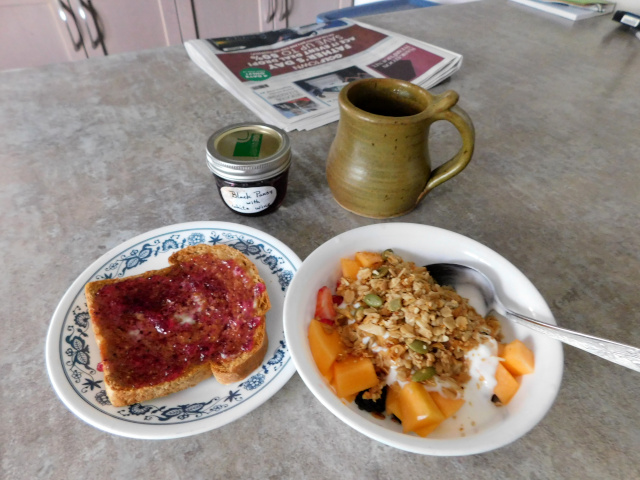
Photo of breakfast: a bowl of fresh fruit, yogurt and granola; a slice of toast spread with jam, a mug of coffee, and a small jar of homemade jam.

            All that came to mind this morning as I spread my homemade jam on a slice of toast (homemade bread) for breakfast. I chose it from the two or three jars of jams/jellies that are typically available in our fridge. Imagine that—I open more than one jar at a time! Every morning I can choose what I wish to put on my toast.

            My mother, however, had always insisted that no new jar of jam was ever, ever opened before the last one was completely used up. That was not a problem for me when we were still a family of six; even my mother’s large jars of jam were usually soon consumed. By the time I was the only child remaining at home, that was no longer the case. I was heartily sick of whatever flavour was currently open before we were permitted to have something else.

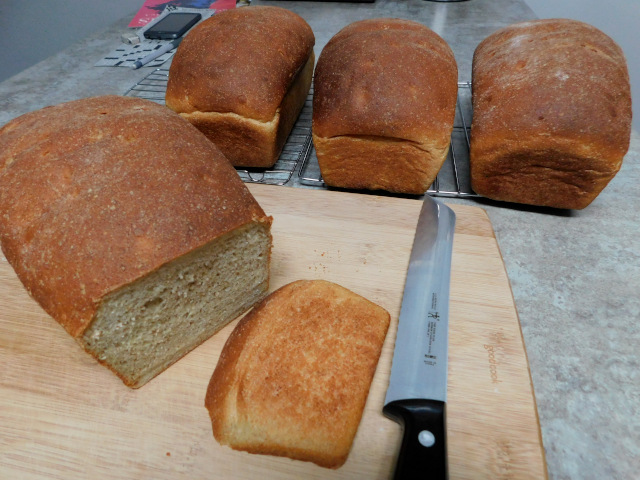
            That principle of using up the old before ever touching the new applied to bread as well (and clothing, but that’s another story), something I hadn’t particularly thought about until we were visiting at the home of one of our children where bread is also home-baked. A fresh loaf, warm from the oven, was sliced for supper even though a partial loaf from the previous baking still sat on the kitchen counter. This was a home where new delights could be fully appreciated without scruple. How wonderful was that!

Photo of four loaves of bread cooling on racks on the kitchen counter, with one loaf already on a cutting board and one slice cut.

            Had I truly been raised in an atmosphere where efficiency and cold, responsible use of everything to its utmost had ruled out so many possibilities of innocent joy? It seems so. I want to make it clear that I appreciate my parents’ compulsion to be thrifty: they had both had intimate acquaintance with poverty, even starvation. I do not have the right to decry their practical ability to use the last bit of everything, even to hoard newness as long as possible. In the face of today’s reckless consumerism amidst an over-stressed environment, their values offer an important counter-narrative.  

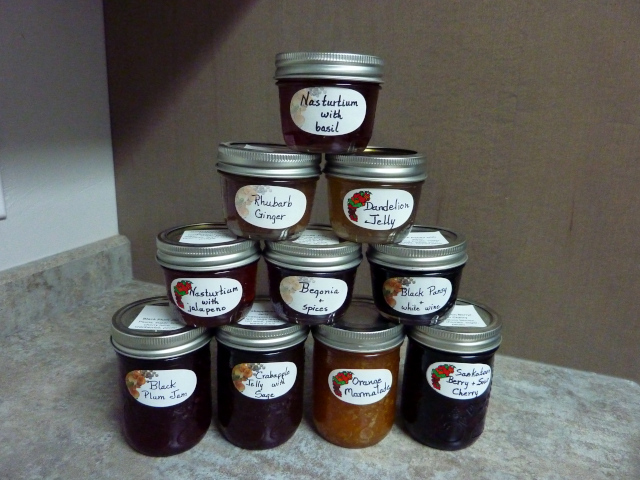
            On the other hand, I want to argue that thrift and utility do not have to rule out generosity or delight. Put the freshly cooked jam, with its glorious color and wonderful odor, into smaller jars (and keep reusing those jars!). Enjoy the freshly baked bread while it’s still warm, knowing that a freezer can take care of whatever older bread remains, or turn the stale bread into croutons and avoid the packaging that comes with buying croutons (my mother would have been truly appalled at the notion of paying good money to get chunks of dried bread!). Simple pleasures are to be treasured and readily shared.

            I still have much to learn about a wider generosity that makes sure that everyone has access to bread and jam—fresh bread and good jam (preferably made from plenty of real fruit and not sugared to death). At the beginning of 2024, I grieve over the increased need for food banks and the continued waste of much food, both in the production and in the sales thereof. We can surely do better than that, although in fairness, I should note that many organizations are working to reduce waste and improve access. What I also hope for is that necessary charity includes dignity, and above all, delight. Let there be joy for everyone.

It would be a long time before I knew that grace is found more in delight than in duty.

Patrick Henry