“There Has to Be Something Better”

Photo of a homemade pencil case, an old geometry set, and a package of 16 crayons on a red background.

            Those words were first uttered in my hearing by a small boy, shopping with his mother for school supplies. A tight budget meant that this was an annual ordeal. I wanted to provide what our children needed. I also didn’t want them to be mocked or disdained by other children for their failure to meet whatever standards were in place that first week of school before the usual breakages and losses evened out differences. I had myself once endured the scorn of classmates and of the bigger bullies from the higher grades.

“There has to be something better” struck a nerve deep down and made an already fraught task downright awful. As I recall, my patience was inadequate. I can only hope now that my frustration didn’t cause lasting emotional damage. What crayons or other tools of education we eventually bought, I don’t remember.

Photo of scattered crayons, an eraser, and a small ruler on a flat gray background.

            Why this particular small incident has stayed with me is puzzling. There were enough other conflicts along the way that my memory could have preserved, other heated exchanges, all the normal trials of parenting three small children. Was it that that one querulous sentence prodded me into some creative thinking about how to teach children to make decisions and then live with the consequences? That would have been a positive outcome. Or was it that our child had unwittingly named a flaw in my own character?

 If I didn’t recognize then how familiar that attitude was to me, I certainly have since. Making decisions has always been my Achilles heel. My childhood was rigidly controlled, and the only way that I could practice the art of choosing was by going against (most often in secret) what was already decided for me. Not until I earned my first paycheck, post high school, could I choose any of my clothing, with the result that for years every purchase was made only after endless dithering and intense anxiety. It was like learning to swim by being tossed into the pool’s deep end with no flotation device.

Recently, as that memory of “there has to be something better” surfaced yet again, I connected it with something besides the difficulty of making decisions. That problem I had more or less understood long ago and learned to manage, admittedly with the help of a more flexible budget. Were I put back into circumstances of financial distress, I daresay that shopping would once again become a horror instead of just an unavoidable nuisance chore.

            But that childish complaint was a signal of something more troubling, in the long run, than not wanting to make decisions. Our child was mimicking a character trait of mine that I had not seen for what it was until probably many years later. Perfectionism: that’s the underlying force that drives “there has to be something better.”

 I have neither the knowledge nor the will to explore fully the sources of perfectionism, certainly not here. However, memory provides me with snapshots of perfectionism in action. I remember watching my mother in the kitchen over many years, fussy about techniques, forever gathering more recipes, experimenting, re-doing old favorites. When I sorted through her store of recipes, as part of cleaning up my parents’ estate, I found multiple recipes for pancakes: always there had to be a better way of making them. I remember also her reluctance to serve guests, her repeated apologies for a meal that wasn’t absolutely perfect. And the meals were never perfect, in her view.  

Was it insecurity? Possibly. Was it that she had so often been judged herself and found wanting that she couldn’t avoid spilling the same displeasure over others? Very likely. It is not my place to play counselor/evaluator for my ancestors.

            What I have learned over the decades—yes, my age is making me reflective—is that what children absorb of the atmosphere in a home is longer-lasting than we might imagine, perhaps much more so than whatever conscious, verbal teaching is given. Without knowing it, without wanting to do so, I had unwittingly and unwillingly absorbed my mother’s perfectionism and doubtless, I let it spill over onto others, especially our children.

 Awareness of one’s attitudes matters, and behaviors can be changed, although it takes much work and persistence, not to mention some painful apologies and the disciplined practice of gratitude. If behaviors and attitudes couldn’t be changed, we would have little hope. Fortunately, we are all exposed, not only to our families of origin, but to many other influences, from friends, work places, books and education, and especially from our partners who cannot help but see our weaknesses and are close enough to help us change. I will be forever grateful to my husband (and his family) and to various friends along the way, who taught me that the mantra of “there has to be something better” needs to be managed with care and often dismissed altogether.

            On the other hand (isn’t there always that ‘other hand’?), I will declare that precision in our work and a desire to do well are assets, not a disadvantage. Conscientiousness doesn’t have to turn into perfectionism. Also important is the ability to recognize when it may, indeed, be time to say, “there has to be a better way to do this” (whatever “this” might be). In my mind, though, there is a difference between “something” and “a way.” That is a huge discussion on its own, which I will leave for another time.

Photo of pencils and a homemade pencil case on a red background.

            Meanwhile, my warmest thanks to the small son who held a mirror up to my face somewhere in the school supplies aisles. 
Thinking About Report Cards

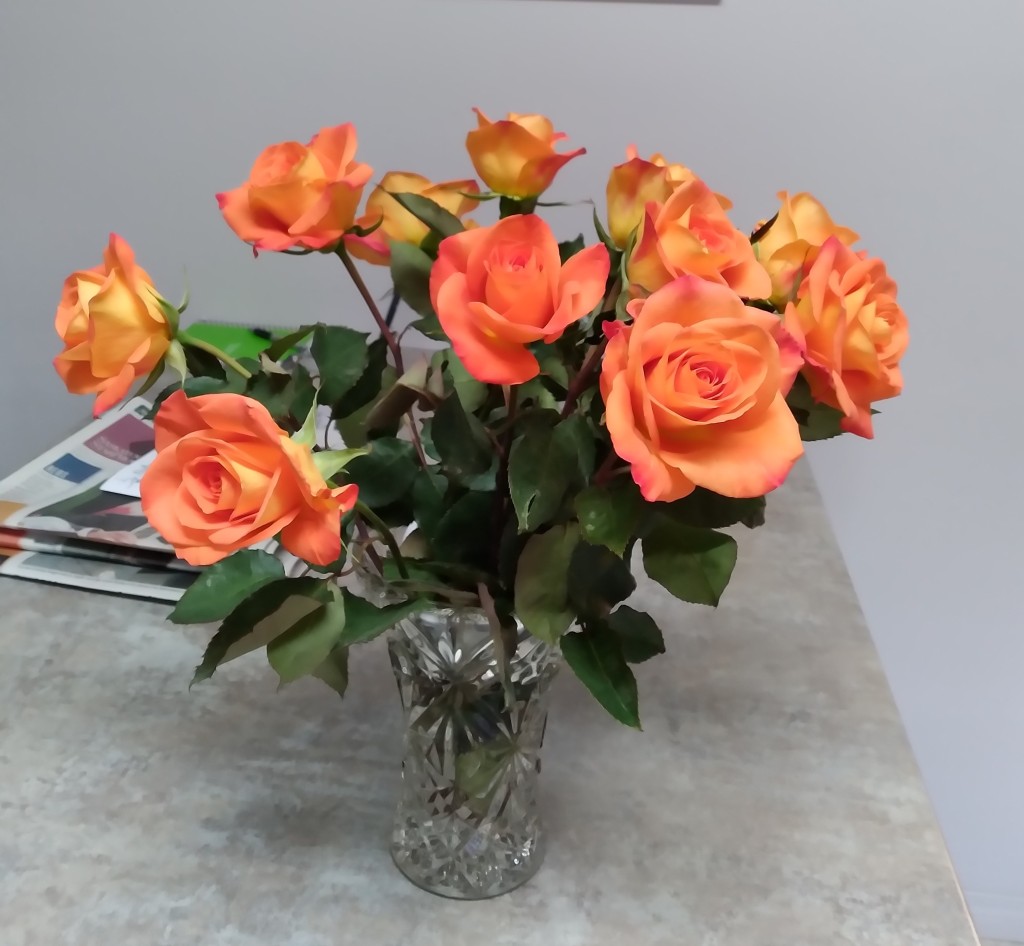
photo of a vase of a dozen coral roses

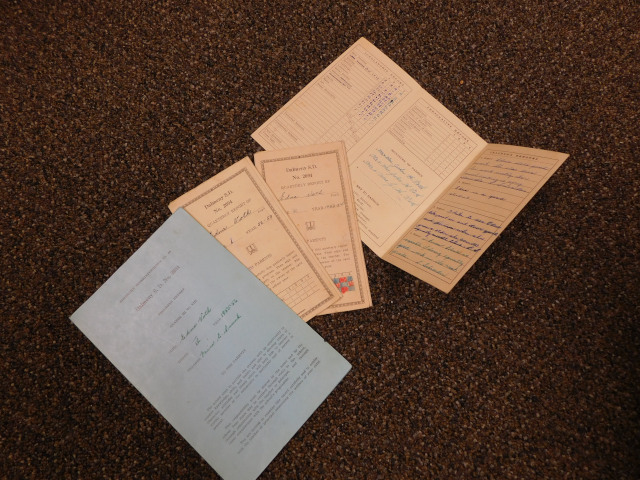
A prowl through a file cabinet drawer, long untouched, revealed a collection of report cards with my name on them (Grades 1 – 12). Oh, my. There were some blunt comments from teachers about my hopeless handwriting—that mattered in those days—and inconsistent work habits, and one anomalous observation on the Grade 3 report card that perhaps as I grew older I would take part more in outdoor sports.

photo of my report cards from Grades 1 - 4.

Remember those report cards, and the trauma of taking them home? Those were the days when children could fail their grade and be asked to repeat it. I was never seriously concerned about that possibility, yet still anxious about what I might have to take home to be signed. Would the report card be good enough that I wouldn’t get any reprimands? My siblings and I were expected to do well in our studies and to conform to strict standards of behaviour. And where there is a clear expectation, there is also the possibility of failing to meet it.  

Which raises two questions, I suppose, with wide application: how clear and reasonable is the expectation? how fair and appropriate is the evaluation?  That bygone teacher who bemoaned my lack of participation in softball had known nothing about the daily hours I spent outdoors walking, exploring, doing farm chores, playing with animals, helping in the garden, even reading in secret places in the nearby bushes. She could not have known that for me solitude in the natural world felt infinitely safer than the ball diamond.   

And I began thinking about the edginess in our societies these days.  I use the plural form of “society” because ever-present social media have created separate cultural groups whose component parts span continents, and because the pandemic has encouraged the creation of very small sub-societies along with huge online silos of rigidly held opinions. No longer do the report cards, in whatever form they take, come only once a year.  

 We live now with evaluations all the time: some are formal, such as work performance reviews, grades on particular projects, peer reviews of publishable articles, demotions or promotions, professional degrees, trade certifications; some are informal, such as the disappointment or delight on someone’s face, a welcome invitation to a social occasion or utter silence from former friends, thousands of likes or brutal online bullying, a stunning bouquet delivered at the door or a package of dog poop left on the porch, acceptance or rejection. There is not much point in railing about the unfairness of evaluation itself—who can ever really grasp everything about someone else’s circumstances or motives?—because we simply cannot manage without evaluations, both great and small.  To be realistic here, I should admit that we have always been living with evaluations; they are nothing new.

 Do we not get quotes for prospective building projects or home renovations? Each business that submits a quote will be evaluated. Do we not develop friendships with former strangers on the basis of our judgment of their trustworthiness and compatibility? Do we not evaluate the politicians who present themselves for office and call for our votes? It’s important that we take time to decide whether trust is justified or not. Will we listen to the cold call we just got on the phone, or slam the receiver on yet another bogus message about credit cards? (It is really too bad that cell phones have no slam option). Will we respond warmly to the chatty clerk or resist what feels like too much sales pressure?

There are degrees of judgmentalism, of course. Some of us are suspicious, automatically assuming that others’ motives must be nefarious at worst, self-interested at best; some of us are more open, assuming that others are well-meaning until we are clearly proved wrong. I am using the personal plural “we” and “us” rather freely here to underline the fact that none of us is entirely one kind of person or the other. Our motives are not consistent; our behaviour is not consistent; our tolerance of risk varies; our ability to learn and change is always there.

 Herein lies the importance of report cards. They do not function only to regulate who is allowed to proceed and who is not qualified for some task (and I know of no society that does not have some such structure for organizing itself). For now, think instead of the personal value for the recipient of the report card, whether it be an actual document with an official seal on it or not.  

  The phrase that comes to my mind is Canadian novelist Adele Wiseman’s description of Abraham, the key character in The Sacrifice. He has visualized himself as a very important man in his small Jewish community; he may be just the local butcher but he’s also a keen student of Torah, a master story-teller, a man of wisdom who “knows” that God has a special role for him. He is, after all, Abraham (and Wiseman gives him no surname). But there comes a moment in a terrible family conflict when the angry words of his daughter-in-law become a “mirror flipped up in his face and he himself stood revealed as he was to another, a stranger. . . (The Sacrifice 316, emphasis mine).  

  That is the function of evaluations. How can we know ourselves without the reactions of others? Child psychologists speak of the importance of parents mirroring the infant’s efforts to communicate. The return smile and the verbal echoes tell the little one that she/he matters. Ditto for the clapping games and the singing and the hugging. The babe is busy discovering a self through parental affection—a process that remains mysterious, despite all the books and much documented experience.  

 This discovering of a self, shaping a self? I understand far too little to hold forth on it with any wisdom. What I do know is that, necessary as unflattering report cards are now and then, equally necessary, in far greater measure, is affirmation of the various selves that we live out in our daily lives—affirmation that is needed in both the giving and the receiving.  

 In these days of way too much judgment and far too many anonymous “report cards” circulating online like some virus worse than COVID, perhaps the best thing we can do is to flip up a gentler mirror that reflects respect: “I see you, and you are a human being of great worth.”

I wish I could show you

when you are lonely

or in darkness

the astonishing light

of your own being.

            (Hafiz)

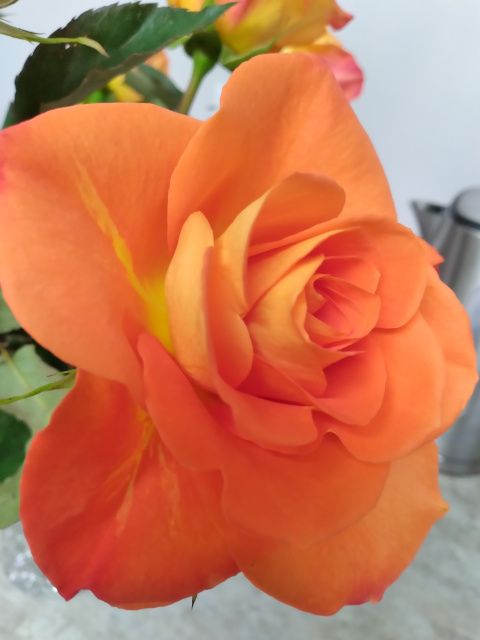
Photo of a single coral rose.