Bread and Jam on New Year’s Day

            On January 1, 1996, I saw my mother for the last time. We had brought her to our home to share a meal with our children and two of my siblings who were visiting from another city. The meal was simple but featured a favourite traditional Mennonite dish – porzelkji (a deep-fried fritter with raisins, typically dipped in sugar). My mother had always served porzelkji on New Year’s Day. Two days later, I got a call from the nursing home where she lived; she had died suddenly.  

            That was 26 years ago. The complex mixture of emotions of that time have long since dissipated and been replaced by gentle nostalgia and acceptance. We had had a difficult relationship, my mother and I. While I had been the favoured last child, one last gift of motherhood for someone who measured her worth through motherhood, I had also been the most rebellious teen-ager and that precisely in the years of her menopausal misery. I was also the only child who settled down in the same city where my parents lived after selling the family farm. Inevitably, I became, in her last decades, both a necessary support and a convenient target of anger when fear and/or illness haunted her.

            Even before she died, I had begun to understand how much she had been shaped by two major traumas: the Russian Revolution when she was a child, and the Great Depression when she was a young adult. Both taught her more than she would have chosen to know about insecurity and scarcity. She never forgot those lessons.  
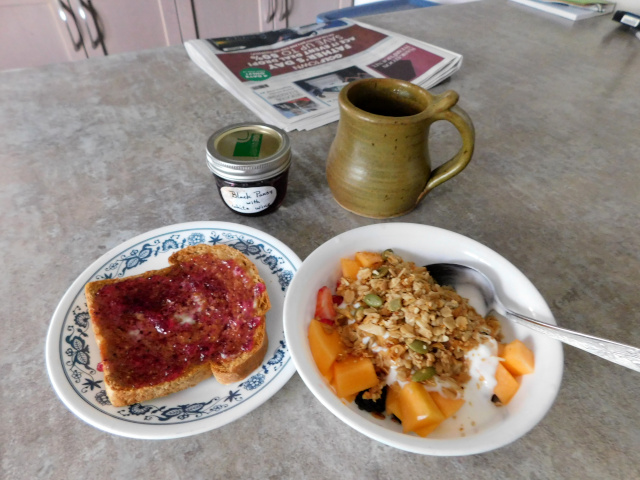
Photo of breakfast: a bowl of fresh fruit, yogurt and granola; a slice of toast spread with jam, a mug of coffee, and a small jar of homemade jam.

            All that came to mind this morning as I spread my homemade jam on a slice of toast (homemade bread) for breakfast. I chose it from the two or three jars of jams/jellies that are typically available in our fridge. Imagine that—I open more than one jar at a time! Every morning I can choose what I wish to put on my toast.

            My mother, however, had always insisted that no new jar of jam was ever, ever opened before the last one was completely used up. That was not a problem for me when we were still a family of six; even my mother’s large jars of jam were usually soon consumed. By the time I was the only child remaining at home, that was no longer the case. I was heartily sick of whatever flavour was currently open before we were permitted to have something else.

            That principle of using up the old before ever touching the new applied to bread as well (and clothing, but that’s another story), something I hadn’t particularly thought about until we were visiting at the home of one of our children where bread is also home-baked. A fresh loaf, warm from the oven, was sliced for supper even though a partial loaf from the previous baking still sat on the kitchen counter. This was a home where new delights could be fully appreciated without scruple. How wonderful was that!
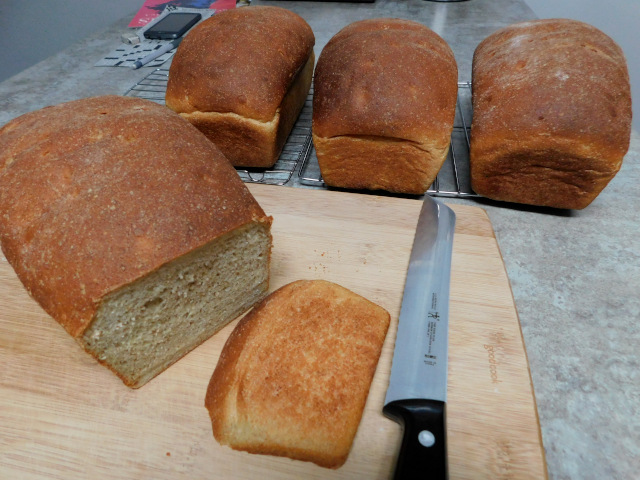
Photo of four loaves of bread cooling on racks on the kitchen counter, with one loaf already on a cutting board and one slice cut.

            Had I truly been raised in an atmosphere where efficiency and cold, responsible use of everything to its utmost had ruled out so many possibilities of innocent joy? It seems so. I want to make it clear that I appreciate my parents’ compulsion to be thrifty: they had both had intimate acquaintance with poverty, even starvation. I do not have the right to decry their practical ability to use the last bit of everything, even to hoard newness as long as possible. In the face of today’s reckless consumerism amidst an over-stressed environment, their values offer an important counter-narrative.  

            On the other hand, I want to argue that thrift and utility do not have to rule out generosity or delight. Put the freshly cooked jam, with its glorious color and wonderful odor, into smaller jars (and keep reusing those jars!). Enjoy the freshly baked bread while it’s still warm, knowing that a freezer can take care of whatever older bread remains, or turn the stale bread into croutons and avoid the packaging that comes with buying croutons (my mother would have been truly appalled at the notion of paying good money to get chunks of dried bread!). Simple pleasures are to be treasured and readily shared.

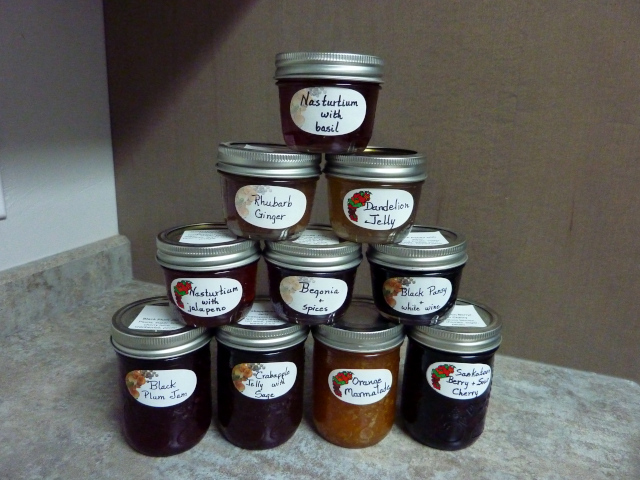
            I still have much to learn about a wider generosity that makes sure that everyone has access to bread and jam—fresh bread and good jam (preferably made from plenty of real fruit and not sugared to death). At the beginning of 2024, I grieve over the increased need for food banks and the continued waste of much food, both in the production and in the sales thereof. We can surely do better than that, although in fairness, I should note that many organizations are working to reduce waste and improve access. What I also hope for is that necessary charity includes dignity, and above all, delight. Let there be joy for everyone.

It would be a long time before I knew that grace is found more in delight than in duty.

Patrick Henry

Our Noisy New Neighbors

            Listening to the news each morning on my favourite CBC morning program can be disheartening some days. What with rancorous political debates, hurricanes and typhoons, ongoing wars, and petty acts of violence in my own province, it’s been a great pleasure to make the acquaintance of a pair of blue jays who are now daily visiting our new birdfeeder.

Photo of blue jay sitting on our feeder.

            We’re not real birders. We know very little about most birds, and can recognize only a limited number of birds. However, we have had a couple of bird feeders hanging in our back yard for years now. Mostly they were patronized by sparrows and chickadees, with some nuthatches, the occasional flicker, and, every now and then, a determined magpie trying to get at the peanut butter log. The feeders were far enough away from our kitchen window that we often used binoculars to observe the birds. Every now and then, we did spot blue jays high in the trees; their brilliant blue plumage was so easy to recognize, and so was their distinctive shriek.  

photo of the feeder on our bedroom window, taken from the front yard.

            Then we attached a new feeder directly to a bedroom window and stocked it with black sunflowers seeds and whole peanuts. So far, the seeds remain untouched but it didn’t take long for the local blue jays to discover this new source for a peanut feast. I have been enchanted by their beauty and their cleverness. Once they became accustomed to the surroundings, they became indifferent to our presence in the room, unless we moved too quickly. We could actually stand quite close to watch them.

Another blue jay photo, this one in profile.
While the blue jays don’t mind being watched, they are difficult to photograph. The sight of a camera made them nervous.

            Sometimes, the jays quickly grabbed a peanut and flew away. Other times, he (or she – there’s no way of telling them apart) carefully pinned the peanut to the edge of the wooden feeder with his claws and hammered the shell apart with his beak to get at the peanuts inside. To my amazement, I learned that blue jays have a capacious pouch beneath their beaks. They can simply swallow two whole peanuts and then grab a third in their beak before flying away. Where they stash their peanuts, I don’t know for sure, but the grass under the linden tree in our front yard is now littered with peanut shells. Blue jays, it seems, are messy neighbours.

            Also noisy. I have been startled awake more than once by a blue jay screaming right beside the open bedroom window. When my heart beat returns to normal, I just smile and think, “Enjoy your breakfast, my friend.”

            I choose to face the window for my usual morning exercises and yoga, so I can watch my lovely new friends. Usually, they come one at a time, waiting their turn if necessary, but sometimes two will sit together on the ledge of the feeder, cocking their heads as they choose the next peanut (they prefer them whole, so they can do their own breaking of the shell). Gradually, I am beginning to recognize different patterns in the grey and white of their breast plumage, and the black rings around their necks have slight differences as well. So I’ve concluded that our feeder is being patronized by one couple—they mate for life, according to websites I’ve checked.  

            Although I can see that this new relationship is going to cost us a fair amount of peanut money, I have no regrets. Even on the coldest day of winter, I will happily don boots and coat to go out to replenish the feeder. That sudden flash of blue and the curious black eyes checking me out warm my heart. Go ahead and shriek, if you need to. You are welcome in our yard.

The blue jay cocks his head in curiousity

            Human relationships are considerably more complex, of course, yet I have pondered how we might make sure that all of us are fed, regularly, without embarrassment or struggle. Why do we smile over bird feeders (going to great lengths to develop various feeders to accommodate different beaks and appetites), yet label the human version, often with disdain in our voices, as “soup kitchens”? That may be a ludicrous equivalent: we are not birds and our habitats and needs are far more varied. Still, couldn’t we pay more attention to providing the kind of habitats that would allow us to thrive? And make sure that all of us get more than just randomly served peanuts?

The Aroma of Freshly-Baked Bread

Four loaves of golden-brown bread still on the cooling racks.
An adapted version of Pilgrim’s Bread from the More with Less Cookbook

            Three circumstances have inspired this nostalgic encomium—it’s also a eulogy—on freshly baked bread: the current fad of baking one’s own bread, my still keen memory of an experimental ten-week gluten-free diet, and the recent birthday of my late mother.

I grew up on wheat, the natural wheat, not the über-processed forms of wheat that now appear in almost every item in the middle aisles of the grocery story. My father grew wheat, sold it in the local elevator, then brought some of it back home again in the form of flour. No additives, no complex processing, just plain milling.

Photo of ancient recipes books of my mothers, yellowed pages and loose clippings, some of the handwriting in German, some of it in English.

Thereafter, my mother’s expert hands turned flour into bread, and much more. She loved everything about the art of baking bread. Always she sought out new recipes, adding notes on ingredients and amount of flour required.  

We ate white bread in all its clean goodness, so perfect with butter and my mother’s homemade jam. We ate brown bread (not totally whole wheat but close) and rye bread. We ate her lovely white dinner rolls, most often the Zwiebach that were traditional for Mennonites. I loved popping off the small top and slipping butter into the hollow beneath. I have no idea who thought up Zwiebach; I was content to eat them, especially when I came home from school to discover racks of them, cooling on the kitchen counter.

A wooden bowl lined with a napkin holds several buns, some made as Zwiebach.
It’s been too long since I made Zwiebach; they lack the perfect shape and balance that my mother almost always achieved.

 Not only buns and bread were created in my mother’s kitchen. She loved all varieties of baked goods: cinnamon buns with raisins and just a trace of icing across the top; sweet rolls with a delectable filling made of cooked prunes, chopped nuts, and orange rind; fancy, twisty rolls with cottage cheese in the dough yielding a sweet-savory treat with darker flecks in the crust; golden loaves of Easter bread with icing on top; schnetkje – soft biscuits rich with lard that opened up easily to accept the gooseberry jam. There were cakes and quick breads, pies of many kinds, waffles, pancakes, dumplings, biscuit crusts over baked sausage.

 I did not then always appreciate my mother’s skill and hard work; I particularly did not understand her emotional connection to the works of her hands, her pride in what she made.  

Back in the early grades, we school children were clearly divided into two social classes: the farm kids who had their lunches at school and went straight home after school on buses or in parents’ vehicles to help with the chores; and the town kids who could walk home for lunch and could play with one another all over the town in their more abundant spare time. There was no doubt in anyone’s mind that the townies were privileged and thus superior.

So perhaps it was inevitable, given my social insecurity, that I came to view my mother’s bread with some embarrassment. My lunch sandwiches were roughly sliced dark bread and egg salad, or some leftover cooked meat. I felt nothing but envy for the neat sandwiches one could make with store-bought sliced bread and precisely shaped baloney. Exactly the kind of differences that become fuel for small-time bullies.

One occasion, an end-of-school picnic, still haunts me. These picnics usually happened on someone’s farm or near a river. The menu never varied: hotdogs with unbelievably yellow mustard, bright red ketchup, and unbelievably green store-bought relish; some delicious potato chips (a rare treat for me); marshmallows for roasting; and watermelon for dessert. Oh, and jugs of KoolAid to drink.

 Children must have been responsible for asking their parents to provide some of the supplies that year, or why else would I have brought dozens of hotdog buns—not purchased but lovingly made by my mother, complete with a perfect egg glaze on the top of each? I remember being ashamed of those homemade buns.  I do not remember how it happened that there were already enough hotdog buns and that it was the store-bought ones that were taken to the picnic. Very likely, I wasted most of that precious afternoon, trying to fabricate some story that I would tell my mother to explain why her buns had not been eaten.

What I do remember with painful clarity is my mother’s stormy anger. She was furious that her buns had sat in an empty classroom all day and probably dried out; she was outraged that her efforts to create just the right shape of buns to hold a wiener (food she didn’t really consider food at all) had been entirely wasted. Time has mercifully blunted the full force of my tangled emotions: shame and embarrassment, fear of what the next days would be like at home, terror of being made to deliver an angry message to the teachers, deep uneasiness concerning how I might behave among the rest of the children among whom I never seemed to belong, relief that there were only a few days of school left and then the long summer could begin.

 Mercifully, there came a time when my attitudes changed, and my taste buds began to hold greater sway over my choices than what peers, in whatever circle, would think of me. I began doing my own baking, and very quickly discovered the sheer pleasure of kneading dough and watching it rise, the creative joy of experimenting with new recipes and new ingredients, and the simple richness of the taste of homemade bread, and other baked delicacies. I loved it all.

I watched our children go to school, make friends whose families had different customs and values. I often thought ruefully that I was being made to relive some of my mother’s frustrations as our children sometimes seemed embarrassed about how we lived. I delivered some of my precious creations to various potlucks and saw them ignored because they looked different or weren’t made with familiar ingredients.

 These days, “home-made” and “store-bought” have reversed their status. At least among my friends and acquaintances, homemade food is valued and the taste of homemade bread treasured above all else. In fact, since the advent of COVID-19, everyone is baking bread again. I’m pleased, especially now that it seems possible to find yeast again.  

 My mother has been gone for almost 25 years. That’s long enough for me to have re-evaluated so many of my memories in light of the understanding that comes when one actually lives through the stages of life once not understood at all. No 10-year-old can expect to fathom the emotions of the unknowable parent. But a 70-something can look back and grant absolution to that shy school girl who failed to claim pride in genuine creativity and skill and generosity. She can also say, with unfeigned sincerity, “I’m sorry, Mama. I didn’t know what you had given then. But I think of you when I turn the dough over in my hands.”

Photo of a loaf of bread on a cutting board. The crust has just been sliced off.
It’s the baker’s privilege to cut and then sample the crust!

All bread must be broken / so it can be shared. / Together / we eat this earth.

Margaret Atwood