
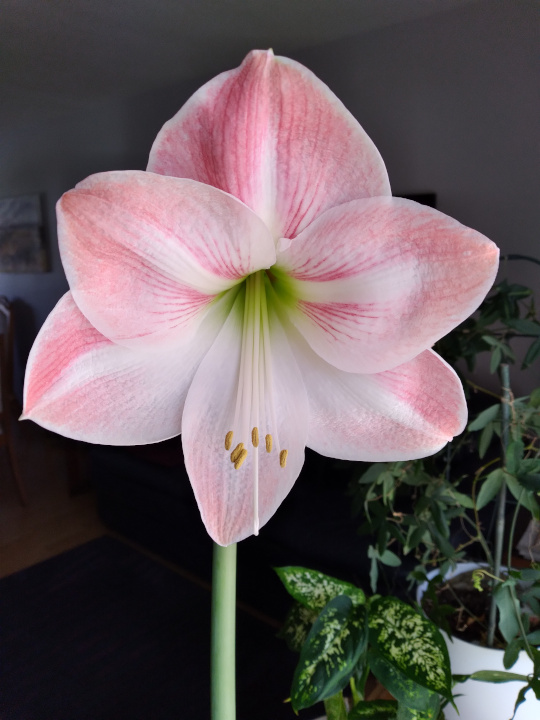
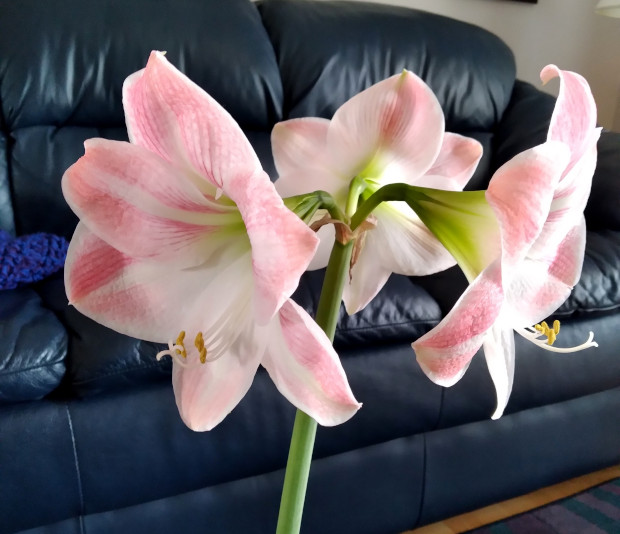
This was an unexpected gift for Easter—well, sort of. The first of three, it opened fully only two days after Easter. I have not yet learned the art of caring for amaryllis in such a way that I can plan the likely date of flowering; that this one came so close to Easter was a blessed surprise.
All during Holy Week, I watched the developing bud with intense hope, praying that it would open in time to delight our visiting grandchildren. My disappointment is eased by remembering their eager faces as they speculated just when that swelling bud would begin to divide itself and when the fattest one would finally spread wide to the sun. I did send them pictures! Too bad the photo didn’t capture a subtle glitter on the topmost petals that is visible only in certain angles of light.
The perfect symmetry of this huge flower (6 inches across and slightly taller than that) fascinates me; it draws my eye from the darkest pink streaks down into the verdant green of the throat where the ovary is hidden. The stamens (male) hold the pollen on the anther at the end of the filament; the pistil in the centre (female) has the pollen receptor, or the stigma, at the end of the style. In this photo, the stigma has not yet opened out and curved up to receive pollen. The ovary, which becomes the seed holder in a fertilized flower, develops just a bit later as the flower begins to wilt.
All of that information is courtesy of several websites that I read through before beginning to write. It had not been at all necessary for simply meditating on such exquisite beauty. Gazing at the lines, the color shading, the texture, the balance of the whole—which is so much more than the assembly of the individual parts—created silence within me. Words became unnecessary. Thought itself held still.
Strangely, looking at the photo does not provoke the same response; it simply calls forth a memory of the silence. Perhaps the difference lies in the absence of the light. For the flower seems to hold light inside itself, as if the petals breathe in light as we breathe in air. In their presence, the heart too gains light and lightness.
Serendipitously, as the amaryllis readied itself to display glory, a book nudged itself into my notice: Solitude by Michael Harris. I no longer remember who or what highlighted the title for me, but its subtitle—In Pursuit of a Singular Life in a Crowded World—demanded attention.
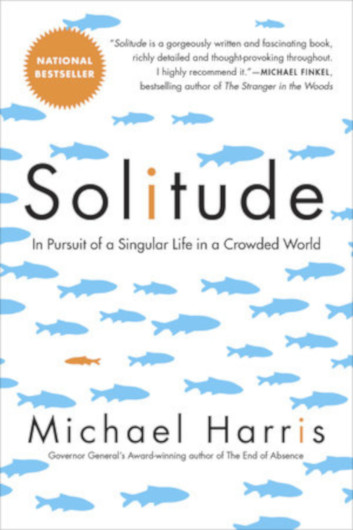
Full disclosure here: there is no doubt that in my case, this book is preaching to the choir; I have ever been a lover of solitude and am usually happy to be in the company of my own thoughts. It is lovely, though, to be told that my lifelong habit of daydreaming, a habit generally dismissed as a waste of time and a self-indulgent laziness, is actually a virtue. Indeed, Harris argues that it is absolutely essential for creativity and for a healthy identity.
One can be instructed in society; one is inspired only in solitude
Johann Wolfgang von Goethe
I do not yet know what remedies Harris will offer to a world seemingly permanently hooked on online distractions, because, as of this writing, I am only a quarter of the way through the book. Already I’m prepared to recommend it to one and all. One early chapter all by itself – “What is solitude for?” – is sufficient to justify the book. Harris answers that question with three items: new ideas (creativity requires solitude), an understanding of self, and closeness to others. To the likely objection that the last benefit is counter-intuitive, Harris explains, “The ability to be alone, . . . is anything but a rejection of close bonds. It’s an affirmation of those bonds on the most essential level. To be happily alone is to affirm one’s faith in the love of others.”
To be happily alone is to affirm one’s faith in the love of others.
Michael Harris
So, then, two Easter gifts have come my way: flowers and a book. I am grateful.
 Stones and Flowers