We Need a New Word

Words are slippery.

They mean what they mean, yes, but they mean always within a context, and contexts change.

            As a child of the Protestant Reformation, a descendant of Mennonites (a radical branch of that Protestant Reformation), and a wordsmith, I’ve been thinking a lot lately about our political language. What on earth happened to protest since the 1500s? Why could I be proud of my religious heritage, yet so much on edge and unhappy now?

The verb “protest” has become more noun than verb. One doesn’t pro-tést these days – one joins a pró-test, and that changes more than just pronunciation and grammatical function.
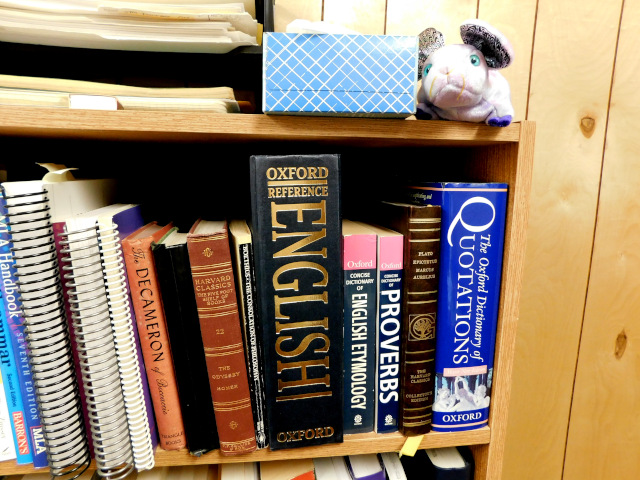
 So: protest as a verb. It differs from object and from disagree. To disagree means, according to Oxford Dictionary, to “hold a different opinion.” In other words, you and I don’t think the same way about some idea or some thing or some action: cement is a better surface for an urban driveway than asphalt. There are good reasons on either side of that disagreement (cost, labor, endurance) but moral implications are absent.   

To object means, again according to Oxford, to express or feel opposition or disapproval or reluctance. That’s stronger than to disagree because emotion is involved. Whatever happens in the discussion, the one who is objecting feels hurt or offended or even appalled. That would be the distinction that my editing self would make. When my late father used to introduce me to his acquaintances as the “baby of the family,” never mind that I was already an adult with children of my own, I objected strenuously. It felt belittling to me, although I’m willing to concede now that he meant it as affection. We disagreed on the meaning of “baby” and I objected to his application of it.  

But to protest is to bring in not only emotion but moral judgment. Here I’m reaching back in time to try to recover the meaning of the word before it became a noun that means an official demonstration against government or some other powerful institution or leader. That’s the primary meaning now. Even in that noun form, perhaps especially in that form, the word carries the weight of moral judgment. A protest (noun) occurs because enough people judge some action morally wrong. It’s deemed unjust, unfair.

 If we’re talking about unfairness or injustice, it follows that the protester is in a position of less power than the person or institution against which the protest has been made. The protestor may be a direct recipient of the unjust action or maybe not. Many protests have been launched on behalf of those who had no voice or influence. The common thread is the moral judgment. This or that action is just wrong; it violates a law or some accepted standard of behaviour.

 There is something else about the verb “protest” that we seem, as a nation, to have forgotten entirely: it is intended to persuade. The very fact that the objection raised is morally justified assumes that the one who protests and the one against whom the protest is made share (or should share) a common ethical standard. The concept of injustice makes no sense without an accepted definition of justice.  Martin Luther, who inadvertently began the Protestant Reformation, appealed to the standard of the Bible and the tenets of Christianity when he protested against several actions of Roman Catholic clergy. His initial intention was first open discussion, then persuasion, based on a common faith.  

(Generally speaking, it is, of course, possible that the objection has been made in bad faith and is not morally justified; equally possible is that those whose behaviour has been objectionable do not have any ethical standards to which one can appeal. Neither case invalidates the protest’s initial purpose of persuasion. I insist that the ideal not be forgotten.) 

            By this point, given the current political climate, all sorts of righteous stances are doubtless being claimed by my readers, not to mention fervent disagreements with my definition of “protest.”

 So I will retreat temporarily into a simple illustration taken from my teaching years. A student was unhappy with an assigned grade; she felt certain that I had marked her paper unfairly because I was prejudiced against her. That is a moral problem. While some subjectivity is always a factor in marking essays, outright unfairness is unacceptable, not only to students but also to university administrators and department heads.   

As long as my student expressed her opinion courteously and presented evidence for her accusation, she was completely within her rights and could hope to be persuasive. My role was either to offer a reasonable explanation of the grade or to acknowledge her point and re-evaluate the paper (and/or ask a colleague to evaluate it). Either way, we should have been able to end the discussion with our dignity intact. Indeed, it could have been the beginning of an improved relationship.  

 However, if she had insulted me as a person and added threats of character assassination or even worse, she would have crossed a line between protest and blackmail—“you do this or I will ruin you.”  That is not yet physical violence, but it is violence. Her protest would have given up the moral high ground and become intimidation, thus turning the interaction into a power struggle, which leaves no one’s dignity intact, and makes an improved relationship very difficult, indeed. 

 When Martin Luther King, Jr., and Gandhi before him, insisted that any and all protests should remain non-violent, in language and in action, they were aiming at persuasion, which seeks to make clear what the relevant moral principles are and appeals to both a common humanity and a common acceptance of those moral principles. This is not to say that protests against long-standing evils such as slavery are easy. By no means. Many, perhaps most, slave-owners saw the protest marches as intolerable uppity behaviour by those whom God had made to be their slaves. As long as the marchers refused to turn their protest into rebellion, they kept the moral high ground and underlined the principle of a common humanity, something the slave owners had consistently denied. 

            I indicated earlier that I was a descendant of Mennonites, first known as Anabaptists, who refused to bear arms and developed a strong code of pacifism. Other groups like the Quakers have also chosen non-violence. That does not rule out protest. To speak up against unfairness and injustice, even oppression, is a moral obligation, especially if the speaking up is not for oneself but for those who cannot speak up.

But the way of peace refuses violence in all its forms, and seeks reconciliation. That is the ideal. I cannot speak for Quakers but I know that Mennonites have not always avoided violence, either on the national stage or in their own families. The teaching remains, though, challenging us to seek actively to make peace.

 I confess that I am congenitally disposed to avoid even legitimate protest. I will write letters to my elected representatives (not very often), but I do not march or carry signs. My preference is to “guard each man’s dignity and save each man’s pride,” to quote from a 1970’s Christian worship song.  Other cultures value the “saving of face” which is simply a different metaphor for the kind of agreement that allows for gracious exits from the conflict.

            Is that always possible? I don’t know. Some situations do present themselves as inherently impossible, yet I have read many inspiring stories of people who have suffered much rather than use violence and have ultimately brought about lasting change. Stephan A. Schwartz argues that social changes attempted through revolution and violence generally do not last as long as those social changes created through non-violent means. He lists several examples, including universal education, abolition of slavery in countries such as Britain, universal health care. Remember the old saying, “a man convinced against his will is of the same opinion still”?

As Stephen Berg wrote in “Deer in the Mist,” “insisting on angels drives angels away.” Or as I heard in a sermon many decades ago, the way of spiritual grace is always a matter of “gift,” not “grasp.”

Everything real, happens first,
out of sight, in the far away furnaces of courage
which are fueled, not by passion, but love.
(Stephen Berg)
Photo of a single clematis vine climbing up a wall with seemingly nothing to cling to. There is one lovely mauve flower.

A Story in Five Rings

            No, this is not a story about the Olympics. It’s a love story, an ordinary one. Many couples could tell it, I guess, except that no two love stories are exactly the same.    

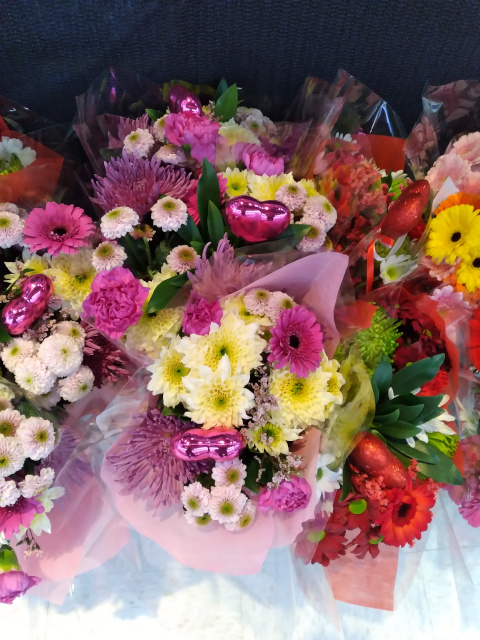
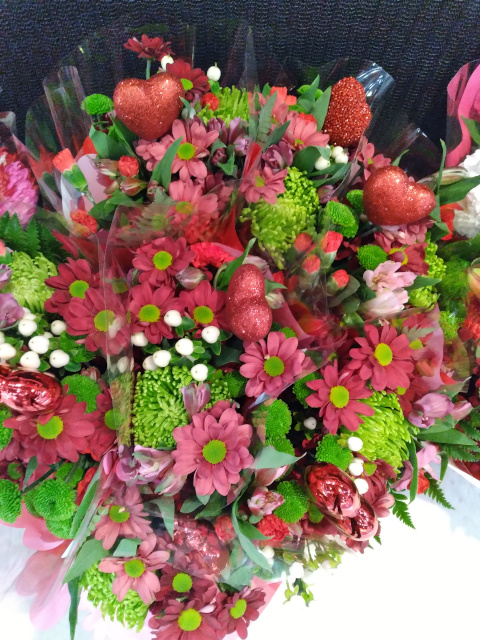
Photo of a Valentine's Day bouquet with a mixture of mostly pink flowers but some red and one yellow. Flowers are mostly mums.

            Western love stories have typically followed familiar plots: 1) two kindred spirits fall in love, face and overcome obstacles, marry and “live happily ever after”; 2) follows plot 1, but adds more obstacles after the wedding, which a) may be overcome and lead to a renewal of the happy ending, or b) may not be overcome and lead to an unhappy divorce, or to affairs, or to divorce and then remarriage for an eventual “happily ever after” ending; 3) either version 1 or 2a is continued into old age with even more obstacles to be overcome. In all variations, some major drama is needed to make the story novel-worthy or memoir-worthy. Add WW2 or clashing cultures (see Romeo and Juliet) or national borders or cancer or Alzheimer’s or a pandemic or death or . . . .

 But this story is made of plain stuff-of-life events—the kind that cause no gasps and raise no eyebrows. Yet I would insist that no lasting relationship is ordinary to the ones who live it. For them, the story in five rings (or three or four or many) is a jewel of great worth.  

The first ring – May 3, 1968  

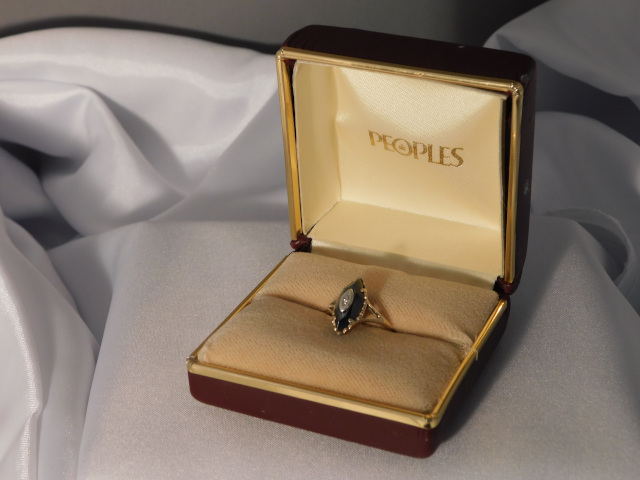
Photo of a ring box with my black diamond ring.

            It was an early birthday gift, given just before I left for a summer job in another province. That was our first experience of letter-writing instead of dates. Our years-long “ordinary” friendship had only months ago deepened into romantic love. No dramatic “falling in love,” no electric glance across the room from a stranger, just increasing warmth in the familiarity of being comfortable together.  

Promise rings hadn’t been officially invented yet, although high school rings were often exchanged (we had not done that). Nothing was actually promised over that black diamond ring, not that I recall. Nevertheless, I quickly discovered why lovers give one another rings, besides to make their commitment more public. A ring is always there, always beautiful. Always a silent affirmation: we love and are loved. That is always a miracle.  

It’s been decades now since I’ve worn it. The thin gold band proved too delicate to tolerate the chores of a household and garden, and the black diamond itself, with its tiny gold clasps, too likely to get caught in sweaters or in fine baby hair. Still, it has not lost its worth as a symbol of our beginning love, even after its place of honor on my left hand was taken by a symbol of much deeper commitment.

The second ring and the third: April 15, 1970 and August 28, 1970.

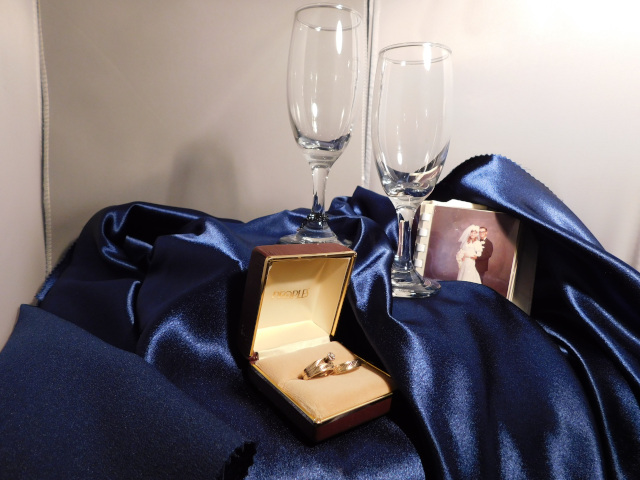
            My engagement ring and my wedding ring were welded together within weeks of our wedding day, after I had caught my hand in a heavy door as I rushed to my university class, and bent both rings badly. I could have taken that as an omen. I didn’t.  

 The engagement ring had been slipped on my finger several days after a long evening spent in a 1958 Chev, parked in a favorite spot by the river. We talked about our future. Both of us were going to be university students in fall, each living on a shoestring budget. No doubt we remember the evening differently: at what point did our half-spoken dream change into a definite plan to share our shoestrings? I couldn’t say.  

Surely it was foolish to become engaged in the middle of exams at the end of my third year of university. I still smile when I remember sitting in some stifling exam room, tension palpable everywhere, and staring in astonishment at the diamond ring on my finger. It’s a wonder I could focus on the exam at all.  

 We began our life together on one scholarship plus one student loan, in a furnished basement suite. We were so confident in our love, so sure that we knew exactly what we were doing and that we were mature enough to face whatever difficulties came. Oh, yes, we did say that. We had no illusions that life “happily ever after” was going to be simple or certain. Of course, there would be tough times. I know now that we had not grasped at all what “tough” would feel like or how long it might hang around.  

That’s a good thing, actually. Love is known best in the midst of loving, not in the fear of what might be. Strength is found in the doing and recognized later in the remembering.   

With this ring, I thee wed

            We exchanged wedding bands in a small church service in the summer of 1970. I was so very happy and proud. We loved and were loved.

Over the years we had to learn to straighten bent conversations and adjust attitudes as we got our rings straightened and strengthened when work or accident tested the gold. No marriage escapes stresses. Those “tough times” we’d been so confident we could handle? They came in guises we hadn’t anticipated. There were some very dark days, when we seemed to be functioning in separate spheres, partly because we were each adapting to new roles on the basis of different family backgrounds.

It is not easy to shift from being single independent adults to being parents of our own children (though they brought us so much joy). Nor was it easy for me to become more responsible for my parents—a change that called for considerably more maturity and self-awareness than I had. A return to graduate studies added more stress and demands on my time. Were we to do it all again, we would make some other choices and seek out more support.  

The fourth ring: August 28, 1995       

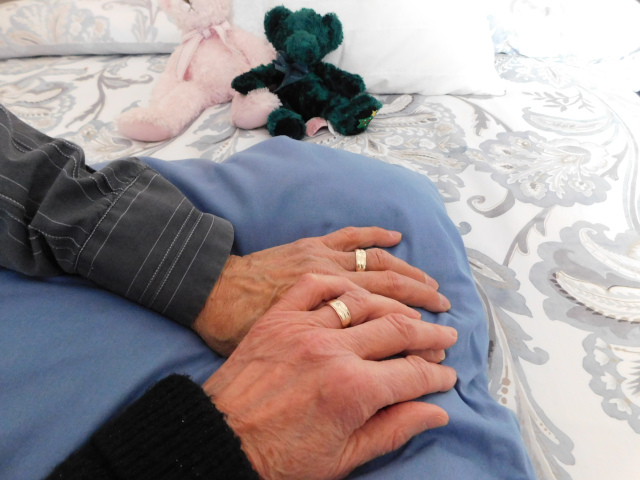
Photo of both our left hands with focus on our wedding bands.

Twenty-five years after our wedding, we went shopping together for new wedding bands. My husband’s ring had worn too thin through years of hard work to tolerate any more straightening; mine also needed repair. It was not only the rings that needed repair. We had traveled a rough road, and it was time to re-evaluate who we were together, and to renew our commitment to love and be loved. Our new wedding rings were simpler, also much wider and stronger, appropriate for our resolve to walk on together in however many years we were granted.

 We have now passed the fifty-year mark of our marriage. It came in the middle of the first pandemic year and right after major cancer surgery for me. Tough times? Yes, indeed. Good times? Absolutely.  

Birthday ring, May 24, 2021

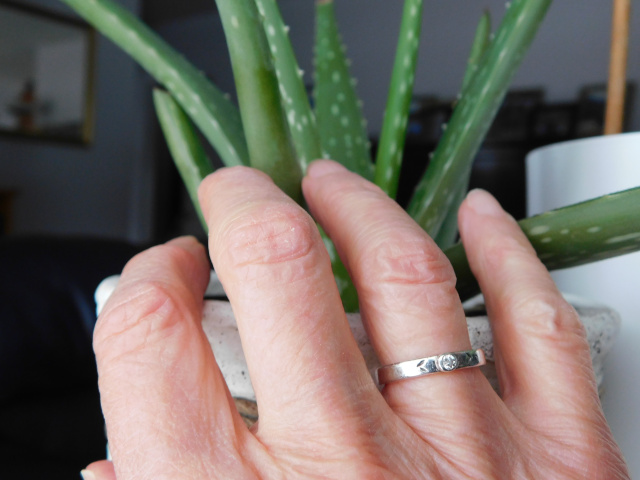
Photo of my hand, next to an aloe vera plant. Focus is on the silver ring on my right hand.

            Although it was a so-called special birthday, the number being somehow significant, I hadn’t expected anything particular. We had had no celebratory parties in the pandemic years. It was enough to have an occasional lovely dinner for two in our house or in the backyard, grateful for our health and for being together. As for gifts? We have what we need, really. Why add more stuff?

 So the ring was a total surprise, yet the longer I wear it, the more meaningful it becomes. It’s silver, not gold, a softer metal, easier to shape I’m told, and comfortable on my arthritic hands. It was made by a local silversmith, who creates jewelry in her spare time. In the years since my husband took up the hobby of making chain maille jewelry, we have learned to appreciate the work and community of local artisans. It is an honor for me to wear this ring.  

In the midst of recent “tough times,” it matters more than ever that commitment has lasted, that the circle of love is there. I’ve heard love defined as an act of the will as much as a feeling; a policy decision as well as a relationship. I agree.  

Love is an act of the will, a policy decision, a long commitment in the same direction.

The story of five rings has an ordinary plot—first dates, engagement, marriage, jobs, children, grandchildren, retirement. Its moments of joy and glory, like those at the Olympics, are made possible through hard work and self-discipline, evident in thousands of ordinary small actions. It’s a story that has been told in some form or another in millions of families, I am sure. Yet every story matters to the ones who live it.

Happy Valentine’s Day to my friend and lover of almost 52 years!

Love is known best in the midst of loving, not in the fear of what might be. Strength is found in the doing and recognized later in the remembering.   

Thinking About Report Cards

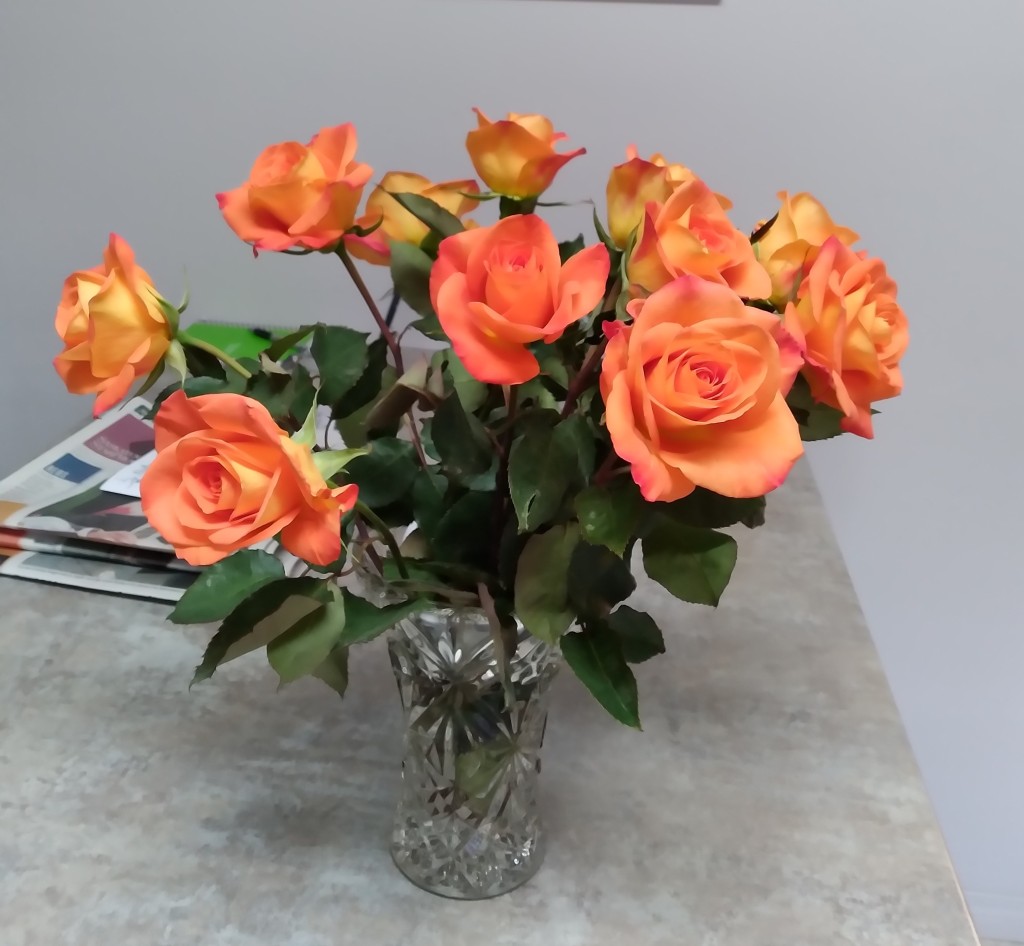
photo of a vase of a dozen coral roses

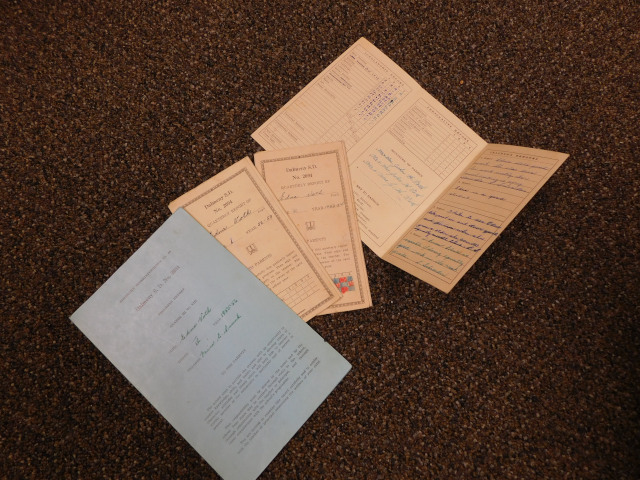
A prowl through a file cabinet drawer, long untouched, revealed a collection of report cards with my name on them (Grades 1 – 12). Oh, my. There were some blunt comments from teachers about my hopeless handwriting—that mattered in those days—and inconsistent work habits, and one anomalous observation on the Grade 3 report card that perhaps as I grew older I would take part more in outdoor sports.

photo of my report cards from Grades 1 - 4.

Remember those report cards, and the trauma of taking them home? Those were the days when children could fail their grade and be asked to repeat it. I was never seriously concerned about that possibility, yet still anxious about what I might have to take home to be signed. Would the report card be good enough that I wouldn’t get any reprimands? My siblings and I were expected to do well in our studies and to conform to strict standards of behaviour. And where there is a clear expectation, there is also the possibility of failing to meet it.  

Which raises two questions, I suppose, with wide application: how clear and reasonable is the expectation? how fair and appropriate is the evaluation?  That bygone teacher who bemoaned my lack of participation in softball had known nothing about the daily hours I spent outdoors walking, exploring, doing farm chores, playing with animals, helping in the garden, even reading in secret places in the nearby bushes. She could not have known that for me solitude in the natural world felt infinitely safer than the ball diamond.   

And I began thinking about the edginess in our societies these days.  I use the plural form of “society” because ever-present social media have created separate cultural groups whose component parts span continents, and because the pandemic has encouraged the creation of very small sub-societies along with huge online silos of rigidly held opinions. No longer do the report cards, in whatever form they take, come only once a year.  

 We live now with evaluations all the time: some are formal, such as work performance reviews, grades on particular projects, peer reviews of publishable articles, demotions or promotions, professional degrees, trade certifications; some are informal, such as the disappointment or delight on someone’s face, a welcome invitation to a social occasion or utter silence from former friends, thousands of likes or brutal online bullying, a stunning bouquet delivered at the door or a package of dog poop left on the porch, acceptance or rejection. There is not much point in railing about the unfairness of evaluation itself—who can ever really grasp everything about someone else’s circumstances or motives?—because we simply cannot manage without evaluations, both great and small.  To be realistic here, I should admit that we have always been living with evaluations; they are nothing new.

 Do we not get quotes for prospective building projects or home renovations? Each business that submits a quote will be evaluated. Do we not develop friendships with former strangers on the basis of our judgment of their trustworthiness and compatibility? Do we not evaluate the politicians who present themselves for office and call for our votes? It’s important that we take time to decide whether trust is justified or not. Will we listen to the cold call we just got on the phone, or slam the receiver on yet another bogus message about credit cards? (It is really too bad that cell phones have no slam option). Will we respond warmly to the chatty clerk or resist what feels like too much sales pressure?

There are degrees of judgmentalism, of course. Some of us are suspicious, automatically assuming that others’ motives must be nefarious at worst, self-interested at best; some of us are more open, assuming that others are well-meaning until we are clearly proved wrong. I am using the personal plural “we” and “us” rather freely here to underline the fact that none of us is entirely one kind of person or the other. Our motives are not consistent; our behaviour is not consistent; our tolerance of risk varies; our ability to learn and change is always there.

 Herein lies the importance of report cards. They do not function only to regulate who is allowed to proceed and who is not qualified for some task (and I know of no society that does not have some such structure for organizing itself). For now, think instead of the personal value for the recipient of the report card, whether it be an actual document with an official seal on it or not.  

  The phrase that comes to my mind is Canadian novelist Adele Wiseman’s description of Abraham, the key character in The Sacrifice. He has visualized himself as a very important man in his small Jewish community; he may be just the local butcher but he’s also a keen student of Torah, a master story-teller, a man of wisdom who “knows” that God has a special role for him. He is, after all, Abraham (and Wiseman gives him no surname). But there comes a moment in a terrible family conflict when the angry words of his daughter-in-law become a “mirror flipped up in his face and he himself stood revealed as he was to another, a stranger. . . (The Sacrifice 316, emphasis mine).  

  That is the function of evaluations. How can we know ourselves without the reactions of others? Child psychologists speak of the importance of parents mirroring the infant’s efforts to communicate. The return smile and the verbal echoes tell the little one that she/he matters. Ditto for the clapping games and the singing and the hugging. The babe is busy discovering a self through parental affection—a process that remains mysterious, despite all the books and much documented experience.  

 This discovering of a self, shaping a self? I understand far too little to hold forth on it with any wisdom. What I do know is that, necessary as unflattering report cards are now and then, equally necessary, in far greater measure, is affirmation of the various selves that we live out in our daily lives—affirmation that is needed in both the giving and the receiving.  

 In these days of way too much judgment and far too many anonymous “report cards” circulating online like some virus worse than COVID, perhaps the best thing we can do is to flip up a gentler mirror that reflects respect: “I see you, and you are a human being of great worth.”

I wish I could show you

when you are lonely

or in darkness

the astonishing light

of your own being.

            (Hafiz)

Photo of a single coral rose.