The Privilege of Paying Taxes

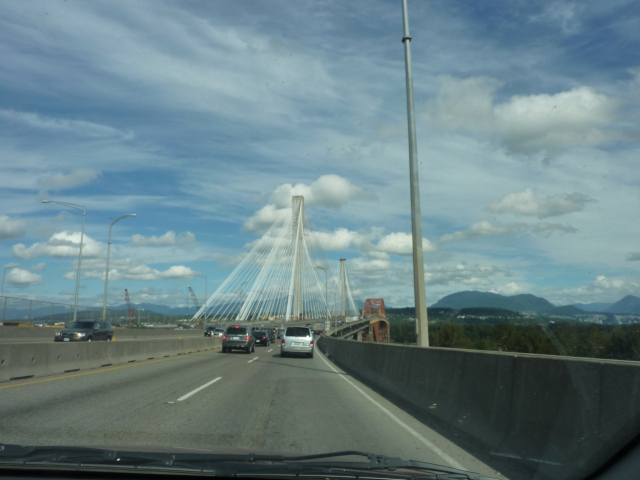
Photo of bridge with dramatic span, and cars crossing the bridge. Mountains in the background.

            He was a former refugee, having arrived in Canada after years in a refugee camp. Now he, with his family, was settled in Regina, speaking English with increasing confidence, earning money at a steady job, and planning to begin his own business in the future. I heard him interviewed on CBC Radio’s Morning Edition about two years ago, and remember still the joy and pride in his voice as he expressed gratitude for being welcomed in Canada and assisted by government agencies. He said—and his words startled me—“I can pay taxes now. That makes me feel good.”

            “I can pay taxes.” When do we ever hear that, especially with such a lilt of happiness?

            It helps to imagine probable circumstances. Whether it was civil war or drug lords or religious fanaticism that made life untenable, he had fled, leaving behind his home, his culture, his extended family, his small business, his connections, his religious community, his language, and his ability to earn money. I am myself a daughter of refugees who came to Canada in the 1920s. I have heard stories of hardships, fear, and loss before, yet I was still moved to hear his gratitude for safety and new opportunities.  

            What makes such a transition from destitution to hope possible? That is worth thinking about.  

            These days we’re hearing about unfathomable losses in the wake of flooding and mud slides, overwhelmed water treatment plants, bridges washed out, farms destroyed. For sure, there are many kind people helping in small and big ways, sharing their homes, bringing in feed for the cattle, driving their boats through the streets to rescue the stranded. However, what will make eventual recovery possible is massive funding and other assistance from governments. Military personnel have come in to help with rescues and begin reconstruction. What individuals cannot do alone can be done by organizations created to take care of the needs of the many. And guess what? Those organizations have been established by governments at various levels and are funded by tax money, of one sort or another, as well as generous personal or corporate giving.

            Just when human beings understood that cooperation would improve survival rates, I’m not sure. As far back as we have any evidence, humans have lived in community and have shared resources and skills and energy. Hundreds of years before unions and insurance companies, craft guilds were formed to establish prices for goods, to look after the widows and children of craftsmen who died, and to set standards of excellence. Someone had to administer the funds and someone else had to make sure that there was no corruption. That was in the days when governments (monarchs, actually) funded their appropriation wars with the “spoils of war,” and rewarded their chief warriors with expropriated land and captured women. Feudal landowners took their share of the crops and in exchange made sure that their knights protected the serfs from marauding bands. It was a quid pro quo society where might made right.

            We need not go into the long history of democracy during which, bit by bit, one law after another, some nation states gradually moved toward a society in which laws gained ascendency over the whims of monarchs, and more people got a say in what those laws regulated. Experience over centuries made it clear that a “free” market functions best where ownership of property is enshrined in law, and contracts made can be enforced without resorting to private armies and intimidation. And bit by bit, regulated taxes replaced government seizure of resources as a revenue base.

            Are current democratic governments without fault? Absolutely not. Any human institution on the face of the earth is imperfect and, as we would say today, vulnerable to hacking. Nevertheless, without government institutions (which we hold accountable in every election and through various oversight bodies), we would have no social safety nets, no universal health care system (for all its flaws), no regulated pension plans, no national or provincial parks. Our roads and bridges and railway lines and electrical systems and water treatment plants are either built by government or regulated by government.
            So by all means, let’s pay our taxes. Go ahead and examine tax laws. Ask questions of your representatives in your provincial legislature and in the federal parliament. Check out what your local city council members or your reeves of rural municipalities are doing. No one is above temptation, and it’s often too easy to waste public funds. Those who manage public purses should be accountable to the people on whose behalf they are managing those purses. On the other hand, without public money to begin with, they can do no good for us all.

Let’s pay our taxes cheerfully.

            Let’s pay our taxes and do so cheerfully and willingly. We might disagree among ourselves about what exactly should be managed by the private sector and what should be controlled by public institutions. That will always be an ongoing discussion, and indeed, should be an ongoing discussion.

            However, can we please put an end to the popular assumption that paying taxes is a great evil to be avoided at all costs, including our personal integrity? What might happen to our public discourse if we could actually change attitudes here? What if every child heard their parents say with gratitude, “we can pay taxes!” For the alternative is not being able to earn an adequate living.

            Actually, there is yet another alternative, and it’s the one that has left so many people suspicious and bitter. That’s earning enough money to pay an accountant to find enough loopholes and tax shelters (as if taxes are a terrible storm that would destroy everything) to avoid paying taxes and thus living off the “largesse” of those who have fewer options. The truth is that no matter how much money you earn, or how hard you work to earn it, you can earn it because the laws of the land, enforced by governments, have made it possible, safely and predictably, to exchange property and goods and services for a profit.

            I wish that I knew the name of the refugee whom I heard years ago exulting over the privilege of paying taxes. I would like to thank him for his practical perspective and his gratitude for all that he had received. May his business prosper and may his children receive many opportunities to follow their father’s model of graciousness.
What We Can Choose – Part Two

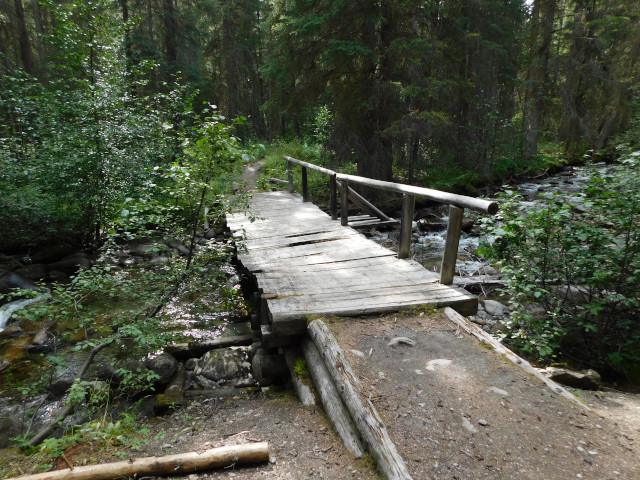
Photo of a trail leading to a rickety wooden bridge over a creek in the forest.

            This reflection will not be obvious. It considers not the what, but the how and the why and the what happens next. Those are often not obvious at all, partly because our culture has cast the language of choice in the individual mode. I am convinced that that can be misleading. There is no such thing as an entirely “personal” choice.

Shelves of packages of candies, taken in  a London Drugs store.

Let’s start with the trivial: which candy I choose to spend my dimes on (oops, not dimes—dollars!) can hardly matter in the grand scheme of human endeavour. The world seems indifferent to such a choice, even to whether I choose candy at all or potato chips (much more likely – I dislike candy). Yet as soon as we back away from a single bag of candy, the scene changes.

Store owners stock only those candies that sell; the more often I and others opt for lemon drops, the more likely it is that stores will stock them. That then determines what factories produce, and if making lemon drops has deleterious effects on the health of factory workers, then my utterly trivial choice matters. The more candy I eat, the more likely it is that the sugar overdose will affect my health, beginning with my teeth. My health, as it happens, is important to more people than just me.

I could also talk about what I choose to do with the now empty wrapper. Does it end up in the ditch at the roadside? or on the sidewalk beside a park? Out of what was that wrapper made? What was its overall cost?  

Even in the most trivial choices, I am in the midst of a whole web of connections with other human beings.

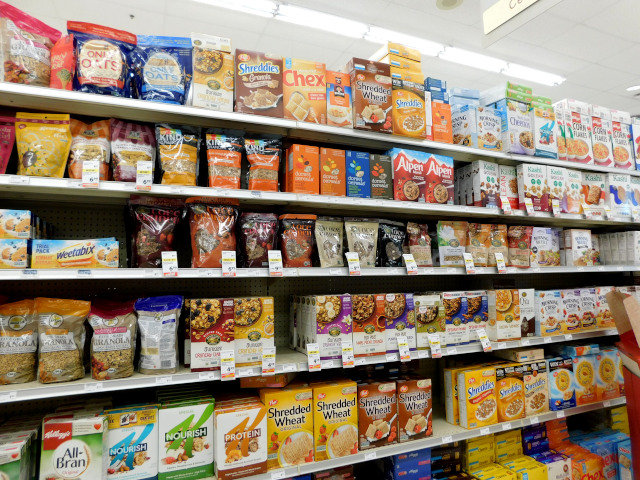
Shelves of different breakfast cereals, also taken in London Drugs.

Consider another seemingly simple choice: what shall I have for breakfast? Someday, archaeologists will draw conclusions about our culture based on packaging debris that survives beneath the rubble of centuries. Be it Frosted Flakes, or granola, or bacon and eggs, or smoothies with startling ingredients, every selection affects which business grows and which does not, which animals and plants are grown and which are not, which divisions of our health care institutions are overworked and which are not, which tracts of land are cared for adequately and which are not (see Michael Pollen’s The Omnivore’s Dilemma).

 The how and why of all our small choices together reveal our tastes, our values, even the causes for which we’ll be prepared to march in the streets. All of those choices have been created in the crucible of our multiple contexts, some of which have been given (perhaps most) and some of which we have chosen, each choice determining to some degree what follows.

Some choices are made without thought, the variables having been sorted out long ago: I need no conscious decision to walk by the candy store without pausing; I will, however, linger by the camping supply store and linger even longer by the book store window.

 Other choices are far more difficult. Why did I leave one church and eventually settle on a different one? Indeed, why have I chosen to continue to identify myself as Christian? (The initial identification as such was hardly a genuine choice, not where I grew up.) To answer those questions would require long stories, which call for a different venue than this blog.

The point I want to make here is that the choice was not personal except in the sense that I was the one who had to make it. In the end, my choice to leave a church I’d been part of for decades was the result of the influence of people (and some books) who invited me into different perspectives and other people who made it increasingly difficult to remain. No doubt my choice likewise affected others. Just how many or how much, I don’t know beyond the fact that some friendships ended.  

 Since we cannot know all the intricate ways in which our smallest choices might affect so many other people, the least we can do is to remain aware that our choices are both personal and not personal. That is, we do have to choose, many, many times a day even; I am the person whose foot pushes down on the brake or the accelerator—no one else does that for me. At the same time, every choice I make is not only the result of all the overlapping circumstances of my life but will then also affect later choices of mine and of others. Every effect becomes itself a cause.

 In our current climate of anxiety over the pandemic and dire political and climatic circumstances, perhaps two principles could and should be kept in mind. One is that sooner or later our choices (even the trivial ones) will enter the territory of values; they will become moral choices. As C.S. Lewis once insisted, all of our decisions, both trivial and momentous, will make us more of a certain kind of person, and who we become matters a great deal.

“I’ve been considering the phrase ‘all my relations for some time now. . . . It points to the truth that we are all related, that we are all connected, that we all belong to each other. . . . ALL my relations. That means every person, just as it means every rock, mineral, blade of grass, and creature. We live because everything else does.”

Richard Wagamese

 The other principle is connected to the previous one: the well-being of others should come first. That is such a huge statement that it has already filled libraries with books as philosophers and theologians and thinkers of all kinds have struggled to work out the relationship between our instinctive—and necessary—care for ourselves and our equally necessary care for others.

If we look out only for Number One, the society around us is likely to become, or least seem, more hostile. When unchecked selfishness is pursued in high office, the entire country becomes a less liveable place. Jesus once said, “Do unto others as you would have others do unto you” and also “those who would save their own souls must first give them away.” Other religions base their rules of conduct on the same principle, albeit worded in slightly different ways.

 If religious reasoning is not your preference, then scientific analysis will lead you to a similar conclusion. It turns out that human infants do not thrive without love (nor, for that matter, do adults), and societies in which altruistic behaviour is encouraged offer better and more satisfying living conditions.

Robert Frost’s famous poem “Two ways diverged in a yellow wood” concludes with “I took the one less travelled by / and that has made all the difference.” Generations of school children absorbed the lesson that we should be brave individuals and choose to be non-conformists. I would argue that had the narrator chosen the more travelled road, it would still have made all the difference. Choices do that.

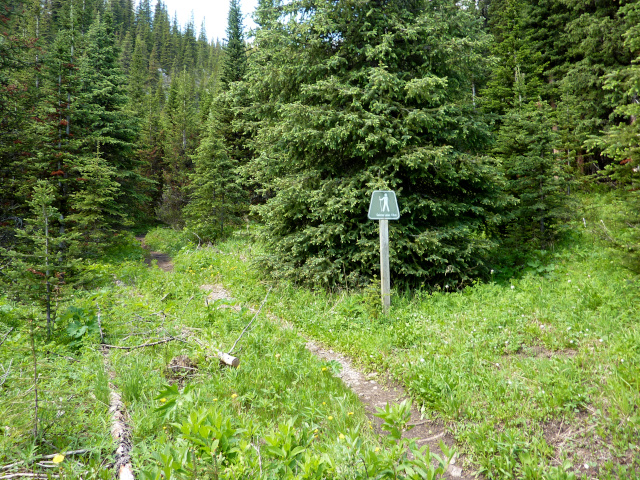
A mountain trail, but it's narrow and half over-grown. Only a small sign beside it reassures the hiker that this is an actual trail through the forest.

Oh, I kept the first for another day!

Yet knowing how way leads on to way,

I doubted if I should ever come back.

Robert Frost